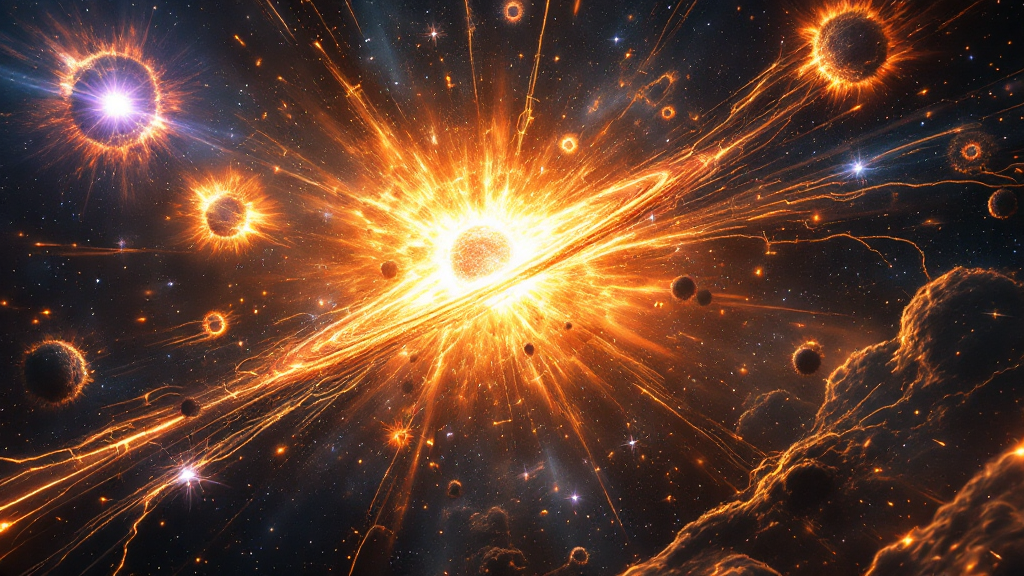
Astronomers have, for the first time, detected radio signals coming directly from the exoplanet β Pictoris b. These signals are of natural origin and are associated with auroras, allowing scientists to estimate the planet's powerful magnetic field.
Astronomers have confirmed the discovery of the youngest known exoplanet, Elias 2-24 b, which is less than a million years old. This finding provides valuable insights into the early stages of planet formation.
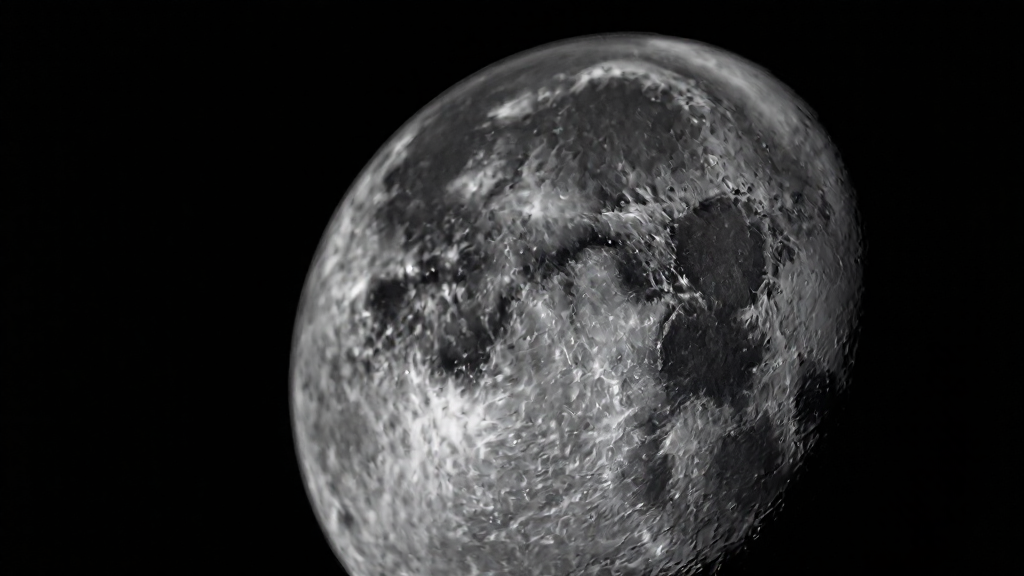
Astronomers have discovered a new large crater on the Moon, measuring 222 meters in diameter, which appeared in 2024. Studying this crater could provide valuable insights into collisions involving large objects and help in planning future lunar missions.
The compact CosmicWatch detector offers a simple and affordable way to detect cosmic particles—muons—opening up new opportunities for education, scientific research, and monitoring of cosmic phenomena. This device is widely used in universities and professional experiments around the world.
In 2022, a photon with record-breaking energy from a gamma-ray burst was detected on Earth—something that, according to current physical models, should not have been possible. To explain this phenomenon, astrophysicists proposed a new model that takes into account unusual effects at extreme energy levels.
Recent observations of Betelgeuse using the ALMA radio telescope have revealed an unusually lumpy surface and hot regions associated with plasma movement. These features may indicate the final stages of the star's evolution, suggesting that it could explode as a supernova in the future.
Recent studies using the Hubble Telescope have revealed that the Milky Way merged with other galaxies in the past, which significantly influenced its structure and evolution.
An international team of astrophysicists has, for the first time, detected signs of vacuum birefringence—a phenomenon predicted by Heisenberg nearly 90 years ago. This discovery could become the first direct experimental confirmation of the quantum properties of vacuum and open up new possibilities for studying the structure of the Universe.
Astronomers have discovered a unique object, S301, moving along an elongated orbit around the supermassive black hole at the center of the Milky Way. Its distinctive features may help scientists measure the rotation of the black hole Sagittarius A* for the first time.
Astronomers have observed an unusually bright flare on the outskirts of a distant galaxy, triggered by a supermassive black hole destroying a star. This discovery raises new questions about the origins of such phenomena outside the centers of galaxies.
A study of wintering at an Antarctic station revealed that constant close contact within a small group does not always improve relationships and can actually increase stress. These findings are important for preparing future space missions and other extreme environments.
Astronomers have, for the first time, observed the early stages of the explosion of the supernova SN 2026gzf in a distant galaxy located 500 million light-years from Earth. What makes this event unique is the unusually weak shock wave and the absence of any signs of a gamma-ray burst, which calls for further investigation.
Astronomers have, for the first time, determined that asteroid 44 Nysa is composed of three distinct parts, making it unique among known asteroids. The origin of such a structure remains a mystery.
In August 2026, the upper stage of a Falcon 9 rocket will collide with the Moon, creating a crater and scattering debris. Astronomers plan to observe and document this event using telescopes and orbital spacecraft.
An international team has developed an artificial intelligence-based simulator that accelerates and simplifies the modeling of heavy element formation processes in the Universe. The new RHINE tool enables more accurate and faster calculations of nuclear reactions during neutron star mergers, significantly reducing computational costs.

 Cursus