

A brilliant flash revealed a black hole on the edge of the galaxy.
Astronomers have observed an unusually bright flare on the outskirts of a distant galaxy, triggered by a supermassive black hole destroying a star. This discovery raises new questions about the origins of such phenomena outside the centers of galaxies.
Cursus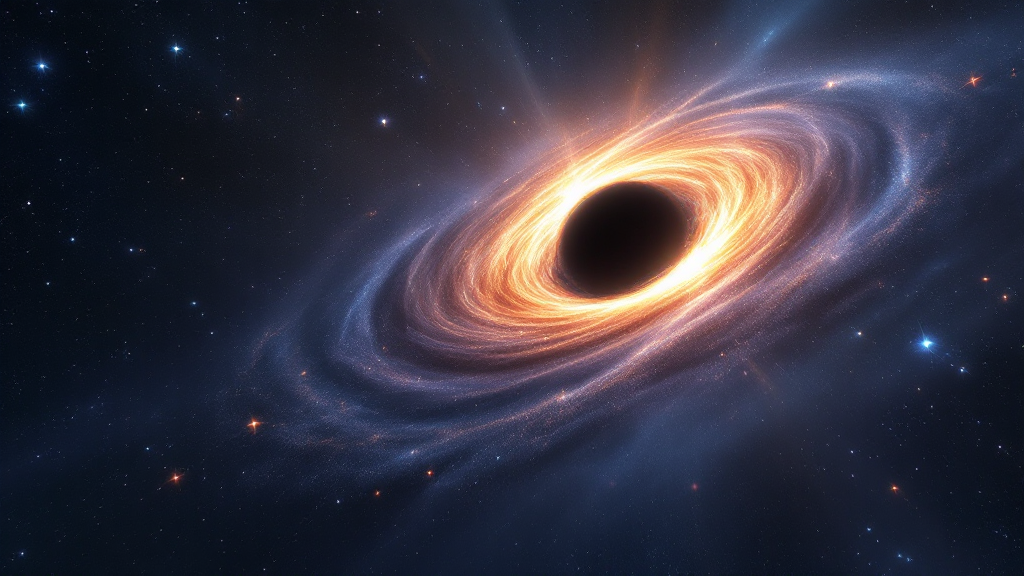
Although supermassive black holes are usually found at the centers of galaxies, some have been discovered in other regions as well. Recently, astronomers observed a bright flare on the outskirts of a galaxy, triggered by a star that ventured too close to a black hole.
This object was first detected in November 2025 using the Zwicky Transient Facility (ZTF) observatory. The mass of the discovered black hole is about a million times greater than that of the Sun, and it is located approximately 750 million light-years from Earth, in the galaxy WISEA J014656.04-152214.7.
During the event, the emission was brighter than the entire galaxy itself and ten billion times more powerful than sunlight. The flare was caused by the destruction of a star by the black hole. Artificial intelligence used in ZTF automatically identified the flare as a tidal disruption event, despite its unusual location on the edge of the galaxy.
Even though the cause of the phenomenon is known, many questions remain about this object. The black hole is situated at the galaxy's periphery, and there is a hypothesis that it may have formed in a smaller galaxy that later merged with a larger one. Further research is needed to obtain more precise information.