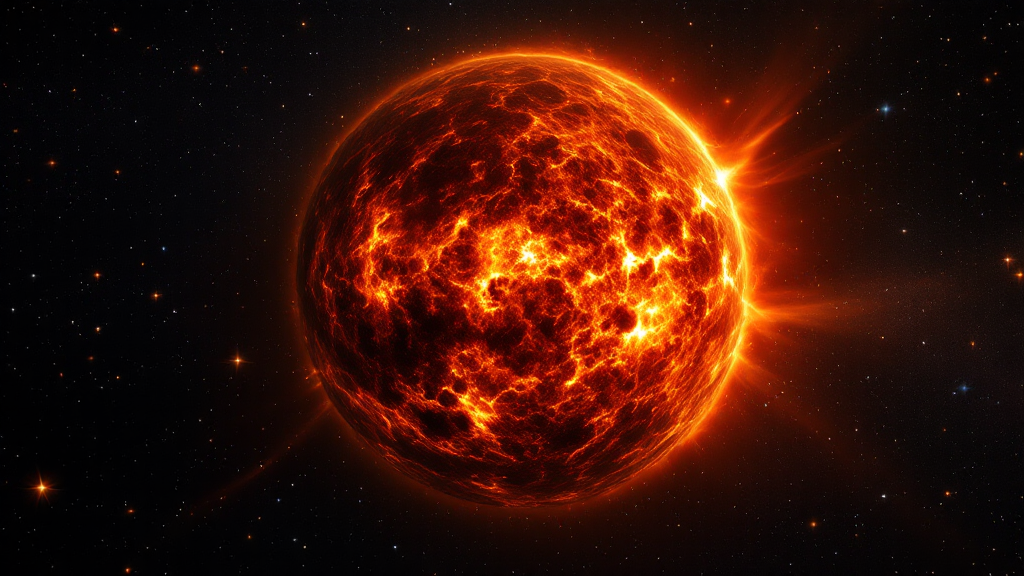
Recent observations of Betelgeuse using the ALMA radio telescope have revealed an unusually lumpy surface and hot regions associated with plasma movement. These features may indicate the final stages of the star's evolution, suggesting that it could explode as a supernova in the future.
Astronomers have, for the first time, observed the early stages of the explosion of the supernova SN 2026gzf in a distant galaxy located 500 million light-years from Earth. What makes this event unique is the unusually weak shock wave and the absence of any signs of a gamma-ray burst, which calls for further investigation.
Astronomers have, for the first time, observed the formation of a magnetar during a supernova explosion, confirming that unusually bright supernovae receive additional energy from these objects. This discovery will help deepen our understanding of the processes that occur when massive stars die.
Astronomers have, for the first time, observed the disappearance of a massive star in the Andromeda galaxy without a supernova explosion—the star transformed directly into a black hole. This discovery will help scientists better understand the final stages of stellar evolution and aid in the search for new black holes throughout the Universe.
Studies have shown that moons ejected from their planetary systems by rogue planets can maintain life-friendly conditions for billions of years thanks to tidal heating. This expands our understanding of where life might exist in the Universe.

 Cursus