

Betelgeuse has revealed the mysteries of its uneven surface
Recent observations of Betelgeuse using the ALMA radio telescope have revealed an unusually lumpy surface and hot regions associated with plasma movement. These features may indicate the final stages of the star's evolution, suggesting that it could explode as a supernova in the future.
Cursus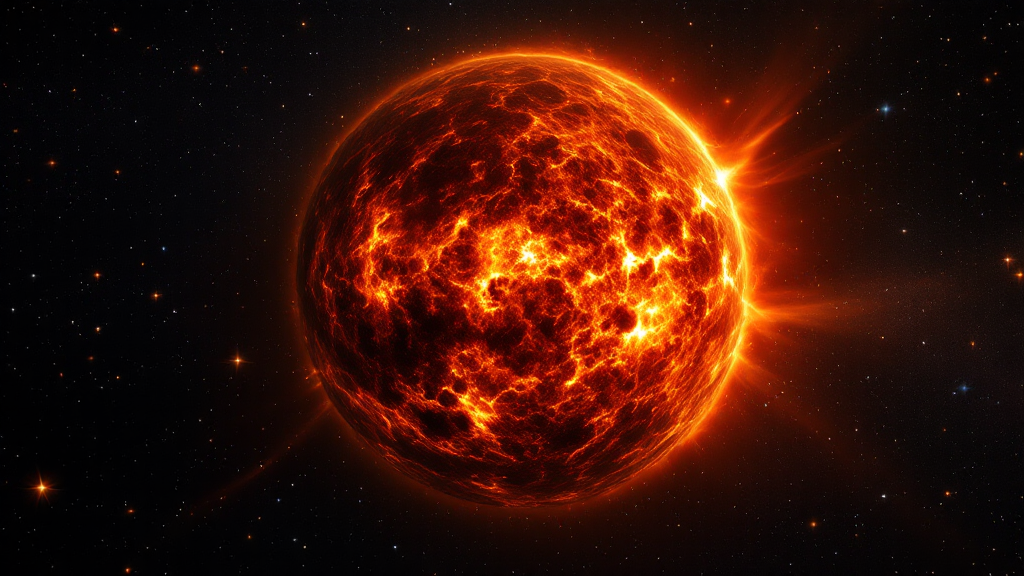
Betelgeuse, located in the constellation Orion, is a red supergiant star that has been studied using the ALMA radio telescope. Research has shown that the surface of this star is significantly different from that of the Sun.
Betelgeuse has been known to astronomers for centuries and is often the subject of scientific study. Despite confirmation of a companion star, new observations have revealed an unusual shape for Betelgeuse itself.
Studies using ALMA have discovered that the star's surface is irregular and features two hot regions. According to experts, these characteristics may be linked to the final stages of the star's evolution.
Betelgeuse has already exhausted the hydrogen in its core. The star's mass is about 20 times greater than that of the Sun, and its radius is 800 times larger. The irregularities on its surface are likely caused by the movement of hot plasma inside the supergiant.
The movement of plasma creates shock waves that travel through the star's atmosphere, forming a bumpy surface. Comparing images taken in 2023 and 2015 showed that one of the hot regions persisted for at least seven years.
The atmosphere of Betelgeuse has also been studied, with its temperature measured at around 2,030 degrees Celsius. The star attracts scientific attention because it could explode as a supernova at any moment, which would be a spectacular event in the sky and offer a unique opportunity for further research. The timing of this event is uncertain and could occur in the near future or thousands of years from now.