For the first time, researchers have used a quantum simulator to model string breaking and the creation of particle-antiparticle pairs, opening up new possibilities for studying the fundamental processes of matter. The experiment demonstrates the potential of quantum computers to solve problems that are beyond the reach of classical computation and brings science closer to understanding the conditions of the early Universe.
Harvard scientists have developed a new method to protect quantum information using microscopic mechanical waves, which has tripled the coherence time of qubits. This approach opens up new possibilities for creating more compact and reliable quantum systems.
В эксперименте с миниатюрной Вселенной учёные впервые показали, что время может возникать как следствие внутренних изменений системы, а не как внешний параметр. Это открытие может помочь объединить квантовую механику и теорию относительности, предложив новый взгляд на природу времени.
Physicists from ISTA have, for the first time, implemented an autonomous method for distributing quantum entanglement using a "quantum bath." This breakthrough could lay the foundation for scalable quantum computers and networks. The new approach enables a continuous connection between distant qubits without the need for active control, opening up new possibilities for the advancement of quantum technologies.
New experiments at the RHIC collider have shown that the carrier of baryon number inside protons is not a quark, but a gluon junction. These findings refine our fundamental understanding of the structure of matter.
For the first time, wave interference has been observed in positronium—an atom composed of matter and antimatter—confirming its quantum nature. This discovery opens new possibilities for studying antimatter and its interactions with gravity.
Researchers at the University of Warsaw have developed and tested a new quantum key distribution (QKD) system with multidimensional encoding, utilizing the Talbot effect to enhance efficiency and simplify the design. This innovative method has been successfully demonstrated in real-world fiber-optic networks and opens up new possibilities for more secure data transmission.
Scientists have developed a technology that enables logical operations to be performed using ultrashort light pulses, which could make processors thousands of times faster than those currently available. The experiment was conducted at room temperature and paves the way for the creation of ultra-fast optical computing equipment.
Scientists have developed a method that allows large quantum systems to be observed for more than a day without distorting their properties. This new approach opens up possibilities for non-invasive studies of materials and precise spectroscopy.
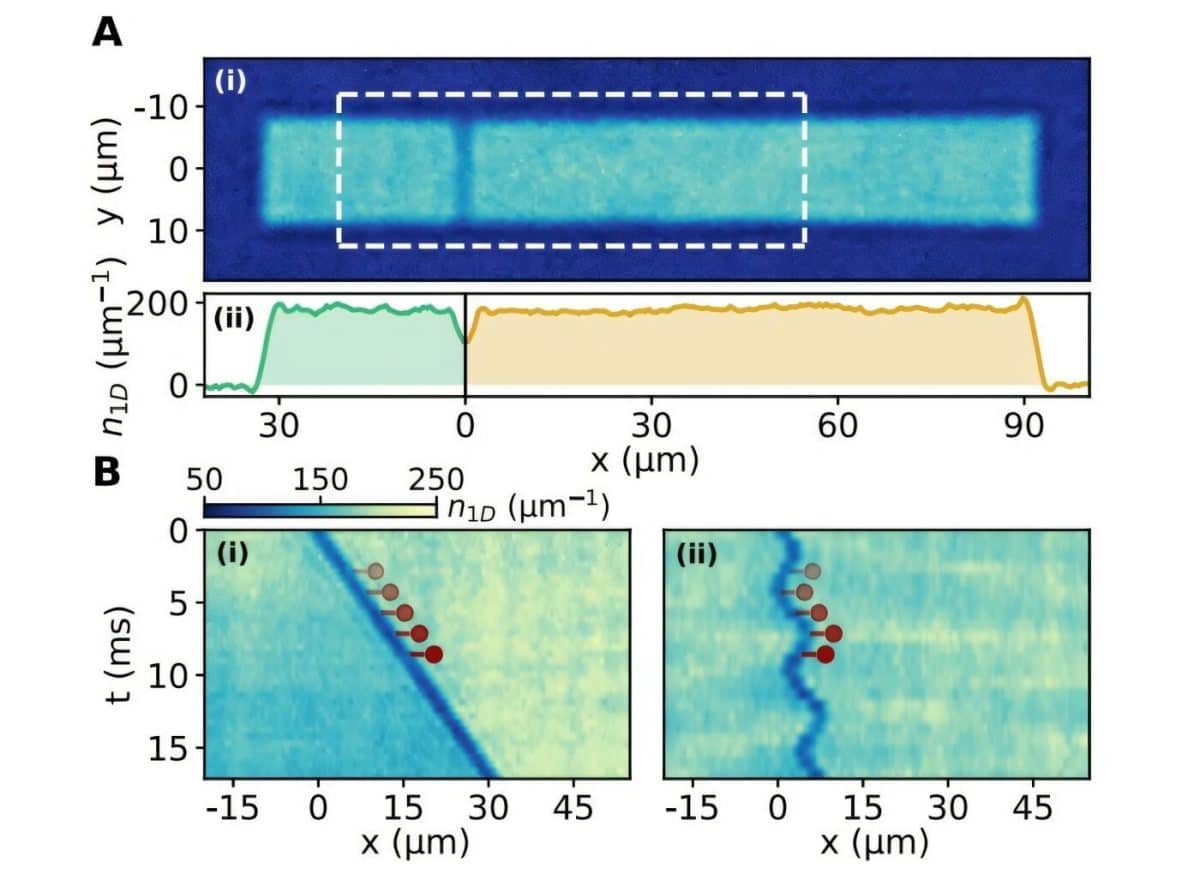
Physicists have, for the first time, observed the Shapiro step effect in a cloud of ultracold atoms—a phenomenon previously seen only in superconductors. This discovery opens up new possibilities for studying quantum phenomena and developing advanced sensors.
Scientists from the University of California have, for the first time, created two-dimensional arrays of quantum defects in synthetic diamond. This breakthrough opens up new possibilities for developing highly sensitive quantum sensors. Such an approach could significantly improve the accuracy of measurements in biology and materials science.
Scientists have proposed a new type of particle—the neglecton—which enables topological quantum computers to perform universal computations using only the braiding of anyons. This discovery expands the possibilities of quantum computing and opens up new directions for research.
Scientists have developed a method that allows simultaneous measurement of a particle’s position and momentum with greater precision than the standard quantum limit. This breakthrough paves the way for the creation of ultra-precise sensors for navigation, medicine, and fundamental research.
UNSW engineers have achieved a breakthrough in quantum computing by enabling isolated atomic nuclei to interact at the scale of modern microchips. This paves the way for building scalable quantum computers using existing technologies.


 Cursus