

Shapiro steps observed for the first time in an atomic cloud
Physicists have, for the first time, observed the Shapiro step effect in a cloud of ultracold atoms—a phenomenon previously seen only in superconductors. This discovery opens up new possibilities for studying quantum phenomena and developing advanced sensors.
Cursus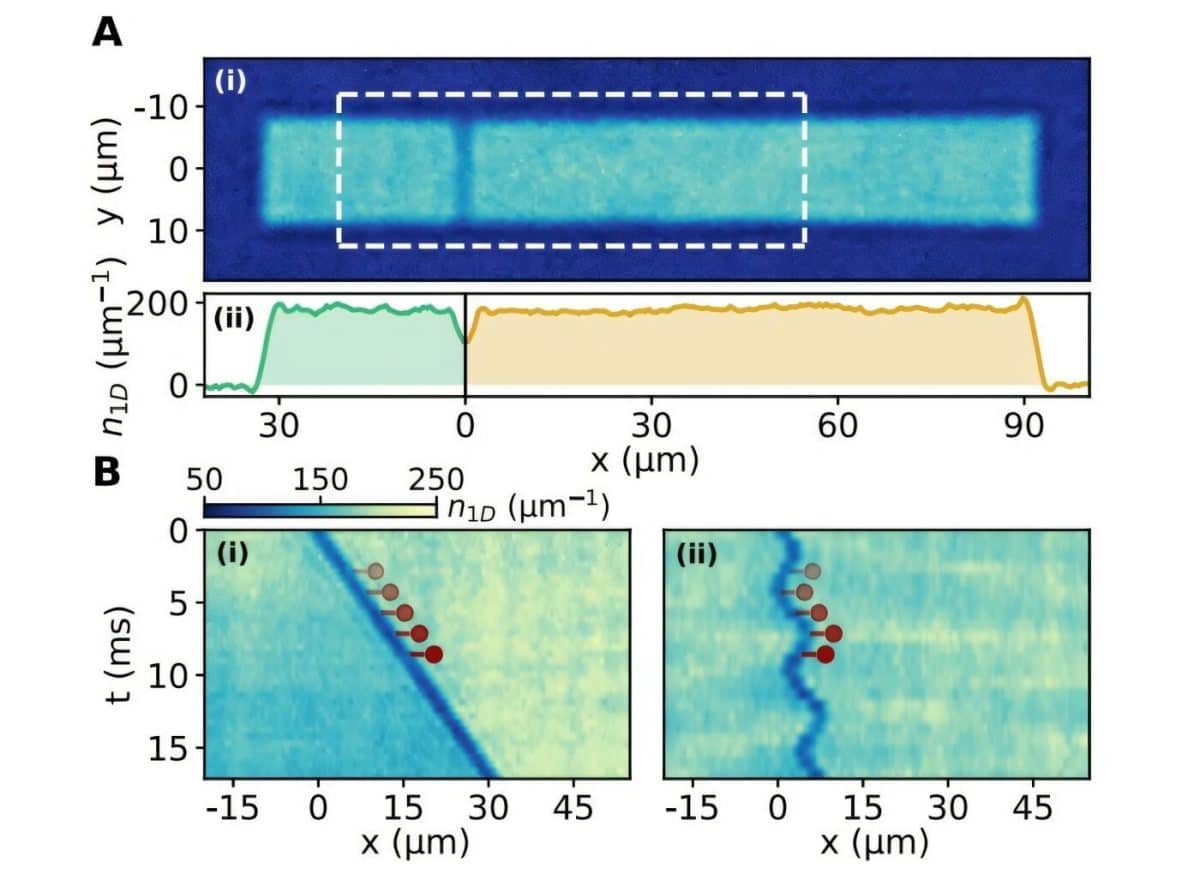
For the first time, scientists have managed to reproduce the Shapiro steps effect—previously observed only in solid superconductors—in a new environment: a cloud of atoms cooled to temperatures near absolute zero.
What is atomtronics?
Atomtronics is a branch of physics that studies the movement of atoms and ways to control this motion. It is analogous to electronics, but instead of electrons, atoms are used. In atomtronics, researchers employ ultracold atoms because their quantum properties and the ability to precisely control them make it possible to model systems with pronounced quantum effects. Lasers are used to move atoms within these setups.
Experiment with ultracold atoms
In their experiment, the researchers used lithium atoms cooled into a superfluid Fermi gas state. In this state, atoms pair up in a way similar to Cooper pairs of electrons in superconductors. To create a Josephson junction—a system consisting of a thin dielectric layer between two superconducting layers—the scientists formed it from two reservoirs of ultracold atoms separated by a laser beam with a wavelength of 532 nanometers.
In the resulting system, atoms were able to undergo quantum tunneling, meaning they could collectively cross a barrier without losing energy. When an alternating external potential was applied, the difference in chemical potentials between the two sides of the junction changed not smoothly, but in discrete jumps, forming uniform "steps." Thus, for the first time, physicists observed Shapiro steps as current passed through a Josephson junction in a cold atom system. The results of the study were published in the journal Science.
The essence of the Shapiro steps effect
Shapiro steps are a quantum effect in which a certain physical quantity can take on strictly defined, quantized values that depend on the parameters of the current. In electronics, this stepwise change is observed in the system's voltage, while in atomtronics it appears in the difference of chemical potentials. The height of each step is directly determined by the frequency of the applied current.
Prospects and applications
Scientists believe that ultracold atoms are an ideal platform for studying fundamental quantum phenomena and a powerful tool for investigating the collective dynamics of quantum systems with a high degree of control. Data obtained in atomtronics can be used to create highly sensitive sensors and simulators of complex quantum materials.