Astronomers have, for the first time, detected radio signals coming directly from the exoplanet β Pictoris b. These signals are of natural origin and are associated with auroras, allowing scientists to estimate the planet's powerful magnetic field.
For the first time, a three-dimensional map of the upper layers of Uranus's atmosphere has been created, revealing how the planet's unusual magnetic field shapes its auroras and influences its cooling. This discovery provides new insights into the evolution of exoplanets and the structure of ice giants.
The James Webb Space Telescope has, for the first time, created a three-dimensional map of the auroras on Uranus, allowing scientists to study the planet's atmosphere and magnetosphere in unprecedented detail. The new data confirm previous observations and open up new possibilities for further research on ice giants.
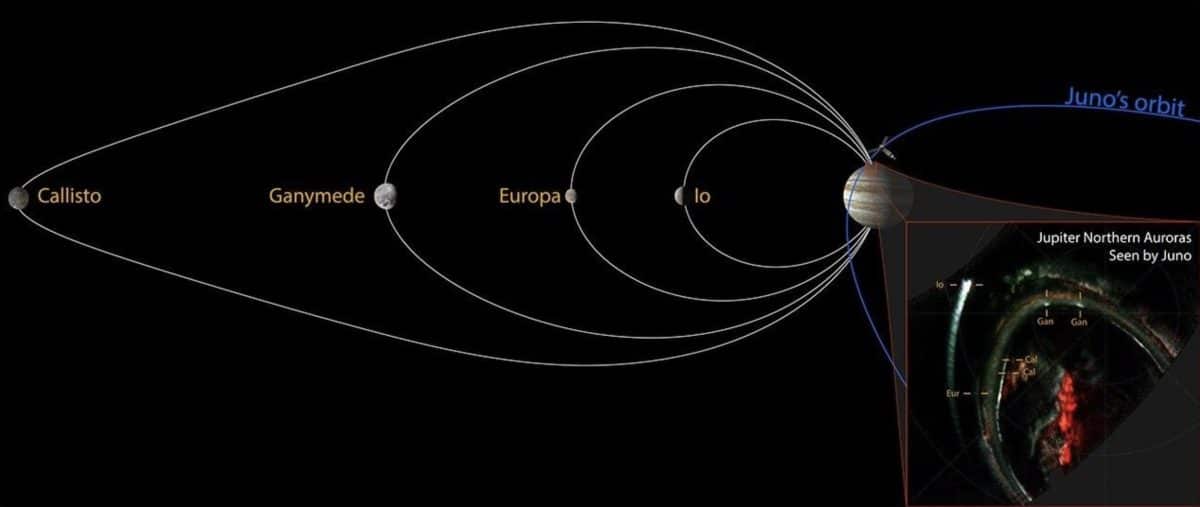
The Juno spacecraft has, for the first time, detected traces of Callisto, one of Jupiter’s moons, in the planet’s atmosphere, thus completing the “portrait” of all the Galilean satellites. This discovery deepens our understanding of how these moons interact with Jupiter’s magnetosphere.

 Cursus