

Juno has detected Callisto's trace on Jupiter for the first time.
The Juno spacecraft has, for the first time, detected traces of Callisto, one of Jupiter’s moons, in the planet’s atmosphere, thus completing the “portrait” of all the Galilean satellites. This discovery deepens our understanding of how these moons interact with Jupiter’s magnetosphere.
Cursus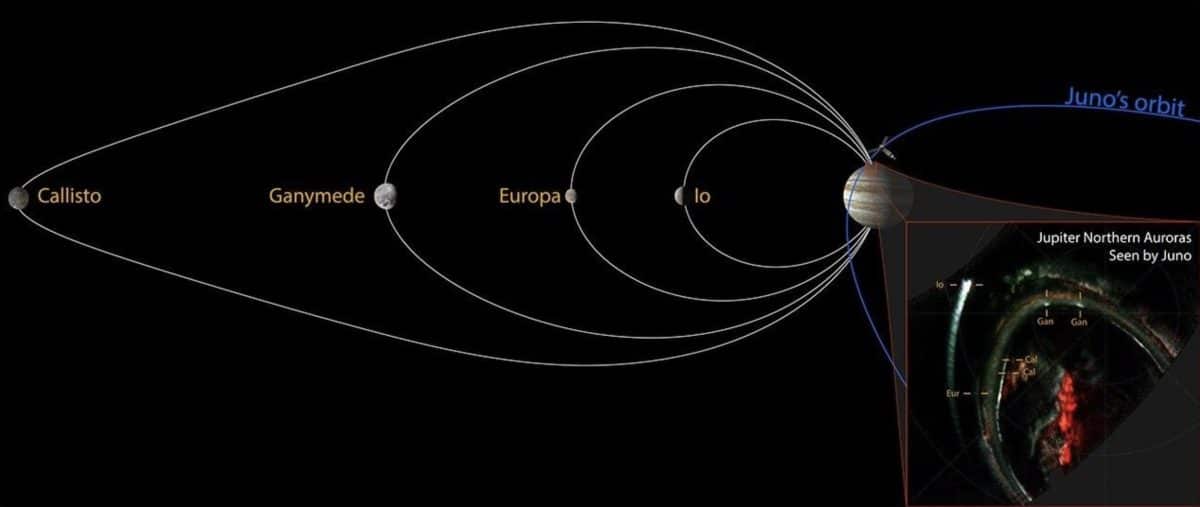
The Juno spacecraft has, for the first time, detected traces of Callisto—the second largest moon of the gas giant—in Jupiter’s atmosphere. Previously, such “signatures” that trigger auroras had only been observed from Io, Europa, and Ganymede.
How Jupiter’s Auroras Form
The bright auroras on Jupiter are not caused solely by interactions with the solar wind, where charged particles guided by the planet’s magnetic field excite atmospheric atoms and make them glow. Jupiter’s moons also play a significant role, crossing the lines of its powerful magnetic field. Unlike on Earth, where auroras are linked exclusively to solar activity, Jupiter’s largest moons leave their own unique “signatures” in the giant planet’s atmosphere.
Callisto: From Hypothesis to Confirmation
Until recently, scientists could confidently associate Jupiter’s auroras only with three Galilean moons—Io, Europa, and Ganymede. Callisto’s contribution remained hypothetical: the weak signal from this moon was usually lost against the bright glow of Jupiter’s main auroral oval. Even the Hubble Space Telescope was unable to confirm the presence of Callisto’s trace in the planet’s atmosphere.
The Breakthrough of the Juno Mission
This changed thanks to NASA’s Juno mission, which has been studying Jupiter from a polar orbit since 2016. In September 2019, when the planet’s magnetosphere expanded due to a weak solar wind and the bright auroral oval shifted about 1,800 kilometers toward the equator, the probe was able to detect Callisto’s trace.
The spacecraft observed a distinctive double glow—two spots with brightness levels of 108 and 137 kilorayleighs (a unit measuring photon flux intensity), corresponding to streams of electrons accelerated by interactions with Callisto. These values were significantly lower than those of auroras from Io (up to 2,000 kilorayleighs), Europa (up to 180 kilorayleighs), and Ganymede (up to 900 kilorayleighs).
Causes of Differences and New Data
The authors of the study, published in Nature Communications, attribute this difference to less efficient energy transfer between the moon and the magnetosphere, as well as to the unique position of Callisto within Jupiter’s plasma environment.
Measurements of plasma parameters in the magnetic tube connecting the moon and the planet, using the JADE and Waves instruments aboard Juno, allowed scientists to register electrons with energies around 10 kiloelectronvolts, as well as electrostatic waves associated with these particle streams. According to calculations, these could trigger radio wave emissions, but the power was too weak for direct detection.
Completing the “Family Portrait” of the Moons
The stability of the glow and its match with Callisto’s calculated orbital speed finally confirmed the presence of Callisto’s trace in Jupiter’s atmosphere. Thus, astronomers have completed the “family portrait” of the Galilean moons, showing that all of them, without exception, leave their “signatures” in Jupiter’s atmosphere.
The Significance of the Discovery
The results of the research team led by Jonas Rabia from the University of Toulouse (France) open new perspectives for studying similar processes in other planetary systems.