

The Greenland ice sheet disappeared 7,000 years ago.
Scientists have discovered that the ice dome in northwestern Greenland completely disappeared about 7,000 years ago due to warming. The study warns that a similar scenario could happen again in the future.
Cursus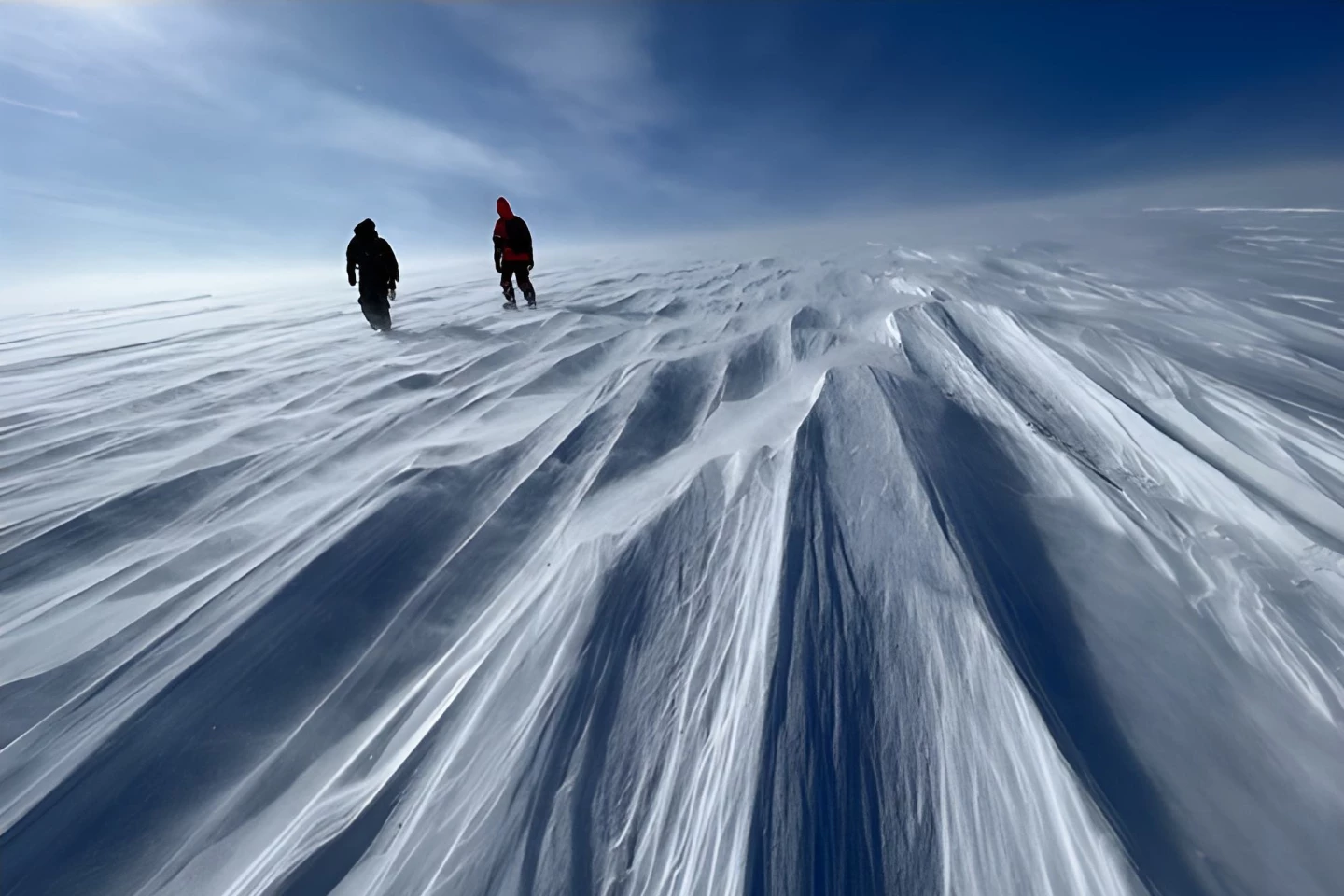
In the northwest of Greenland, a team of scientists working on the GreenDrill project drilled through a 500-meter-thick ice dome and made a surprising discovery: this dome completely disappeared about 7,000 years ago. Researchers warn that a similar event could happen again in the future.
Greenland Ice Sheet: Importance and Scale
Roughly 80% of Greenland’s territory is covered by ice, forming what is known as the Greenland Ice Sheet. This is the planet’s second largest reserve of fresh water: it spans about 1.7 million square kilometers and contains around 2.9 million cubic kilometers of ice. As such, the ice sheet holds a significant portion of the world’s fresh water resources.
In the northwest, the Pradhoe Dome rises above the ice sheet, having formed over thousands of years. Ice accumulating on a stable base gradually spread outward, creating a smooth elevation that stretches for hundreds of kilometers. Though it may seem unremarkable at first glance, the dome is crucial because its layers preserve a compressed record of climate and environmental history.
The GreenDrill Project: Studying the Past to Understand the Future
To understand how the Greenland Ice Sheet responded to periods of global warming in the past—and how it might change in today’s climate—scientists from various universities, including Columbia University and the University at Buffalo, launched the GreenDrill project. Funded by the US National Science Foundation, the initiative aims to drill through the ice sheet at different locations and reach the bedrock to obtain direct data about its history.
The results of the first drilling were recently published in the journal Nature Geoscience. In spring 2023, the expedition drilled into the Pradhoe Dome to a depth of 509 meters using the Agile Sub-Ice Geological Drill, developed as part of the NSF’s ice drilling program.
Methods and Key Discoveries
To analyze the cores, the team used a method called luminescence dating. This technique is based on the fact that as sediments are buried, electrons accumulate in mineral grains. When these grains are exposed to light again, they emit a glow, and the intensity of this luminescence reveals when the sediment was last at the surface.
The study showed that the sediments of the Pradhoe Dome were last exposed to daylight between 6,000 and 8,200 years ago. This means the entire dome had melted, allowing sunlight to reach that sediment layer.
Lead author Caleb Wolcott-George notes: “This tells us that the Pradhoe Dome melted during the early Holocene, when temperatures were three to five degrees Celsius higher than today. Some projections suggest we could reach similar levels of warming in the dome’s region by the year 2100.”
Significance for Sea Level Predictions
The Greenland Ice Sheet contains enough water that, if it were to melt completely, global sea levels would rise by 7.4 meters. This poses a serious threat to coastal communities worldwide. The drilling experiment at the Pradhoe Dome—conducted both at the summit and along its edges—helps scientists understand how and where the ice sheet might begin to melt first, and which regions are most vulnerable.
Co-author Jörg Schaefer from Columbia University emphasizes: “The rocks and sediments from beneath the ice sheet directly show which of its edges are most vulnerable, which is critically important for accurate local sea level predictions. This new field of science is changing the game in forecasting ice melt.”
Historical Context and Future Perspectives
During the drilling expedition, researchers lived in tents near Camp Century—a former Cold War military base where army scientists once tried to drill into the ice to install nuclear missiles. At that time, sediments were recovered and stored for decades at the University at Buffalo. Analysis of these sediments in 2023 revealed that much of the Greenland Ice Sheet was absent about 400,000 years ago. The GreenDrill project builds on this data and will contribute even more through future deep drilling efforts.
Caleb Wolcott-George concludes: “When you’re surrounded by nothing but ice, it’s hard to imagine that it was gone in the recent geological past—and that it could disappear again in the future. It really gives you pause.”