

Ancient genes reveal the secrets of life's origins
Scientists are studying universal paralogs—ancient genes preserved in all living organisms—to learn more about the earliest stages of evolution and the origins of life on Earth. New analytical methods make it possible to reconstruct the functions of these genes and bring us closer to understanding how the first cells emerged.
Cursus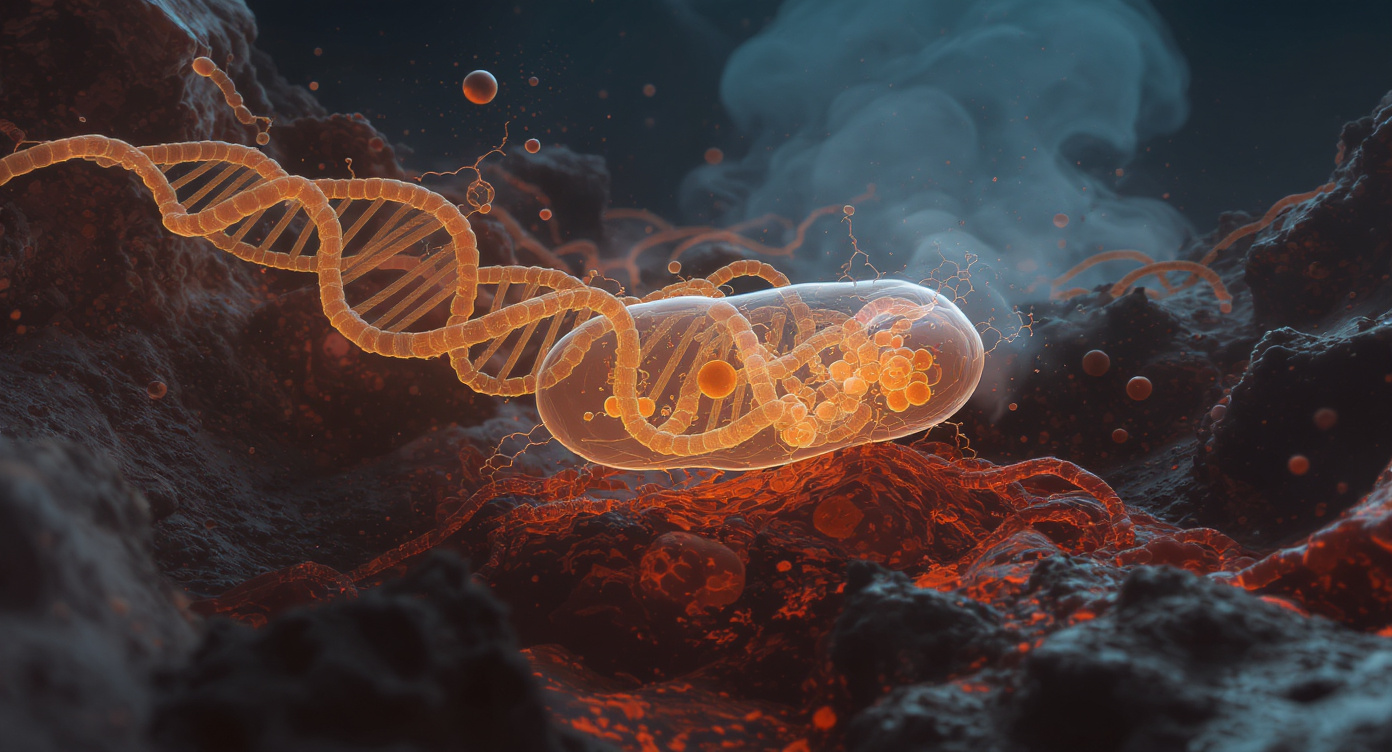
Every living organism on Earth traces its lineage back to a single common ancestor that existed around four billion years ago. This ancient organism, known as the last universal common ancestor, is considered the earliest form of life that can be studied using modern evolutionary methods.
Traces of Ancient Life
Research shows that many key features of modern life had already developed by that time: cells had membranes, and genetic information was stored in DNA. Since these essential traits were already present in the last universal ancestor, scientists seeking to understand the origins of life must look even further back—to events that preceded the appearance of this ancestor.
A New Look at Ancient Genes
In an article published in Cell Genomics, researchers Aaron Goldman (Oberlin College), Greg Fournier (MIT), and Betül Kacar (University of Wisconsin–Madison) describe their approach to studying this early evolutionary period. As Goldman notes, although the last universal common ancestor is the oldest organism that can be analyzed with evolutionary methods, some genes in its genome are much older than the ancestor itself.
The scientists focused on a special group of genes—universal paralogs. These genes carry information about biological changes that occurred before the emergence of the last universal ancestor.
What are paralogs?
Paralogs are related genes that exist in multiple copies within a single genome. For example, humans have eight different hemoglobin genes in their DNA, all of which code for proteins that transport oxygen in the blood. All these genes descended from a single ancestral gene—globin—which existed about 800 million years ago. Over time, copying errors led to the creation of additional gene copies, each gradually acquiring its own specialized function.
Universal paralogs are much rarer. These gene families are found in at least two copies in the genomes of nearly all living organisms. Their widespread presence suggests that the original gene duplication occurred before the appearance of the last universal ancestor, and the duplicated genes have been passed down through countless generations and are still found in modern organisms.
The Importance of Universal Paralogs
Because of their deep evolutionary origins, universal paralogs are considered an important, though often underappreciated, resource for studying the earliest history of life on Earth. Modern artificial intelligence methods and specialized equipment now make it possible to analyze ancient genetic patterns in detail, making this approach increasingly practical.
Although only a few universal paralogs are known, they can provide valuable insights into what life was like before the last universal ancestor appeared. As Fournier points out, the history of these genes may be the only source of information about the earliest cellular lineages, making it crucial to extract as much knowledge from them as possible.
Reconstructing Ancient Proteins
In their analysis, Goldman, Fournier, and Kacar examined all known universal paralogs. Each of these genes is involved either in protein synthesis or in transporting molecules across cell membranes. This suggests that protein synthesis and membrane transport were among the first biological functions to emerge during evolution.
The researchers also emphasize the importance of reconstructing ancient forms of these genes. In one study from Goldman's lab, a group of universal paralogs involved in embedding enzymes and other proteins into cell membranes was examined. Using evolutionary and computational biology methods, the team reconstructed a protein produced by the original ancient genome.
The results showed that this simpler, ancient protein could still attach to cell membranes and interact with protein synthesis mechanisms. It likely helped early proteins integrate into primitive membranes, offering a glimpse into how the very first cells might have functioned.
Prospects for Further Research
The authors hope that advances in computational tools will help identify additional families of universal paralogs and allow for a more detailed study of their ancient ancestors. As Kacar notes, studying universal paralogs helps connect the earliest stages of life on Earth with the tools of modern science. This offers a chance to turn the deepest mysteries of evolution and biology into discoveries that can be tested in practice. The goal of the researchers is to build a clearer picture of evolution before the last universal ancestor and to shed light on how life emerged in its modern form.