

The caves of Arabia have revealed traces of ancient humans.
A new study of caves in northeastern Arabia has uncovered traces of ancient humans and animals, helping to reconstruct the region's ecosystems over the past 100,000 years.
Cursus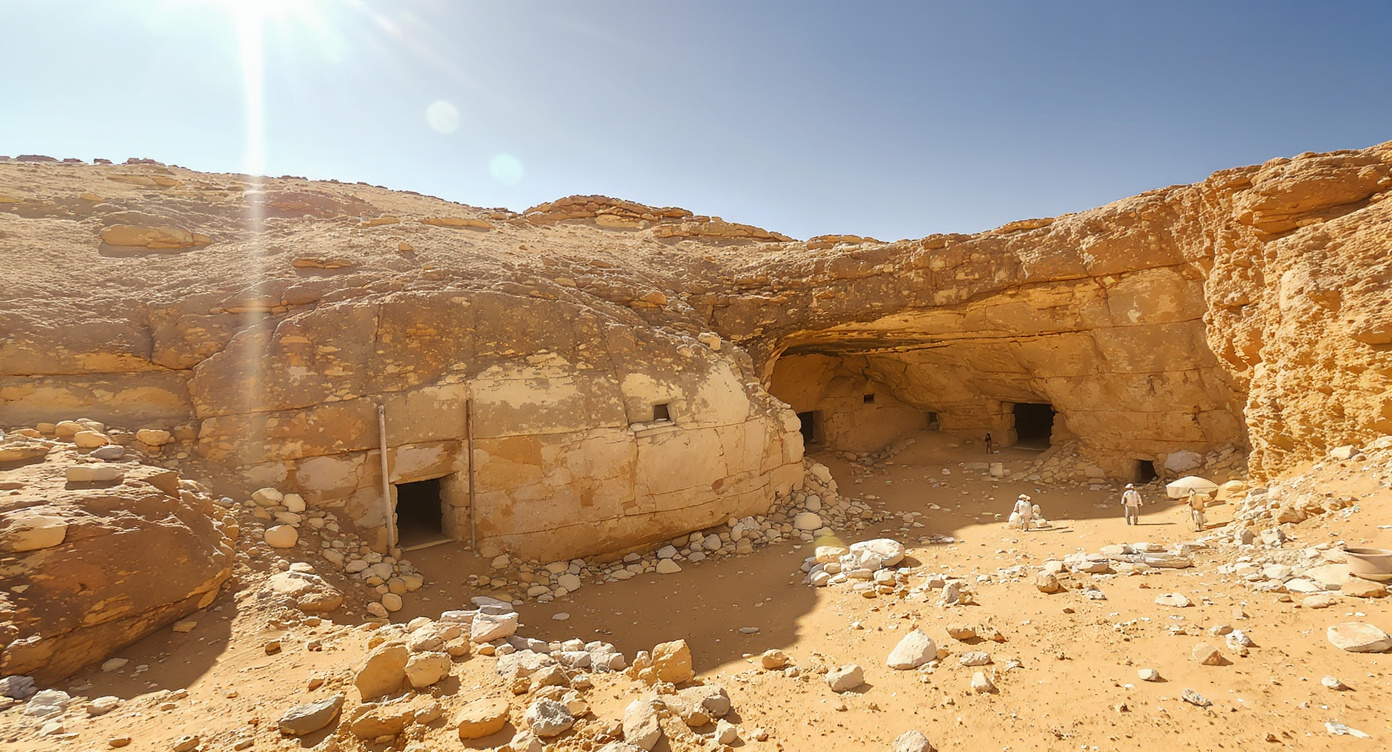
Today, the Arabian Desert, which stretches across the Arabian Peninsula, is considered one of the harshest and most inhospitable places on Earth. Extreme temperatures, almost complete lack of rainfall, and sparse vegetation make this region extremely difficult for permanent habitation, except for a few oases and coastal areas. However, around 100,000 years ago, the climate here was much wetter, creating favorable conditions for the existence of numerous animal groups. Recent research has provided direct evidence that during those times, ancient humans—hominins—lived alongside animals in this region.
New Discoveries on the Arabian Peninsula
Over the past twenty years, paleontologists and archaeologists have made numerous discoveries that have significantly changed our understanding of ancient human migrations out of Africa and the timeline of their settlement. Studies have shown that the harsh Arabian Desert was not always an insurmountable barrier for living creatures. Periods of increased humidity, known as "green windows," transformed Arabia into a network of savannas, lakes, and rivers, along which animals—and likely ancient humans—migrated.
Gaps in Knowledge and New Research
Until recently, the interior regions between Qatar and Kuwait remained virtually unexplored in terms of prehistoric human presence, despite geological data indicating sufficient rainfall in the past. This gap made it difficult to form a complete picture of the settlement of the Arabian Peninsula.
To address this, an international team of archaeologists, paleontologists, and anthropologists led by Huw Groucutt from the University of Malta focused their attention on the interior of northeastern Arabia. They selected areas with distinctive landscapes for their research: ancient riverbeds, cave networks, and flint outcrops at the surface.
Caves as Archives of Ancient Life
Flint outcrops are places where this hard rock, ideal for making stone tools, lies close to the surface and was accessible to ancient craftsmen. Caves were seen as unique archives: they could serve as shelters for people and animals, and also preserve remains and climatic evidence.
During extensive fieldwork, scientists surveyed 79 caves and the surrounding areas. This strategy proved successful: in several caves, they found convincing evidence of ancient human presence. One particularly important discovery was at the entrance to one cave, where more than 400 stone tools were found—a kind of "carpet" of artifacts, indicating active hominin activity.
Reconstructing Ancient Ecosystems
Inside the caves, researchers found bones of reptiles, bats, birds, camels, gazelles, hyenas, and wolves. Many fragments were preserved in excellent condition, offering a rare opportunity to reconstruct the ecosystems that existed here thousands of years ago.
By analyzing the techniques and types of stone tools, specialists were able to determine the time frames of ancient human presence in the region—from 10,000 to 100,000 years ago. The traces of habitation belong to different periods of history, including the Middle and Late Paleolithic, but most of the finds are associated with the Middle Paleolithic.
Evidence of Ancient Climate
In addition to stone tools and bones, researchers discovered speleothems in the caves—mineral formations created by water. These will help scientists learn how humidity levels in the region changed and during which periods the Arabian Peninsula became "green" and suitable for life.
Scientific Community Assessment
Experts not involved in the study have praised Groucutt’s team’s work. According to Monika Markowska from Northumbria University, the team’s findings provide, for the first time, a comprehensive picture of the archaeological record of northeastern Arabia.
Evolutionary biologist Michael Petraglia from Griffith University in Australia, whose years of research laid the foundation for the study of ancient Arabia, considers the new publication a logical step forward. He notes that such work is gradually bringing science closer to a full understanding of how the peninsula’s dynamic ecosystems shaped the lives of ancient humans and animals over hundreds of thousands of years.
The research results have been published in the journal PLOS One.