

A volcanic eruption accelerated the breakdown of methane in the atmosphere.
The eruption of the Hunga Tonga-Hunga Ha'apai volcano in 2022 allowed scientists to observe, for the first time, the accelerated breakdown of methane in the atmosphere caused by the interaction of volcanic ash, seawater, and sunlight. This discovery could contribute to the development of new methods for reducing methane levels and slowing global warming, though further research is needed to assess potential consequences.
Natura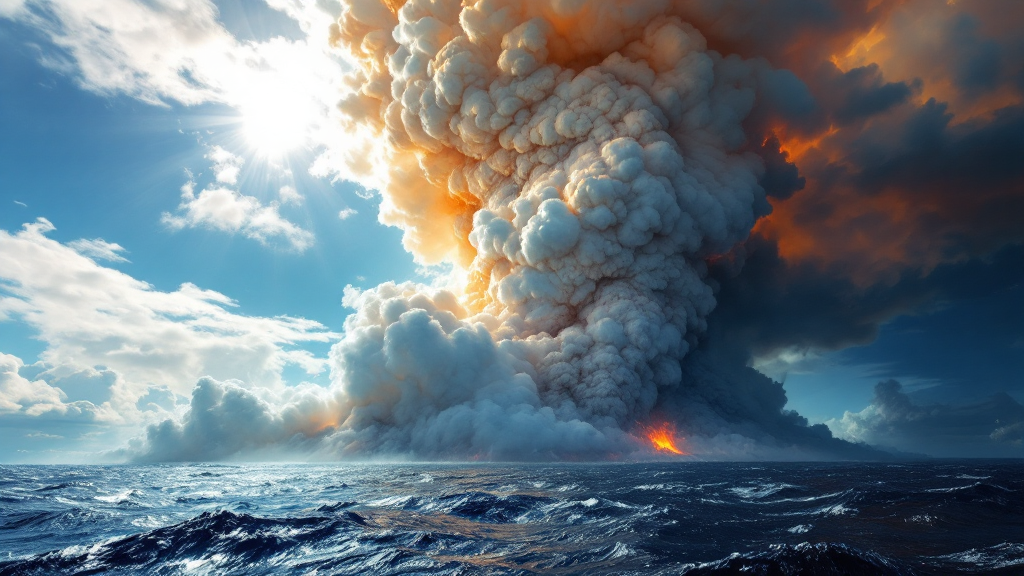
When the underwater volcano Hunga Tonga-Hunga Ha'apai erupted in the southern Pacific Ocean in January 2022, it became one of the most powerful volcanic eruptions of modern times. The eruption produced a massive cloud that, as researchers discovered, contributed to the breakdown of some of the methane released by the volcano itself.
The Impact of the Volcanic Cloud on Methane
Satellite data analysis revealed that the cloud formed after the eruption contained unusually high concentrations of formaldehyde—a substance that appears in the atmosphere as a result of chemical reactions that destroy methane. Since formaldehyde is short-lived, its significant presence indicates active methane destruction within the cloud.
Estimates suggest the volcano released about 300 gigagrams of methane, which is comparable to the annual emissions of more than two million cows. At the same time, the cloud was removing around 900 megagrams of methane per day—an amount equivalent to the daily emissions from two million cows.
The Mechanism of Methane Breakdown
Research has shown that methane destruction is linked to the interaction of volcanic ash, seawater, and sunlight. Similar processes have previously been observed in other conditions, such as when Saharan dust mixes with sea salt, leading to the formation of iron-salt aerosols. Under sunlight, these particles release chlorine atoms, which actively break down methane molecules.
In the case of the Hunga Tonga-Hunga Ha'apai eruption, the emissions of salty seawater and volcanic ash reached the stratosphere. Sunlight interacting with this mixture promoted the formation of reactive chlorine, which then reacted with methane and accelerated its breakdown. High levels of formaldehyde detected by satellites confirmed this process.
Implications for Climate
Methane is one of the main drivers of global warming, trapping heat in the atmosphere much more effectively than carbon dioxide. Although its atmospheric concentration is lower than that of CO2, over a 20-year period, methane has about 80 times the warming effect. Methane remains in the atmosphere for about 10 years before being broken down by chemical reactions, whereas CO2 can influence the climate for centuries.
Because methane has a relatively short atmospheric lifetime, reducing its emissions can have a noticeable climate impact within the next few decades. Therefore, lowering methane levels is considered one of the fastest ways to slow warming, although significant CO2 reductions are still needed for long-term temperature stabilization.
Prospects for Artificial Acceleration of Methane Breakdown
The discovery of the methane destruction mechanism in a volcanic cloud could be useful for developing new methods to accelerate the removal of methane from the atmosphere. Currently, research is underway to create safe chemical processes capable of speeding up the breakdown of existing atmospheric methane.
However, one of the main challenges remains proving the effectiveness of such technologies, since methane is spread over vast areas and small changes are difficult to detect. The Hunga Tonga-Hunga Ha'apai event provides a unique opportunity to observe methane destruction on a scale suitable for satellite monitoring.
Adjusting Climate Models
The results of this research may lead to a revision of global methane balance calculations, as the impact of atmospheric dust—including volcanic ash—was previously not fully accounted for. If such particles do indeed accelerate methane breakdown, climate models describing the movement and removal of this gas from the atmosphere will need to be updated.
Technological Aspects of Observations
The analysis used data from the TROPOMI instrument on the European Space Agency's Sentinel-5P satellite, which scans Earth's atmosphere daily. Detecting formaldehyde in the stratospheric volcanic cloud required additional calibration of the instrument's sensitivity and consideration of the effects of high sulfur dioxide concentrations.
Conclusion
The Hunga Tonga-Hunga Ha'apai eruption provided researchers with a unique example of large-scale atmospheric methane destruction and demonstrated possible ways to monitor this process from space. These findings could help develop new strategies to reduce methane levels and slow global warming, but any interventions in atmospheric chemistry require careful study of potential consequences.