

Japanese physicists have uncovered a new aspect of the Kondo effect.
Japanese researchers have experimentally demonstrated for the first time that the Kondo effect can not only suppress but also enhance the magnetic properties of a material, depending on the magnitude of the spin. This discovery opens up new possibilities for controlling quantum states and developing materials for quantum technologies.
Cursus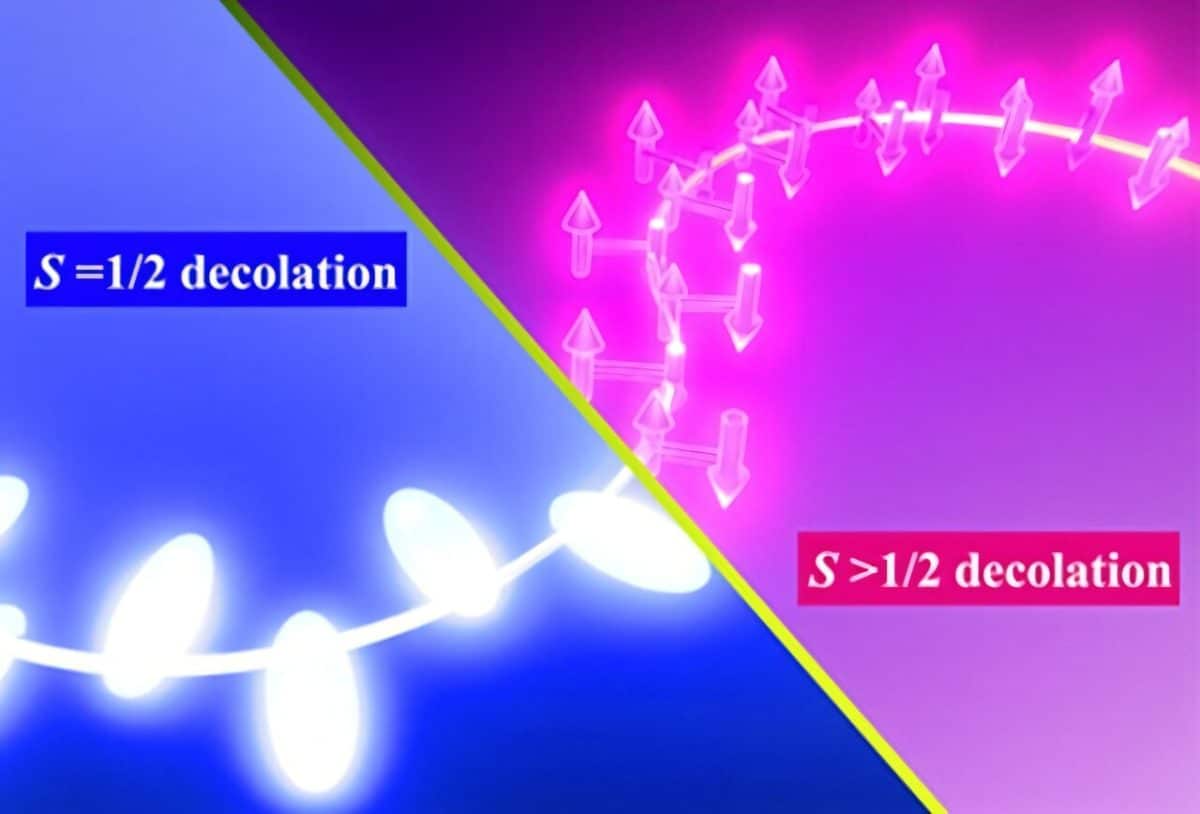
A precisely assembled hybrid material has enabled physicists to observe the boundary of the Kondo effect at the spin 1/2 level for the first time. Up to this boundary, the effect suppresses the material’s magnetic properties, but beyond it, the effect actually enhances them.
What is the Kondo Effect?
When spins—the intrinsic angular momentum of elementary particles—interact in a solid, phenomena arise that do not occur in isolated particles. One such phenomenon is the Kondo effect: quantum interactions between spins and electrons alter the magnetic and electronic properties of a material at temperatures below the characteristic Kondo temperature.
In these materials, electrons possess not only spin but can also move between orbitals. With a large number of interactions within the substance, it becomes difficult for scientists to isolate the influence of spin effects responsible for the Kondo effect. In 1977, Sebastian Doniach proposed the “Kondo necklace” model, which provides a simplified description of this effect. Despite its theoretical value, it was only recently that such a model could be realized experimentally.
A Breakthrough by Japanese Scientists
A team of physicists from the Graduate School of Science at Osaka Metropolitan University (Japan) successfully created a material with a new type of “Kondo necklace.” Their research revealed that as the localized spin increases from 1/2 to 1, the Kondo effect begins to work in the opposite direction: magnetic order and magnetism in the material increase. The results of their work were published in the journal Communications Materials.
This finding challenges the traditional view that the Kondo effect suppresses magnetism by pairing free spins into singlets—states with a total spin of zero. With spin 1/2, the spins pair up and “cancel” each other, so the material’s magnetism does not increase.
A New Understanding of Spin Interactions
It turns out that with spins greater than 1/2, complete compensation is impossible: the remaining spins can interact and form magnetic order. Thermodynamic measurements showed a sharp phase transition to a magnetically ordered state as the spin changed from 1/2 to 1. This occurs because the Kondo coupling mediates effective magnetic interactions between moments with spin 1, stabilizing long-range magnetic order in the material.
According to the researchers, this discovery is the first direct experimental confirmation that the function of the Kondo effect fundamentally depends on the magnitude of the spin. For the experiment, the substance was theoretically designed using the RaX-D molecular design system and created from organic radicals and nickel ions.
Implications for Quantum Technologies
“The discovery of a quantum principle dependent on spin magnitude in the Kondo effect opens a new field of research in quantum materials. The ability to switch quantum states between non-magnetic and magnetic regimes by controlling the spin magnitude offers a powerful strategy for designing next-generation materials,” noted Professor Hironori Yamaguchi.
Controlling whether a Kondo lattice is magnetic or non-magnetic is crucial for future quantum technologies. This control allows for the management of quantum entanglement, magnetic noise, and quantum-critical phenomena, all of which are critical for the stable operation of quantum computers and sensors.