

The unusual superconductor PtBi₂ paves the way for quantum technologies
The material PtBi₂ exhibits unique superconductivity only on its surfaces and forms Majorana particles, which are promising for creating stable qubits in quantum computers. Researchers are exploring ways to control these properties for future quantum technologies.
Cursus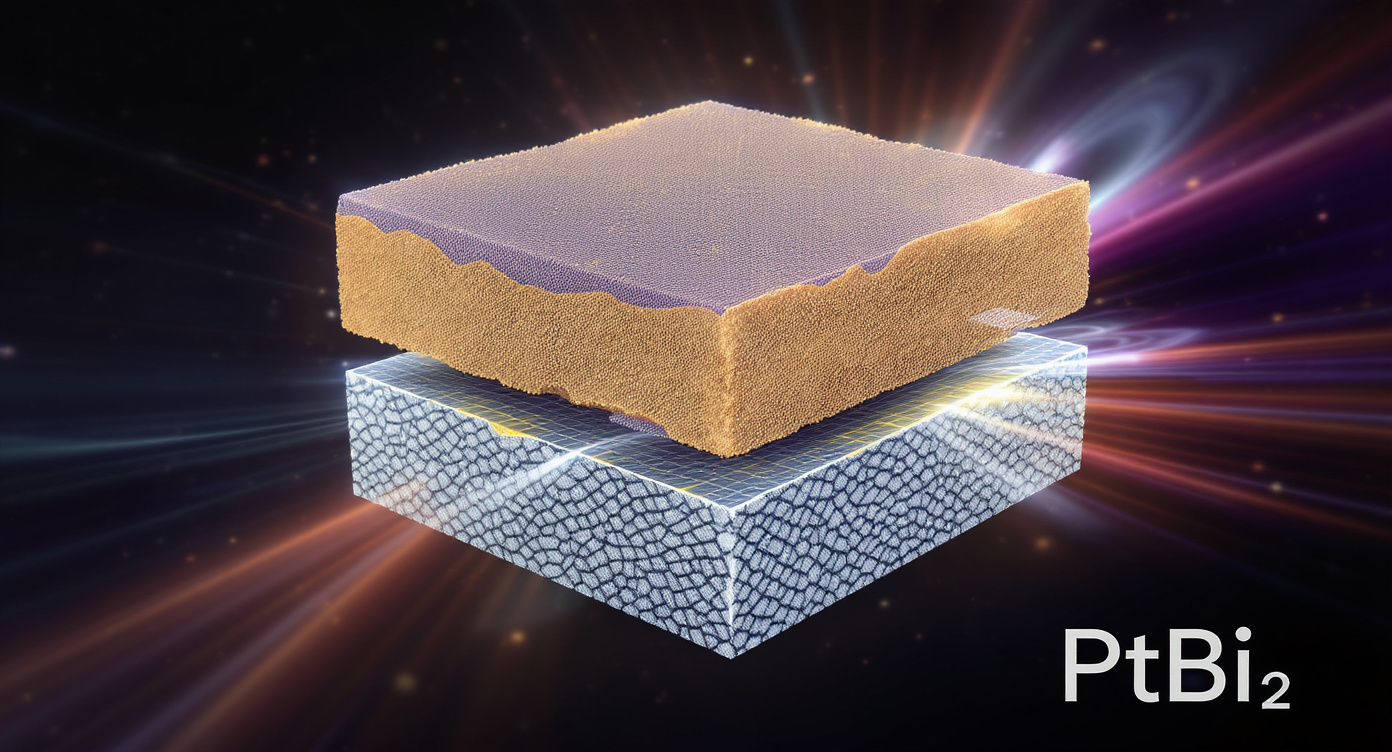
In the material PtBi₂ (platinum-bismuth-2), the top surface becomes superconducting: here, electrons pair up and can move without resistance, a hallmark of all superconductors. Thanks to this property, PtBi₂ can levitate a magnet above its surface—a phenomenon known as magnetic levitation. However, what sets this material apart is that there are six specific directions in which electrons cannot form pairs, distinguishing PtBi₂ from other superconductors.
Unusual Properties of PtBi₂
Inside the PtBi₂ crystal, despite its ordinary appearance, electrons behave in a completely unexpected way. Recent studies by scientists from IFW Dresden and the ct.qmat cluster have shown that only the top and bottom surfaces of the crystal become superconducting, allowing electrons on these faces to flow without resistance. Meanwhile, electrons within the bulk of the material remain normal and do not participate in superconductivity. This effect creates a unique structure—a natural superconducting "sandwich," where the outer surfaces conduct electricity perfectly, while the inner part remains metallic.
Topological Protection and Unique Symmetry
The superconductivity in PtBi₂ is due to topologically protected surface electrons. These properties are exceptionally robust: they persist as long as the overall symmetry of the crystal is maintained, even if its shape changes or it is exposed to electromagnetic fields. A special feature of PtBi₂ is that electrons associated with the top surface always have corresponding partners on the bottom, regardless of the crystal's thickness. If the crystal is cut, new surfaces immediately host similar surface electrons.
Unusual Electron Pairing
Experiments conducted in Dr. Sergey Borisenko's laboratory (IFW Dresden) revealed that not all surface electrons participate in superconductivity equally. In six specific directions on the surface, electrons do not form pairs at all. This unusual pattern reflects the threefold rotational symmetry of the atomic arrangement on the surface of PtBi₂. In conventional superconductors, electrons pair up regardless of their direction of motion, while in some unconventional ones—such as cuprates—a fourfold symmetry is observed. PtBi₂ is the first known superconductor with pairing restrictions along six directions.
Majorana Particles and Prospects for Quantum Technologies
Another important feature of PtBi₂ is the emergence of Majorana particles at its edges, which are considered promising building blocks for error-resistant qubits in future quantum computers. According to calculations, the topological superconductivity in PtBi₂ automatically generates Majorana particles along the material's edges. Moreover, by artificially creating stepped edges in the crystal, it is possible to produce as many Majorana particles as needed.
Majorana particles appear in pairs that together behave like a single electron, but individually possess unique properties. This concept of "splitting" the electron underpins topological quantum computing, where qubits become much more resistant to noise and errors.
Ways to Control the Properties of PtBi₂
Now that the unusual superconductivity of PtBi₂ and the edge-bound Majorana particles have been identified, researchers are focusing on controlling these effects. One approach is to reduce the thickness of the material, which can turn the inner layer from a conducting metal into an insulator and prevent ordinary electrons from interfering with Majorana-based qubits. Another method involves applying a magnetic field, which can move Majorana particles from the edges of the crystal to its corners, opening up new possibilities for using PtBi₂ as a platform for future quantum technologies.