

The self-protection mechanism of the AQP3 protein channel has been discovered
Biophysicists have discovered how the protein channel AQP3 self-regulates the transport of molecules across the cell membrane in response to acidity and hydrogen peroxide. This finding could lead to new approaches for treating diabetes and protecting cells from oxidative stress.
Cursus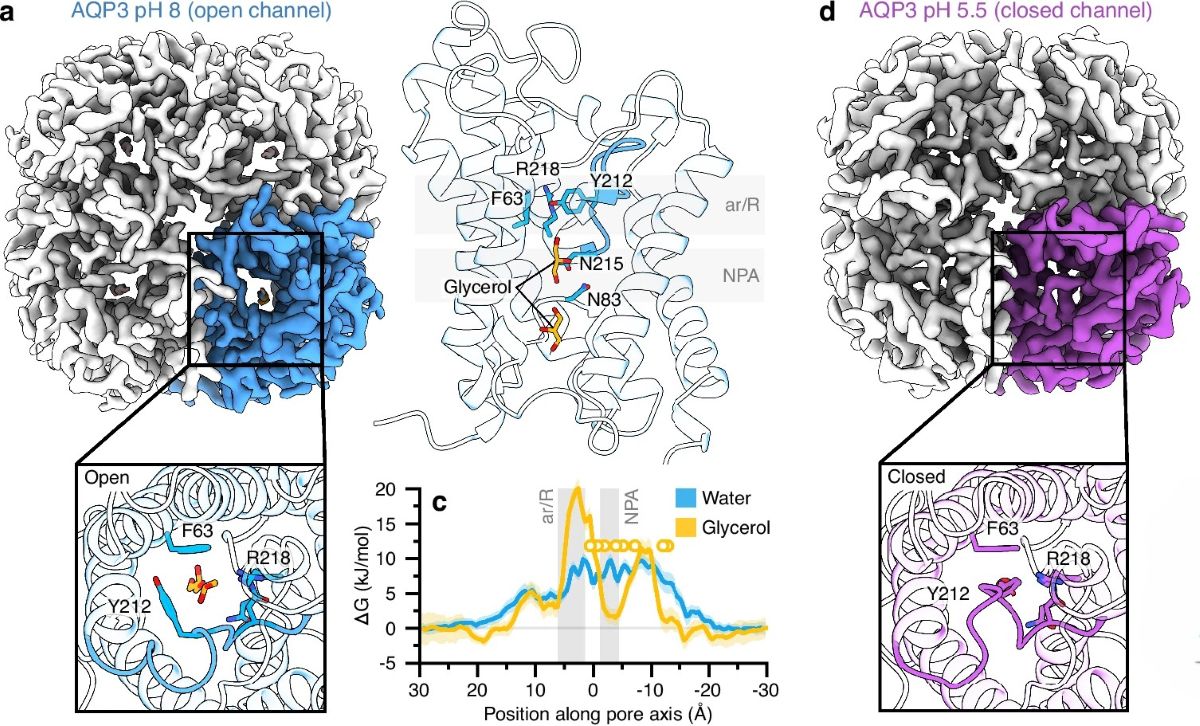
Biophysicists have uncovered the self-regulation mechanism of the AQP3 protein channel, which is responsible for transporting signaling molecules across the cell membrane. Using cryo-electron microscopy, researchers discovered that when the environment becomes more acidic, this channel physically "closes" from the inside, a process that may worsen pathological conditions in type 2 diabetes.
The Dual Role of Reactive Oxygen Species
Reactive oxygen species, such as hydrogen peroxide (H2O2), play two roles in the body. At high concentrations, they are toxic and destroy cells, but in small amounts, they serve as important signaling molecules. For example, in pancreatic beta cells, hydrogen peroxide acts as a signal to trigger insulin production. Special channels called aquaporins, particularly aquaporin-3 (AQP3), allow these molecules to pass through the membrane. It was previously known that changes in environmental acidity (pH) could stop the channel from functioning, but it remained unclear how the protein "senses" when to block the flow and what structural changes occur.
Studying the Structure of AQP3
To clarify the details of this process, researchers froze and photographed AQP3 protein molecules in three different states: in a neutral environment, in an acidic environment, and in the presence of hydrogen peroxide itself. Computer modeling helped reconstruct the dynamics of atomic movement.
The analysis revealed a built-in safety mechanism, similar to an emergency valve. In a neutral environment, the channel remains open, allowing water and glycerol to pass freely. However, when the environment becomes acidic (pH drops to 5.5), a key amino acid (aspartate-163) becomes protonated. This triggers a chain reaction: the protein’s external loop (Loop E) loses stability, "collapses" into the pore, and completely blocks it.
Unexpected Discoveries
The most surprising finding was that the channel can close not only in response to acid, but also when exposed to high concentrations of hydrogen peroxide. In this way, the toxin itself initiates the blocking of its own pathway, preventing the cell from becoming oversaturated.
Connection to Diabetes
The study’s authors linked this mechanism to the development of diabetes. It is known that high blood sugar levels cause the cell’s internal environment to become more acidic. In diabetic tissues, the amount of AQP3 protein is increased, but due to chronic acidification, the channels are likely to remain constantly closed. As a result, hydrogen peroxide cannot exit or enter the cell to transmit signals, leading to a double negative effect: insulin secretion is disrupted and oxidative stress accumulates, damaging pancreatic cells.
Implications for Medicine
This new research demonstrates that aquaporin-3 is not just a passive channel, but a "smart" sensor that regulates the cell’s oxidative balance. Understanding the mechanism of its blockage opens the door to developing drugs that can selectively open or close this channel to protect cells.