

Vine Robot: A Gentle Assistant for Medicine and Everyday Life
Engineers from MIT and Stanford have developed a robot with flexible tentacles capable of delicately grasping and moving both fragile and heavy objects. This new system is particularly promising for assisting in patient care and could also be applied in other fields.
Ingenium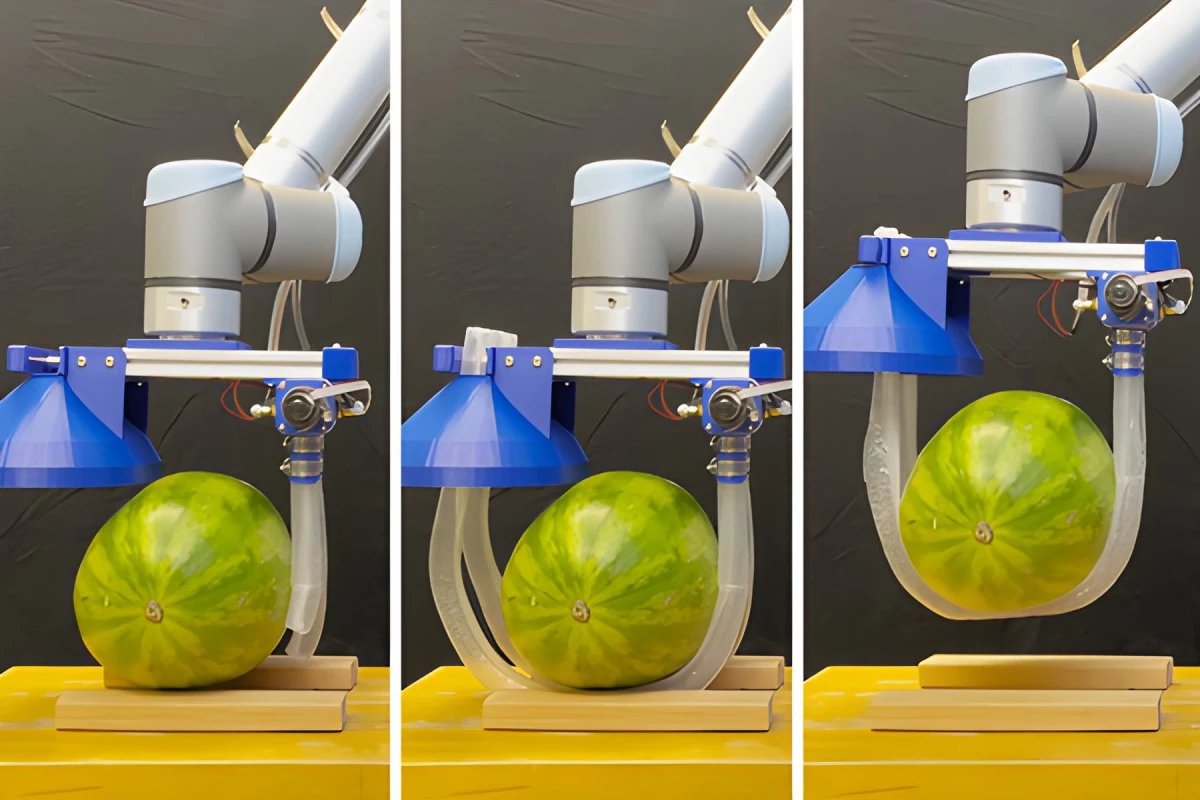
Although modern robots are becoming increasingly advanced, their precision when handling objects often leaves much to be desired. Engineers from MIT and Stanford have proposed an innovative solution to this problem: their new robotic system uses flexible, vine-like tentacles to grasp a variety of objects.
Unique Design and Operating Principle
The developed system consists of a set of pneumatic tubes that extend from a sealed housing located on one side of the robotic arm. Using air pressure, the tubes can wrap around or slide under the desired object, then return to the arm from the opposite side and lock in place. Once secured, the arm can move, and the tubes can coil to lift or rotate the captured object. The key innovation is the ability to form closed loops, which sets this system apart from previous "vine" robots.
Thanks to its soft, adaptable "hands," the robot can perform delicate tasks, such as gently lifting and moving a fragile glass vase.
Advantages of Closed Loops
“Many people think that to grab something, you just need to reach out and take it,” explains Kentaro Barhait from MIT’s Department of Mechanical Engineering. “But in reality, the process involves several stages: positioning and holding. By transforming open loops into closed ones, we achieve new levels of efficiency, leveraging the benefits of both forms at the appropriate stages.”
Testing and Application Potential
During tests, which can be seen in the video, the team demonstrated that the system can lift round objects, operate in cluttered environments, handle fragile items (such as a glass vase) with care, grasp large objects at a distance, gather groups of items (like a bundle of metal rods), and manage heavy or irregularly shaped objects, such as a watermelon. However, the main intended use for the "vine" robot is to assist in lifting human bodies in hospitals and elder care facilities.
Prospects for Medicine and Care
“Transferring a person from a bed is one of the most physically demanding tasks for a caregiver,” notes Barhait. “Such a robot could ease the workload of assistants and be gentler and more comfortable for patients.”
Typically, to move a patient, they must be turned to both sides to place a sling sheet underneath, which is then lifted with a hoist. This process can cause discomfort and interfere with medical equipment. Because the tubes can pass through very narrow spaces, such as under a patient’s body, the "vine" robot system makes these transfers softer and less traumatic.
“I am truly inspired by the possibility of using such robots to provide physical assistance to people with limited mobility,” adds Allison Okamura from Stanford. “Soft robots can be relatively safe, affordable, and optimally designed for specific human needs, unlike other approaches such as humanoid robots.”
Potential for Other Fields
Although the "vine" robot was originally developed for medical applications, researchers note that it has potential uses in other areas as well, as demonstrated during testing.
“We believe this robot design can be adapted for many industries,” says Barhait. “We are also considering its use in heavy industry, for example, to automate crane operations in ports and warehouses.”
The invention is described in detail in a study published in the journal Science Advances.