

Ocean acidity is transforming coral reefs and ecosystems
A study of coral reefs off the coast of Papua New Guinea has shown how increasing ocean acidity is gradually transforming marine ecosystems: corals are being replaced by algae, and biodiversity is declining. These findings help predict the future of reefs and coastal communities as CO2 emissions continue to rise.
Natura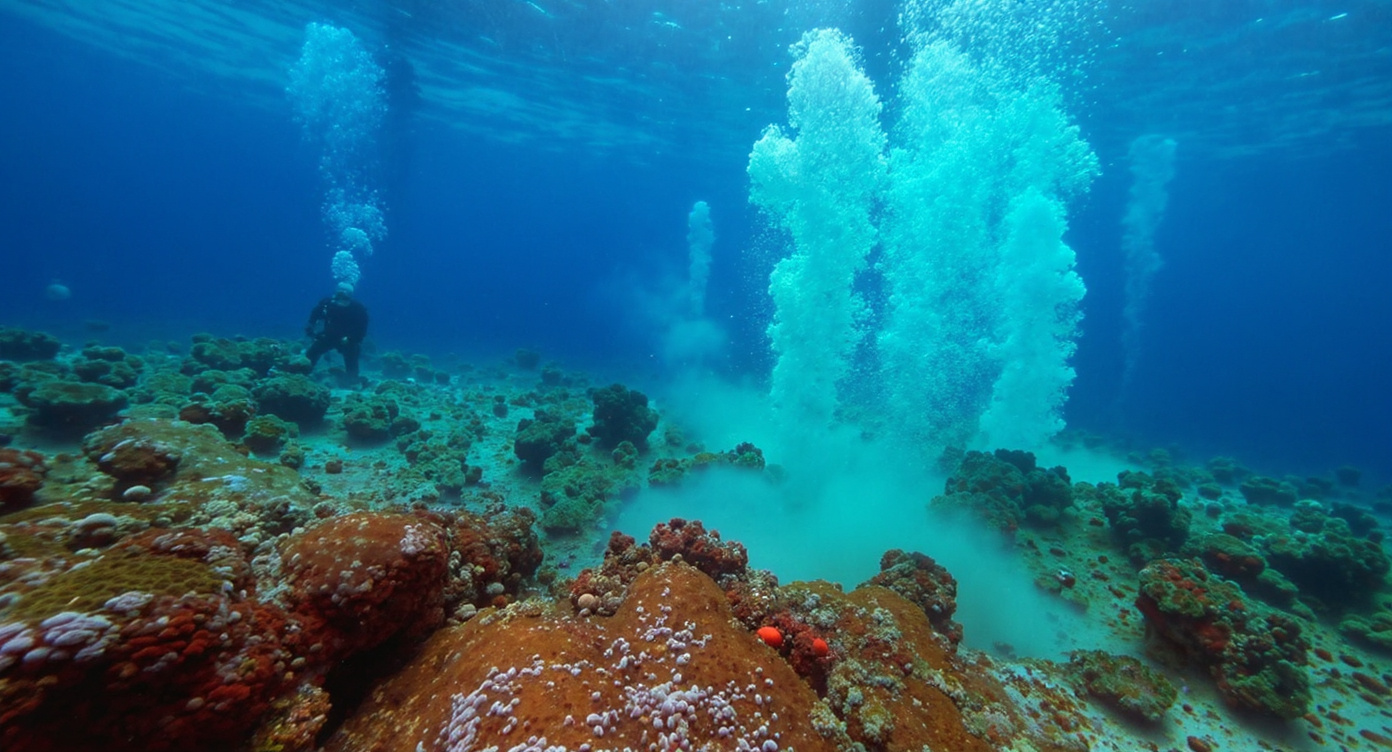
On a remote coral reef off the coast of Papua New Guinea, streams of bubbles constantly rise from cracks in the shallow seabed, fueled by an underground volcanic system. For scientists, this natural phenomenon has become a kind of "crystal ball," allowing them to glimpse how changes in the oceans might affect marine life.
A Natural Laboratory for Studying Ocean Acidity
Researchers from the Australian Institute of Marine Science (AIMS) discovered that these volcanic bubbles, composed almost entirely of carbon dioxide (CO2), cause localized increases in water acidity. As the gas rises, it forms visible streams of bubbles that dissolve into the seawater, altering its chemical makeup. Because this occurs near coral reefs in Milne Bay, scientists can observe firsthand how elevated CO2 levels impact marine ecosystems. Essentially, this is a unique natural experiment that cannot be replicated in laboratory conditions.
A Glimpse into the Future of Reefs
Dr. Katharina Fabricius, lead author of the study and a coral ecologist at AIMS, notes: “These unique natural laboratories are like time machines. Areas with high CO2 concentrations allow us to study the limits of reef resilience and make predictions: how will reefs cope if emissions align with the Paris Agreement goals? And what if they don’t?”
Fabricius first encountered volcanic bubbles in 2000 while studying coral garden biodiversity. Later, she returned with a team of scientists to analyze the gas composition—discovering it was almost pure CO2. This marked the beginning of a decade-long investigation into how tropical marine ecosystems adapt—or fail to adapt—to increasingly acidic conditions.
How Life on the Reef Changes
The scientists established 37 research stations along a gradient—from areas without bubbles, reflecting current ocean chemistry, to zones with intense gas emissions, simulating conditions expected by the end of the century. Importantly, other factors—temperature, currents, light, and salinity—remained unchanged, allowing the team to focus solely on the effects of acidification.
At each station, they measured how favorable the water was for forming calcium carbonate—the material corals and some algae use to build their skeletons. They also photographed the seabed, counted young corals, assessed habitat structure, and collected algae for analysis. This approach provided a continuous picture of how reef life changes as organisms’ ability to build and maintain skeletons declines.
Gradual but Noticeable Changes
The results were surprising: there was no sharp threshold at which life disappeared at a certain CO2 concentration. Instead, the coral community changed gradually and progressively—even with a slight increase in CO2 levels in the water.
The first signs of change appeared with only a minor drop in pH, within ranges already recorded on many reefs worldwide. The diversity of both adult and juvenile hard corals quickly declined, and the most sensitive species—branching and plate corals that provide shelter for fish and invertebrates—disappeared even with moderate pH reductions and were almost absent in the most acidic zones.
Meanwhile, large, rounded Porites corals showed remarkable resilience, creating a misleading impression of community stability. If these corals were excluded, the outlook became much bleaker.
Consequences for the Entire Ecosystem
Dr. Sam Noonan from AIMS emphasizes: “The reefs of Papua New Guinea show that with each increase in CO2, there are fewer corals and more fleshy algae. We also found far fewer young corals, meaning reefs will struggle to grow and recover quickly. This affects all species that depend on reefs, including people. Many coastal communities rely on fish that begin their lives on coral reefs.”
Algae that usually help bind and build reef structures also quickly disappeared as CO2 levels rose, eventually vanishing altogether. Normally, these algae aid the settlement and growth of young corals, so their loss worsens the problem. In contrast, non-calcifying algae expanded their presence: brown and red algae covered the seabed, taking advantage of open space and reduced competition. Sponge numbers also increased. Overall, the reef shifted from a complex, coral-built habitat to a simpler, flatter environment dominated by algae.
Global Risks for Marine Life
If reefs are the tropical forests of the ocean, then CO2 is turning them from lush, diverse landscapes into open pastures—bad news for the roughly 25% of the world’s fish that rely on corals for shelter, breeding, raising young, and finding food.
Fabricius notes: “By studying organisms at 37 sites along a 500-meter CO2 gradient, we saw what happens as CO2 increases. There was no sudden collapse; instead, as CO2 rose, fleshy algae became dominant, outcompeting and suppressing corals and calcifying algae.”
The Importance of the Study
This research is crucial for predicting how reefs worldwide will change as ocean acidification intensifies this century and beyond. While coral bleaching—caused by rising water temperatures—is well studied, there is far less data on how acidification affects vulnerable species and the consequences for fish and invertebrates that depend on reefs.
“We are already seeing coral reefs begin to change in response to CO2 gradients on the Great Barrier Reef. The reefs of Papua New Guinea show what lies ahead. The more CO2 we emit into the atmosphere, the more dramatic the changes will be for coral reefs and the coastal communities that depend on them. And this is in addition to the impacts of global warming and rising sea levels,” says Fabricius.
She adds: “Ocean acidification is a huge global problem that has so far been under-researched and underreported. This study is the first of its kind, providing unique field data and allowing us to assess how entire communities change under real-world conditions.”
The study was published in the journal Communications Biology.