

Martian volcanoes may have created equatorial glaciers
A new study has shown that powerful volcanic eruptions on early Mars may have led to the formation of thick ice sheets in the planet's equatorial regions. This explains the unusually high hydrogen content found in these areas and could play an important role in the future colonization of Mars.
Cursus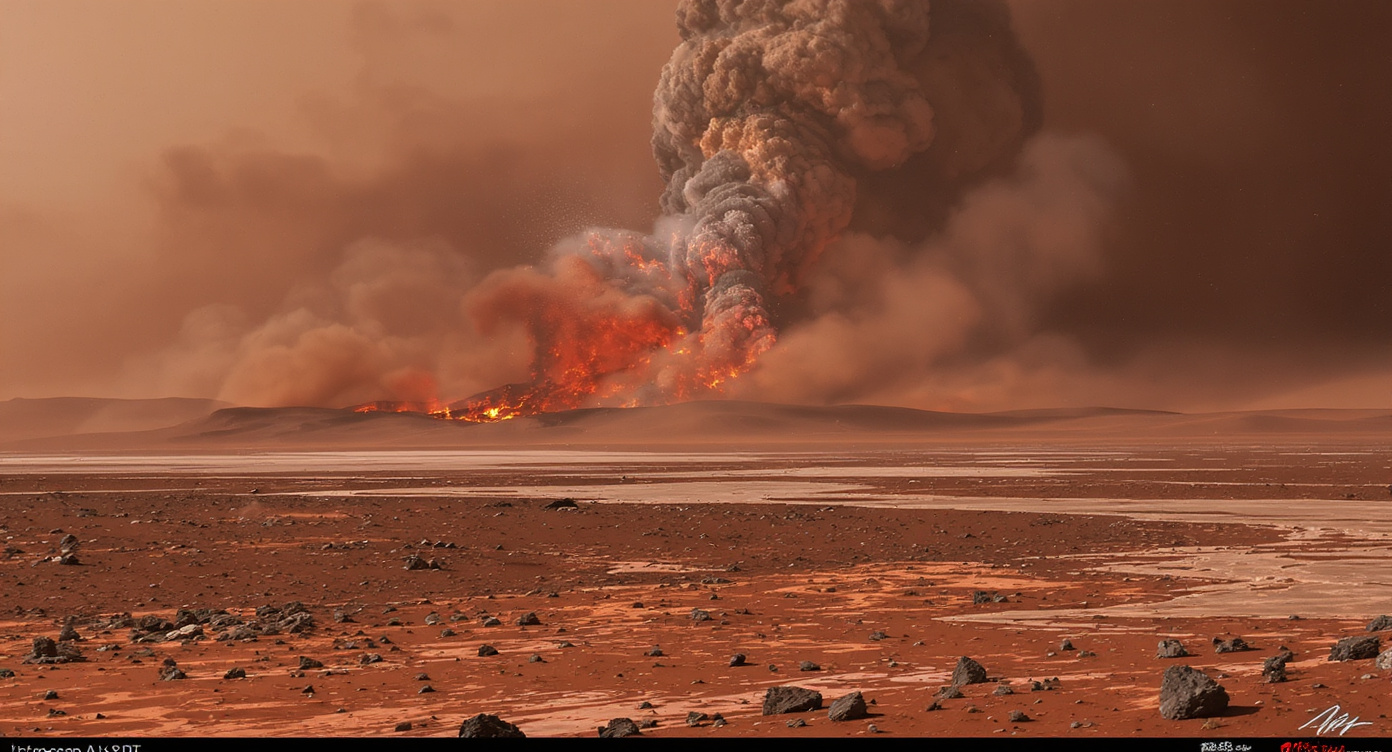
A team of planetary scientists conducted computer simulations of the climate on ancient Mars, focusing on the period 3–4 billion years ago. Their research revealed how volcanic eruptions could have created thick ice sheets in the planet’s equatorial regions.
Orbital spacecraft have detected unusually high levels of hydrogen in the soil near Mars’ equator, particularly in the areas of Meridiani Planum and the Medusae Fossae Formation. Since hydrogen is most commonly found in water, this suggests the possible presence of subsurface ice deposits.
The scientists modeled explosive eruptions from the ancient Apollinaris and Syrtis Major volcanoes, which are located near zones with anomalous hydrogen concentrations. The simulations showed that during these eruptions, large amounts of water vapor were released into the atmosphere, which then froze and fell to the surface as ice.
A single eruption, ejecting water at a rate of over 100 million kilograms per second and lasting for three Martian days, could have produced an ice layer up to five meters thick.
The volcanoes also emitted sulfuric acid, which formed a dense layer of aerosols. This triggered a “volcanic winter” and slowed the melting of the ice. The rate of sublimation dropped from 14 to just 1.3 kilograms per square meter per year.
Over time, the ice became covered with layers of dust and volcanic ash, which could have preserved it for billions of years. The results of the study were published in the journal Nature Communications.