

The South Atlantic Anomaly is rapidly expanding and becoming more complex.
The South Atlantic Anomaly in Earth's magnetic field continues to expand and become more complex, increasing risks for satellites and requiring constant monitoring to better understand the processes occurring deep within the planet.
Cursus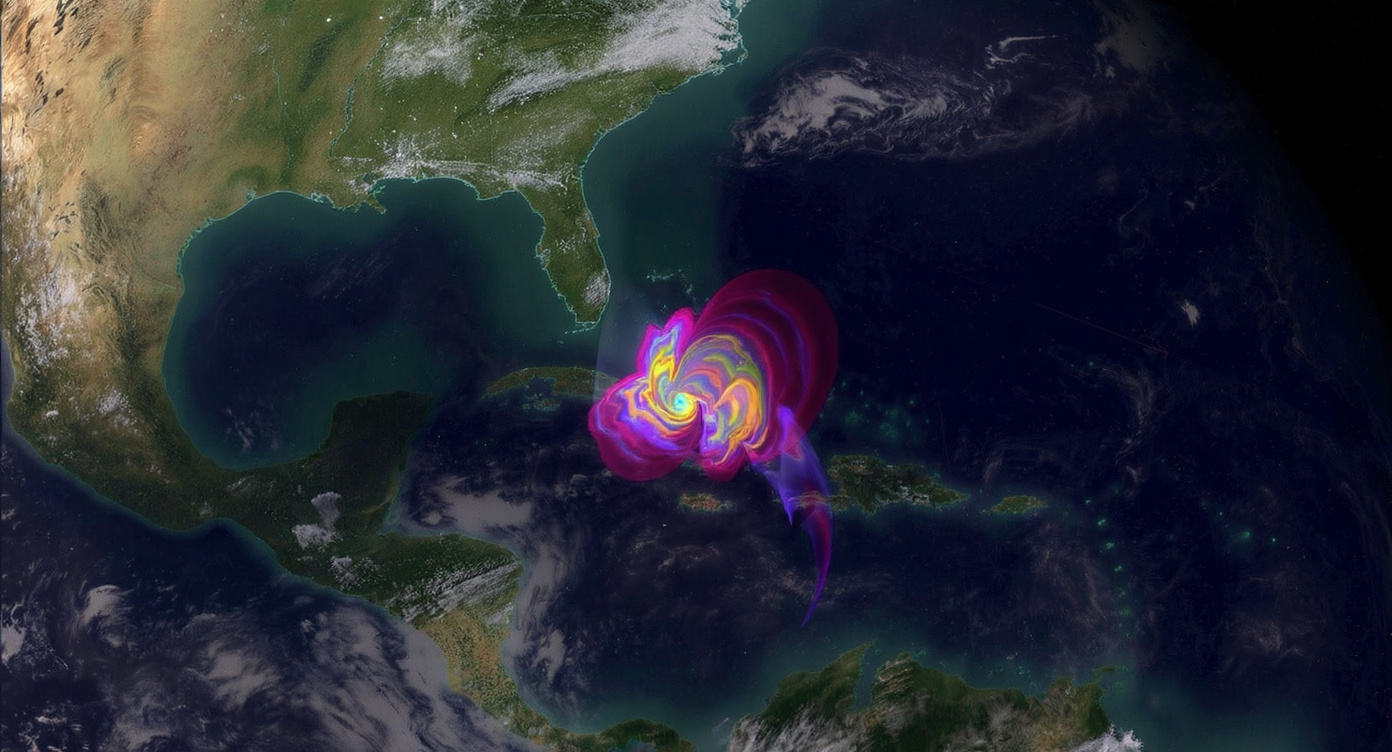
The weak zone in Earth's magnetic field over the South Atlantic has grown significantly, increasing risks for orbiting satellites and other space technology. Research over the past 11 years has shown that this area of weakening continues to expand, and its dynamics are more complex than previously thought.
Features of Earth's Magnetic Field
Our planet's magnetic field is generated by flows of molten iron in the outer core and protects the surface from cosmic radiation. However, this field is not stable and has its own vulnerable regions.
The South Atlantic Anomaly
The most well-known of these regions is the South Atlantic Anomaly—a vast area where the magnetic field strength is significantly reduced. Passing through this zone is dangerous for spacecraft, as the elevated radiation levels can cause malfunctions in their electronics.
New Data on the Anomaly's Development
A team of scientists from the Technical University of Denmark analyzed data collected over 11 years by three satellites from the European Space Agency's Swarm mission. These instruments precisely measure magnetic signals originating from deep within the planet. The results of their study were published in the journal Physics of the Earth and Planetary Interiors.
From 2014 to 2025, the South Atlantic Anomaly has steadily expanded. The area where the field strength dropped below 26,000 nanoteslas increased by 0.9% of Earth's total surface, and the minimum field strength within the anomaly decreased by 336 nanoteslas.
Internal Variability of Changes
An important discovery was the internal variability of these changes. The section of the anomaly southwest of Africa is weakening much faster than its central part over South America, especially after 2020. This is believed to be due to complex processes at the boundary between Earth's liquid core and mantle, about 3,000 kilometers deep. In these regions, so-called reverse flux patches exist: unlike the norm, where magnetic lines emerge outward from the core, here they are directed back inward.
Swarm data showed that one such patch beneath Africa is shifting westward, causing the accelerated weakening of the field in this part of the anomaly.
Changes in Other Regions
The satellites also recorded opposite trends in the polar regions of the Northern Hemisphere. Two areas with strong magnetic fields stand out here: over Canada and Siberia. During the observation period, the Canadian region weakened and its area shrank by 0.65% of the planet's surface. Meanwhile, the Siberian region, on the contrary, strengthened and grew by 0.42%. This process is directly linked to the ongoing shift of the North Magnetic Pole toward Siberia and reflects the redistribution of molten metal flows in the core.
The Importance of These Observations
The diverse changes on Earth's surface reflect the complex hydrodynamics within the planet. They show that the magnetic field changes unevenly, as a result of the interaction of many local processes.
Continuous monitoring from orbit not only allows us to track these changes but also to better understand the fundamental mechanisms that govern Earth's magnetic shield. This is crucial for forecasting "space weather" and ensuring the safe operation of navigation systems.