

Direct Hit: How to Protect Earth from an Asteroid
A new study has shown that, to effectively deflect dangerous asteroids, it is crucial to precisely choose the impact site. This helps prevent the asteroid from returning to a hazardous orbit and ensures the long-term protection of Earth.
Cursus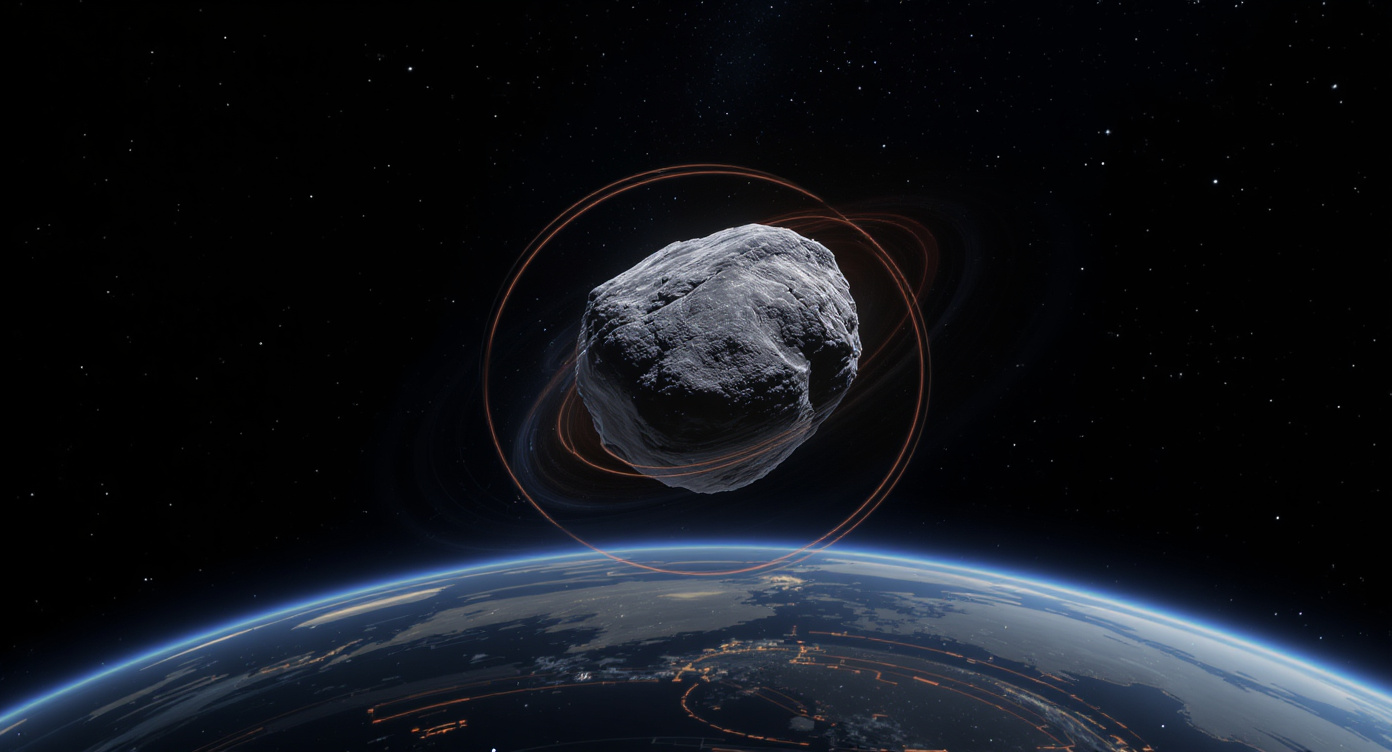
The selection of the impact site for a spacecraft to collide with a hazardous asteroid requires exceptional precision and thorough analysis, as highlighted by new research presented at the EPSC-DPS2025 conference in Helsinki. An incorrectly directed impact could send the asteroid into a so-called "gravitational keyhole"—a region in space that, if passed through, could alter the asteroid’s orbit in such a way that it might collide with Earth in the future.
Why the Impact Location Matters
Even if an asteroid is successfully diverted from a trajectory that would lead to a collision with Earth, it is crucial to ensure it does not pass through one of these dangerous gravitational zones. Otherwise, the threat of a future impact could re-emerge years or even decades later. This warning comes from Rachel Makadia, a NASA fellow and a member of the research team that presented these findings at the conference.
The DART Mission Example
In September 2022, NASA’s DART mission (Double Asteroid Redirection Test) successfully altered the orbit of the small asteroid Dimorphos, which orbits the larger Didymos, using a kinetic impact. This experiment demonstrated that asteroids potentially hazardous to Earth can indeed be deflected. In December 2026, the European Space Agency’s Hera mission will continue to study the aftermath of the DART impact.
In the case of the Didymos-Dimorphos system, the exact impact location was not critical, as the system’s mass is too great for it to be accidentally sent onto a dangerous orbit. However, for other asteroids orbiting the Sun, even a minor change in trajectory could cause them to pass through a gravitational keyhole.
What Is a Gravitational Keyhole?
A gravitational keyhole is a small region in space where a planet’s gravity can alter the path of a passing asteroid so that, in the future, it could return on a collision course with that planet. If, after being deflected, an asteroid passes through such a keyhole, the risk of an Earth impact is only postponed—not eliminated.
How to Minimize the Risks
Scientists’ task is to determine the optimal spot on the asteroid’s surface for the impact, minimizing the chance that the asteroid will pass through a gravitational keyhole. Every point on the asteroid’s surface carries its own probability of such a scenario after a kinetic impact. Makadia’s team has developed a method for creating probability maps of an asteroid’s surface, using data from the DART mission as a reference. However, each asteroid is unique, and calculations must account for its individual characteristics.
Accurate analysis requires advance knowledge of the asteroid’s shape, topography, rotation, and mass. Ideally, this information is obtained through a space mission that approaches the object and transmits high-resolution images and data. However, for some asteroids—especially when there is little time between their discovery and a potential Earth impact—such an approach is not feasible. In these cases, scientists must rely on ground-based observations.
Long-Term Protection of Earth
By calculating the asteroid’s trajectory after impact and identifying the most dangerous orbits, scientists can choose the safest location for intervention. “With the help of probability maps, we can deflect asteroids in a way that prevents them from returning to a hazardous trajectory, thereby ensuring the long-term protection of Earth,” Makadia concludes.