

A "naked" black hole has been discovered in an ancient galaxy
Astronomers have discovered a black hole in an ancient galaxy whose mass exceeds that of all the surrounding matter. This finding challenges standard theories about black hole formation and calls for new explanations.
Cursus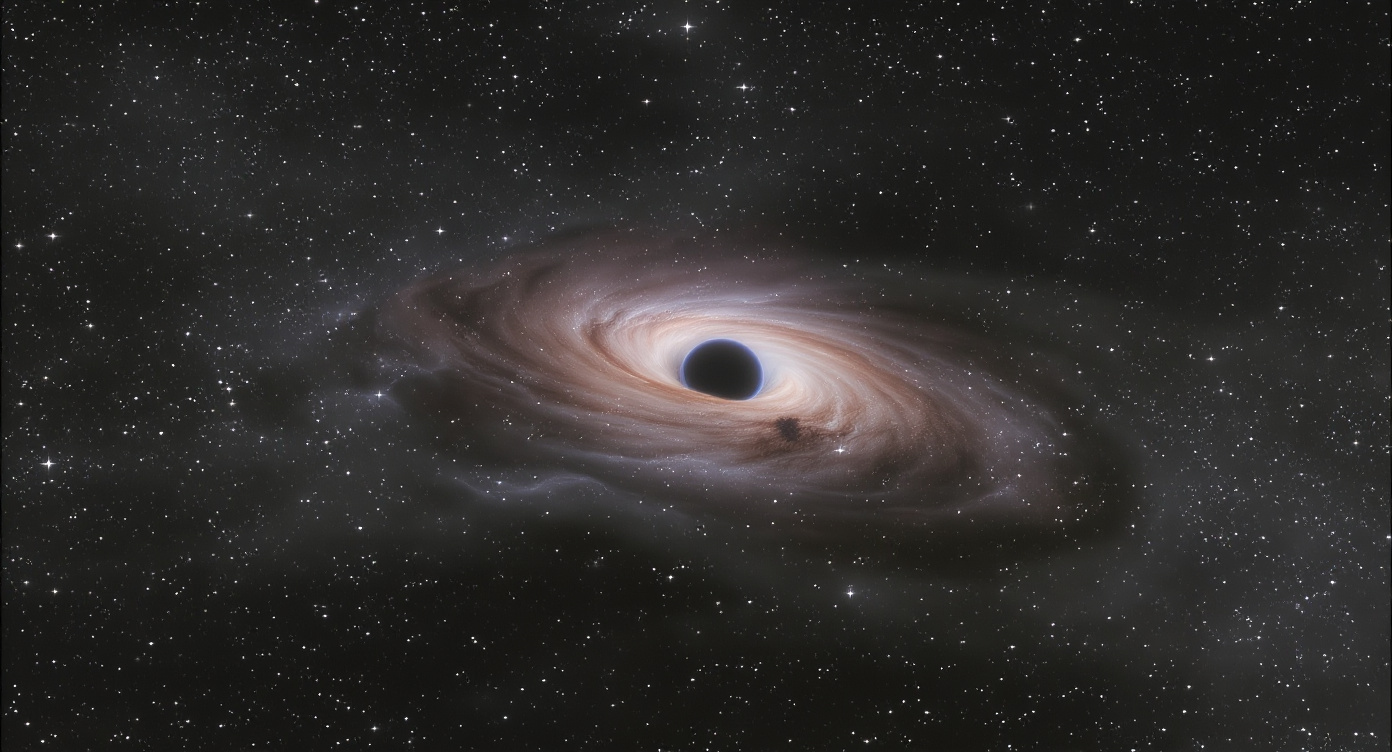
Astronomers have once again studied one of the so-called "little red dots" discovered by the James Webb Space Telescope. Their research revealed that at the center of this tiny and extremely ancient galaxy lies a black hole with a mass of about 50 million solar masses. Remarkably, the mass of the surrounding galaxy is significantly smaller. This imbalance suggests that such a black hole could not have formed from stars alone—its existence requires a different mechanism that does not fit within the standard cosmological model.
Unusual Discoveries by the James Webb Telescope
In recent years, the James Webb infrared space telescope has detected a number of objects that, as noted in scientific publications, do not align well with traditional ideas about the evolution of the Universe. Among these are massive black holes that existed more than 13 billion years ago. According to the standard cosmological model, all black holes form from stars and initially have masses comparable to a few suns.
Supermassive black holes, whose masses reach millions of solar masses, are thought to appear only after numerous mergers of ordinary black holes or by absorbing gas and dust from their host galaxies. However, in the first billion years after the Big Bang, galaxies were poor in gas and dust, and black hole mergers were relatively rare, since their gravitational capture radius is much smaller than that of stars like our Sun.
Skepticism and New Research
Such discoveries have sparked skepticism among some in the scientific community. Some researchers suggested that the masses of black holes in the early Universe might have been overestimated, and that in reality, they are much smaller, which would allow their existence to be explained within the standard cosmological framework.
However, a group of scientists conducted a new analysis of one such black hole, located in the active galactic nucleus Abell 2744-QSO1. We observe this object as it was 13 billion years ago. The results of their study were published on the Cornell University preprint server.
Unique Properties of an Ancient Galaxy
The analysis showed that the black hole in Abell 2744-QSO1 is about 50 million times more massive than the Sun. At the same time, the mass of the rest of the galaxy turned out to be even less than that of the black hole itself, which led researchers to call it "naked"—lacking the usual stellar surroundings. This is highly unusual, as typically a black hole can only consume a small fraction of its galaxy's mass. For example, in our own galaxy, which has a mass exceeding one hundred billion solar masses, the most massive black hole is only a few million solar masses (a ratio no higher than one to several tens of thousands). In the case of Abell 2744-QSO1, this ratio exceeds one to one.
Additionally, the spectral lines of matter from Abell 2744-QSO1 indicate the "primitiveness" of the local galaxy: it contains hydrogen and helium, but almost no heavy elements. This suggests that the galaxy did not have many supernovae, where such elements are formed. Black holes usually originate from supernovae, so the formation of a supermassive black hole from stellar black holes in such an environment is extremely unlikely.
Primordial Black Holes: Hypothesis and Challenges
The authors of the study consider the black hole in Abell 2744-QSO1 a candidate for a so-called primordial black hole. These are hypothetical objects that did not arise from supernova explosions, but from the direct collapse of ultra-dense matter in the early Universe—less than a second after the Big Bang.
This concept, first proposed by Yakov Zeldovich and Igor Novikov in 1966, has its weaknesses. The formation of such objects in the Universe almost immediately after the Big Bang would require significant density fluctuations. The physical mechanisms needed for their appearance have yet to receive convincing and widely accepted theoretical justification.
Alternative Explanations
There is another hypothesis for the appearance of supermassive black holes in the first billion years of the Universe—relic black holes. In the so-called bounce cosmology, the Universe repeatedly goes through cycles of expansion after a Big Bang, contraction, and then another explosion. In one such model, black holes from a previous cycle could survive the period of maximum space-time compression and transition into the next cycle, persisting into the new era of the Universe's development.