

Ant queens create clones of males from another species
Iberian harvester ants have been found to possess a unique method of reproduction: queens are able to produce clones of males from another species, ensuring the survival of their colony. This unusual symbiosis reveals new aspects of insect evolution.
Cursus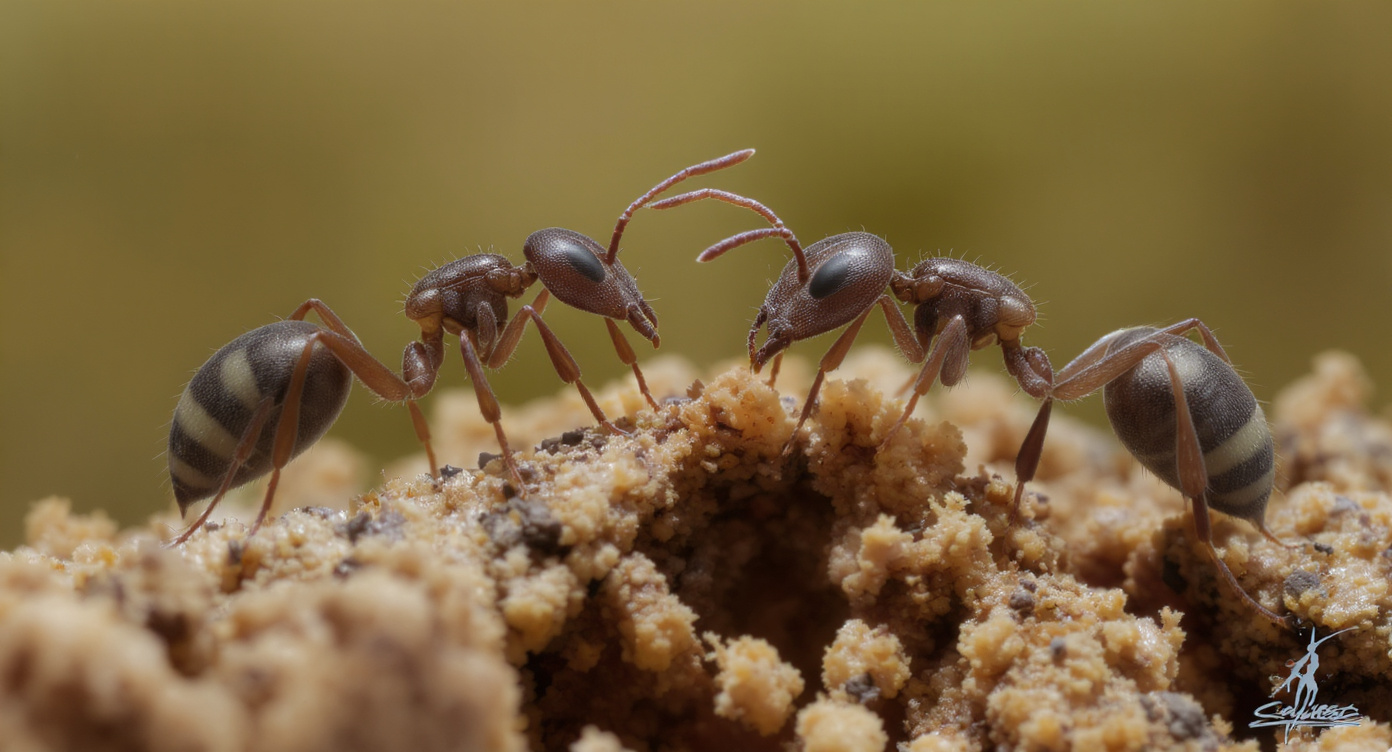
Queens of Iberian harvester ants have a remarkable ability: not only can they produce offspring of their own species, but they can also create males of another species through cloning. Once these “outsiders” appear, they become the fathers of all worker ants in the colony. This unusual reproductive and survival mechanism in ant colonies puzzled scientists for a long time, but now it has finally been unraveled.
An Unusual Discovery in Sicily
During an expedition to Sicily, a team of biologists led by Jonathan Romiguier from the University of Montpellier (France) studied Iberian harvester ants (Messor ibericus) and discovered something extraordinary: all the worker ants in the colonies—sterile females living from several weeks to several years—turned out to be hybrids. About half of their DNA matched that of the steppe harvester ant (Messor structor), a different species.
The researchers hypothesized that the worker females are born as a result of the Messor ibericus queen mating with Messor structor males. While interspecies hybridization is known among other ant species, the reasons for this phenomenon remain unclear. There are two main hypotheses: the first is the heterosis effect, where hybrid offspring are more viable; the second is a unique genetic issue in Messor ibericus, where mating with males of their own species only produces new queens, but not workers, putting the colony at risk of extinction. Interspecies hybridization may be an evolutionary mechanism that helps overcome this obstacle.
The Genetic Paradox and Its Solution
However, Messor ibericus colonies are also found in regions where Messor structor does not live, such as Sicily itself. Yet, researchers found strange, hairless males in the nests that resembled Messor structor. How is this possible?
Genetic analysis of the mitochondrial DNA of these males showed that it belonged to Messor ibericus, meaning their mother was a queen of this species. To test their hypothesis, scientists collected nearly 50 colonies and observed them in the laboratory for two years. As a result, they managed to obtain three hybrid males, confirming that a Messor ibericus queen can indeed produce males of both her own and another species.
The Cloning Mechanism
How does fertilization occur if there are no living representatives of the other species in the colonies? The only possible explanation is the cloning of “outsiders” from Messor structor sperm stored in a specialized organ of the queen—the spermatheca.
The queen’s egg contains her own genetic material. If the egg is not fertilized, it develops into a Messor ibericus male; if fertilized, it becomes a female (a future queen). Males of her own species arise exclusively from the mother’s genes, while females require the father’s contribution. This reproductive method is called haplodiploidy.
If the queen has previously mated with males of both species, her spermatheca stores two types of sperm: “native” (from Messor ibericus) and “foreign” (from Messor structor). To create a Messor structor male, the queen uses the “foreign” sperm, not for fertilization, but as a genetic container for cloning. Instead of fertilization, the genetic material of the egg is replaced by that of the sperm cell. The result is a clone of a Messor structor male, with only the mitochondrial DNA coming from the queen.
Evolutionary Significance and Symbiosis
This mechanism ensures the colony’s survival: the queen produces two types of reproductive males. Her daughter-queens mate with males of their own species to start new queens, while the army of workers is created using Messor structor clones. Their sperm gives rise to viable hybrid worker offspring and new clones for future generations.
In nature, there are cases where the sperm of a male from one species “tricks” the egg of a female from another species, forcing her to produce foreign offspring, but this parasitism only benefits the male. In Iberian harvester ants, the system is different: here, symbiosis is advantageous. Queens cannot survive without male clones to maintain the colony’s viability, and the clones, in turn, need the queen to reproduce themselves. Moreover, the hybrid workers feed and protect all members of the colony.
It is important to note that there is no evidence that Messor structor clones ever mate with females of their own species, meaning they do not return to “native” sexual reproduction. However, due to the lack of new genetic input, the clones accumulate dangerous mutations, making their lineage vulnerable in the long term. Nevertheless, for now, this mechanism works: Messor ibericus colonies are successfully spreading throughout the Mediterranean, even occupying regions where Messor structor was previously absent.
The results of the study have been published in the journal Nature.