

Lunar phases govern the lives of nocturnal birds.
The study revealed that the life cycle of red-necked nightjars is closely linked to the phases of the Moon: these birds are most active during the full moon, while during the new moon they enter a state of torpor to conserve energy. Lunar cycles also influence the migration and breeding patterns of these nocturnal birds.
Cursus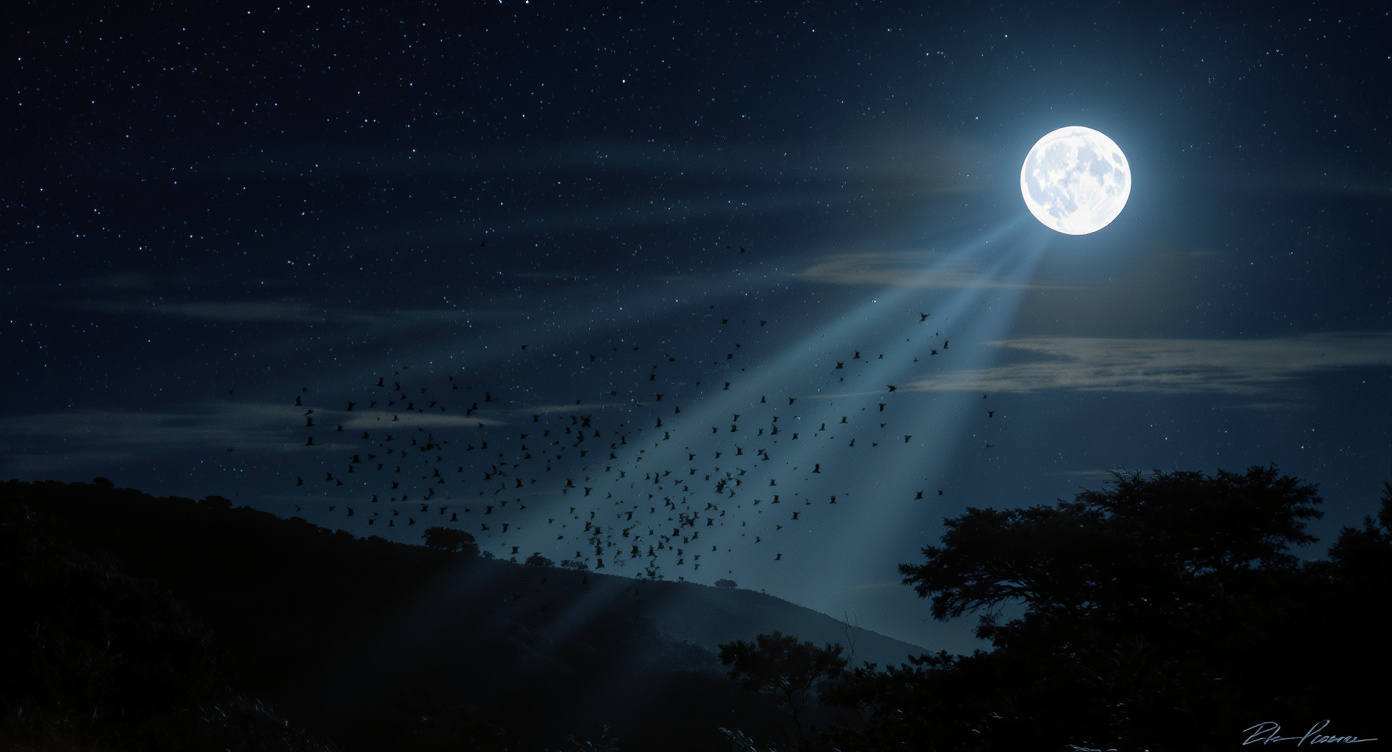
Swedish and Spanish biologists have discovered that the life cycle of red-necked nightjars is closely linked to the phases of the Moon. During the full moon, these nocturnal birds are at their most active, hunting and gaining weight, while on the dark nights of the new moon, they face energy shortages and enter a state of light torpor. Changes in illumination affect not only the birds’ daily metabolism but also the timing of their seasonal migrations and breeding.
The Influence of Lunar Phases on Behavior and Physiology
For a long time, it was assumed that moonlight influences the behavior of nocturnal animals, but observing this process in natural conditions proved challenging. Red-necked nightjars (Caprimulgus ruficollis) feed on flying insects, which they catch at dusk or by moonlight. Until recently, it was unclear how changes in illumination impact the birds’ energy balance and how they survive periods without the Moon, when visual hunting is impossible.
Over ten years, researchers observed nightjars in Doñana National Park in Spain. Miniature sensors weighing about two grams were attached to the backs of 74 adult birds. Accelerometers recorded flight periods, temperature sensors measured skin temperature, and built-in GPS modules tracked movement routes.
Additionally, the birds were captured at different times of day, weighed, and their abdomens palpated to assess the fullness of their muscular stomachs. This allowed scientists to accurately calculate the rate of food digestion and model daily energy expenditure and intake depending on the lunar phase.
Observation Results
The data showed that nightjars are most active in hunting and feeding during the full moon. On bright lunar nights, the birds fly almost continuously and accumulate fat reserves. The population’s mass peaks about six days after the full moon. On the dark nights of the new moon, the birds stop flying almost immediately after sunset.
To survive the hungry, moonless nights, nightjars have developed physiological adaptations. During the short periods of morning and evening twilight, the birds fill their elastic muscular stomachs with insects. In a single hunt, a nightjar can eat an amount of food equal to 13% of its body weight, not counting fat. Digesting this reserve takes about 6.5 hours. However, in winter, during their stay in Africa, nights can last up to 12 hours, and the calories obtained are not enough to last until dawn.
To get through this period, the bird enters a state of torpor—an energy-saving mode. About an hour after the moon sets, body temperature drops from the usual 38 to 35 degrees Celsius, and sometimes even below 30 degrees. This short-term torpor helps avoid exhaustion before the morning twilight begins.
The Connection Between Lunar Cycles and Life Events
Lunar cycles also synchronize larger events in the population’s life. The spring migration from Africa to Europe peaks on average 13 days after the full moon. Breeding is also tied to the lunar calendar: females lay eggs so that the chicks hatch with the next full moon, when food is easier to find. However, the timing of molting does not depend on moonlight.
The study showed that the Moon regulates the metabolism of nocturnal birds. To adapt to the nocturnal ecological niche, these animals have developed large digestive organs and the ability to directly control their body temperature.