

Jupiter and Saturn have gained new "invisible" moons
Astronomers have discovered new small moons orbiting Jupiter and Saturn using powerful telescopes. There are now 101 known moons around Jupiter and 285 around Saturn, and more discoveries are expected in the coming years.
Cursus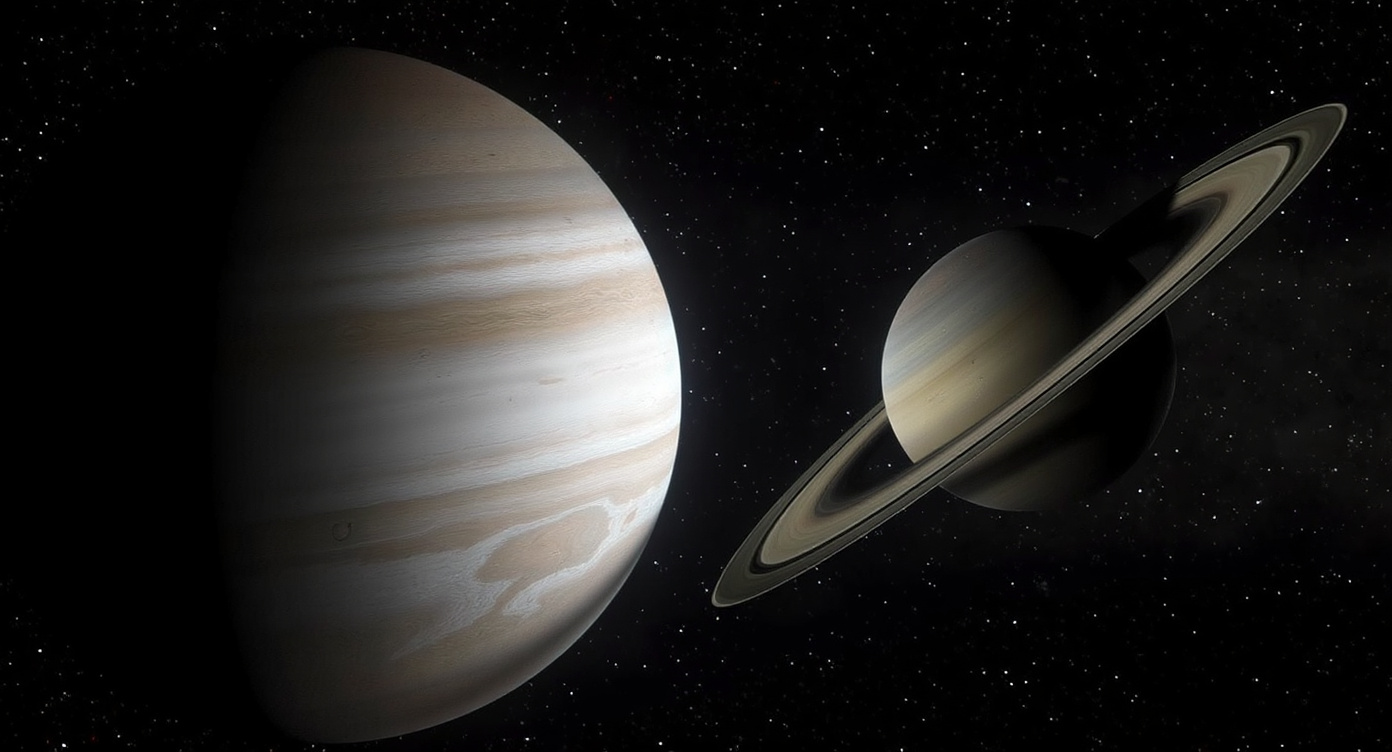
Astronomers using modern telescopes have discovered new moons orbiting Jupiter and Saturn. In the near future, upcoming space missions are expected to lead to the discovery of additional natural satellites around these gas giants.
Jupiter and Saturn are the largest planets in the Solar System, each surrounded by numerous moons. Recent observations have revealed four new moons around Jupiter and eleven around Saturn. These discoveries have been officially recorded by the Minor Planet Center.
The newly found objects are relatively small, with an average diameter of about 3 kilometers. They are characterized by very wide orbits and extremely low brightness, ranging from 25 to 27 in apparent magnitude. Because of this, it is impossible to observe them with amateur telescopes.
To detect these new moons, astronomers used powerful instruments such as the Magellan telescopes, the Canada-France-Hawaii Telescope (CFHT), and Subaru.
As a result, the total number of known moons of Jupiter has reached 101, while Saturn now has 285. These numbers may change in the coming years, as new spacecraft are heading to Jupiter and may make further discoveries.
It is also noted that moons can form quite rapidly, especially in chaotic environments where collisions between celestial bodies are frequent. Over time, under the influence of gravity, fragments can merge and settle into orbit around a planet.