

The mimic spider disguises itself as a victim of the zombie fungus.
Archaeologists have described a new species of spider that disguises itself as a victim infected by a parasitic fungus in order to avoid predators. This discovery broadens our understanding of mimicry in the animal kingdom.
Cursus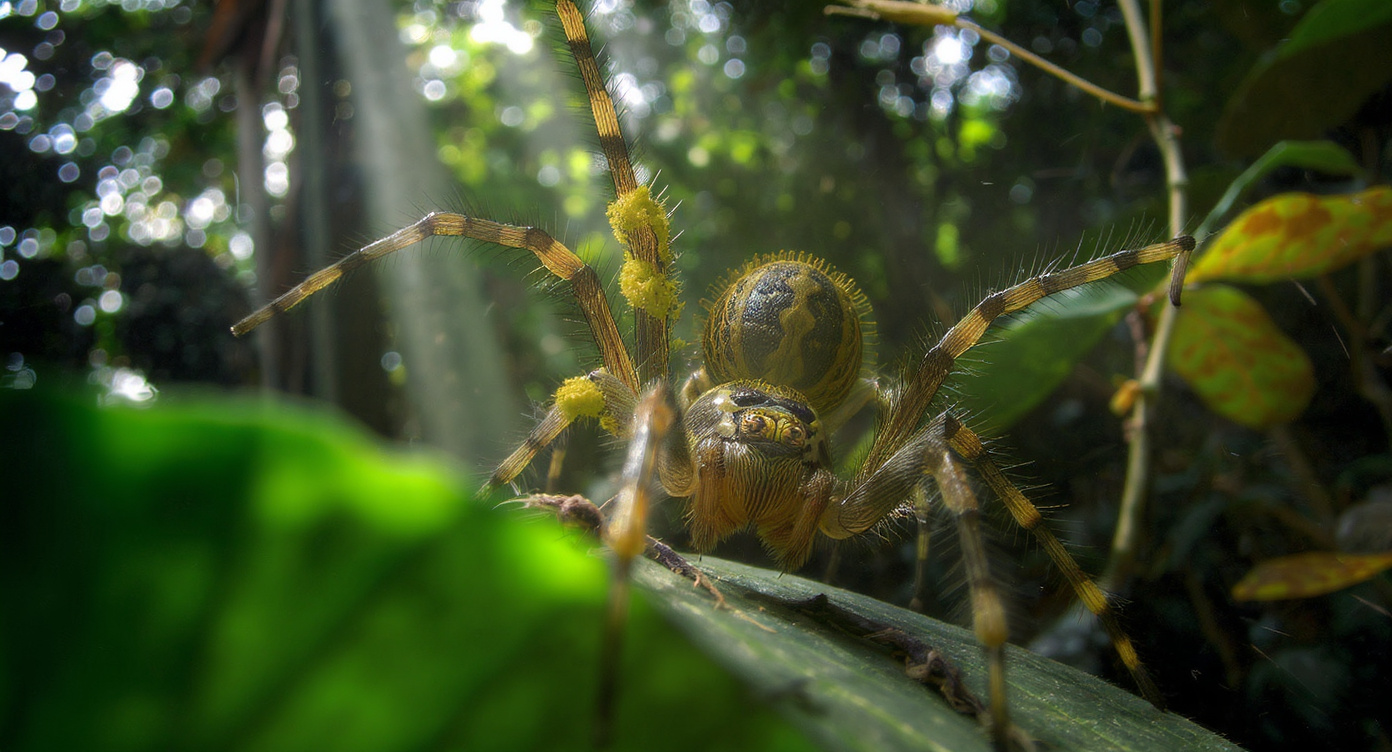
Archaeologists have described a new species of spider that mimics the appearance of dead individuals infected by parasitic fungi, in order to avoid attracting the attention of predators. In nature, such fungi infect their hosts, affect their nervous systems, and force them to climb to elevated spots, which helps spread the spores. This discovery broadens our understanding of mimicry in animals.
Life Cycle of Parasitic Fungi
Parasitic fungi of the genus Ophiocordyceps and their relatives, such as Gibellula, pose a threat to many insects and arachnids. Their life cycle begins when a spore lands on the host’s body, for example, a spider. The germinated spore forms a germ tube, which, using specialized structures, penetrates the exoskeleton and enters the body. The fungal cells then spread through the hemolymph—the fluid that serves as blood in arthropods.
After this, the fungus actively reproduces, influencing the spider’s physiology and behavior, likely through chemical effects on the nervous system. The infected host leaves its shelter and moves to an exposed, elevated location where conditions are favorable for spore dispersal.
Once the host dies, the fungus grows through the exoskeleton, including the initial entry points, and forms long spore-bearing structures from which spores are released.
Mimicry and the Discovery of a New Species
Because of this behavior, these fungi have earned the unofficial nickname “zombie fungi.” Ophiocordyceps became the inspiration for the parasitic fungus that controls its host in the video game and TV series “The Last of Us.”
In August 2025, during an expedition in the Ecuadorian Amazon, a specimen was found that outwardly resembled a victim of Ophiocordyceps: it had distinctive yellowish spore-bearing structures that looked like tentacles. However, when contact was attempted, the object moved, disproving the initial assumption of fungal infection.
A photograph of the find was posted on the iNaturalist platform to gather more information. Users suggested that it was a spider disguising itself as an infected creature.
Research and Description of the New Species
The specimen was given to a spider specialist from Ecuador’s National Institute of Biodiversity. Analysis showed that it belonged to the rare genus Taczanowskia, a previously unknown species that was named Taczanowskia waska. The spider was not infected by a parasite; instead, it simply copied the appearance of a dead, fungus-infected individual.
To study the mimicry mechanism, the spider was placed in a laboratory, where its behavior and anatomy were observed. Special outgrowths were found on its abdomen, imitating the spore-bearing structures of parasitic fungi—the same kind that appear after the host’s death and serve to spread spores.
Through evolution, the spider developed the ability to mimic the appearance of infected victims, helping it avoid attacks from predators that steer clear of infected creatures due to the risk of contamination.
Features of the Taczanowskia Genus
The researcher examined photos from other naturalists and found spiders with similar “fungal camouflage,” all belonging to the orb-weaver family (Araneidae), which are typically known for building webs. However, Taczanowskia waska is an exception: these spiders do not weave classic webs but hunt from ambush, catching prey in midair with their front legs.
Only eight species of the Taczanowskia genus are listed in the World Spider Catalog. The first representatives were discovered in 1879, and since then, individual specimens have been found rarely, so their behavior and ecological role remain poorly understood. Almost all found individuals are females; males are much smaller and usually do not reach a centimeter in length.
Significance of the Discovery
The new data help us better understand the role of spiders in the Amazon ecosystem and their interactions with other organisms, including parasites.
The scientific article was published in the journal Zootaxa.