

Granite beneath the Antarctic ice reveals secrets of the climate
Unusual granite boulders discovered atop mountains in West Antarctica have helped scientists uncover the structure of rocks hidden beneath the ice and trace the movement history of the Pine Island Glacier. This information improves predictions about changes to the ice sheet and sea level in the context of future climate change.
Cursus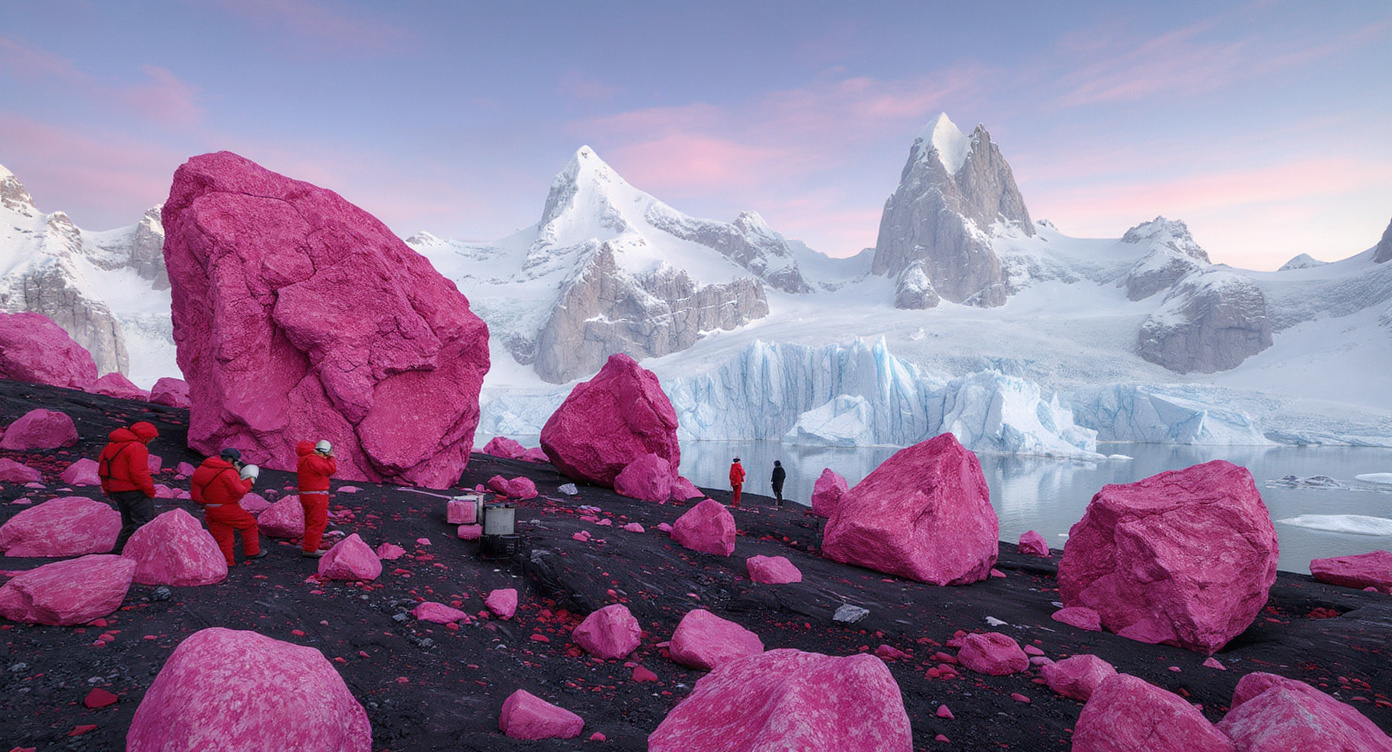
Bright pink granite boulders discovered on the dark volcanic peaks of the Hudson Mountains in West Antarctica have led to a significant scientific breakthrough. Beneath the Pine Island Glacier, researchers identified a massive granite formation stretching about 100 kilometers wide and 7 kilometers thick—roughly half the size of Wales in the United Kingdom.
For many years, the origin of these unusual rocks remained a mystery. Their presence atop high mountain ridges raised questions about how they got there and what they could reveal about Antarctica’s geological past and future.
The research team analyzed the granite by studying the radioactive decay of elements within mineral crystals. Their findings showed that the boulders formed around 175 million years ago, during the Jurassic period. However, even after determining their age, it was still unclear how these rocks ended up on the mountain peaks—until new data from aerial surveys of the region became available.
Using highly sensitive gravimetric measurements taken from aircraft, scientists detected an anomalous signal beneath the glacier. This data matched the characteristics of a massive granite body hidden under the ice. By linking the surface boulders to this deep underground structure, researchers were able to explain their origin. It turned out that the Pine Island Glacier once moved differently, lifting rocks from its base and transporting them up the slopes when the ice sheet was much thicker.
This discovery provided crucial insights into the glacier’s behavior after the last ice age, about 20,000 years ago. Understanding the former thickness of the ice and its movement patterns helps improve computer models used to predict how Antarctica’s ice sheets will respond to future climate changes.
The findings also highlight the influence of the geology beneath the Pine Island Glacier on current processes. In recent decades, this region has experienced one of the fastest rates of ice loss in Antarctica. The type of rock under the ice affects how the glacier slides and how meltwater flows beneath it. A more precise understanding of these processes will help refine models that estimate future sea level rise.
Granite boulders serve as important sources of information about the deep layers hidden beneath the ice sheet. By tracing their origin, scientists have been able to reconstruct the path that brought them to the surface, offering insights into possible changes in the West Antarctic Ice Sheet in the future—information essential for assessing the impact of rising sea levels on coastal regions worldwide.
This research demonstrates how combining geological and geophysical methods can reveal Antarctica’s hidden features and deepen our understanding of the processes that shape our planet.