

Mushrooms have learned to freeze water using proteins.
Scientists have deciphered the genetic mechanism that enables soil fungi to produce proteins which trigger the crystallization of water at mild subzero temperatures. These proteins, acquired by fungi from bacteria, could offer a safe alternative for weather modification, industrial freezing, and cryopreservation.
Cursus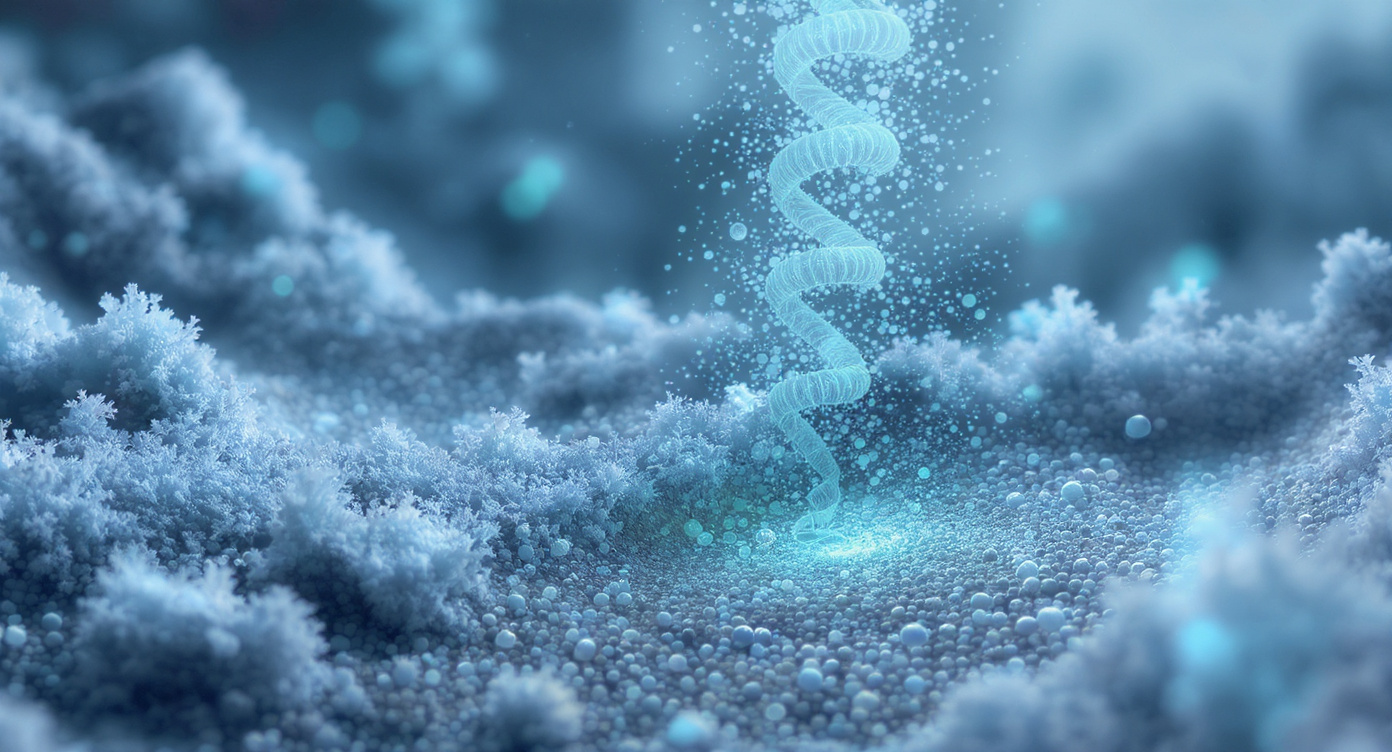
Proteins secreted by soil mycelium can bind water molecules and trigger crystallization at slightly subzero temperatures. These proteins function in aqueous environments without the need for lipid membranes found in living cells. Fungi acquired this ability from bacteria through horizontal gene transfer that occurred hundreds of thousands of years ago.
Mechanism of Ice Formation
Ice formation requires overcoming a significant energy barrier. Pure water freezes only at around -46 °C. In nature, this process is accelerated by biological catalysts. Some bacterial membrane proteins can initiate crystallization at just -2 °C.
Human Use of Biocatalysts
Similar biochemical mechanisms are used to create artificial snow and control weather conditions. During cloud seeding, atmospheric water crystallizes, becomes heavier, and falls as precipitation. Typically, toxic silver iodide is used for this purpose, since bacterial molecules are effective only on the surface of living cells and are unsuitable for use in clouds.
Research on Fungal Proteins
The ability of soil fungi to secrete extracellular antifreeze agents was discovered back in the 1990s, but only recently has the genetic code for this mechanism been fully deciphered in members of the Mortierellaceae family. Researchers sequenced the genomes of Mortierella alpina and a lichen isolate, Peltigera britannica, to identify regions responsible for assembling ice-nucleating proteins. Special attention was given to sequences encoding repeating motifs of the amino acids threonine, serine, and leucine.
Analysis revealed that these DNA fragments were copied from the bacterial InaZ gene. The guanine and cytosine content in the discovered gene was significantly higher than typical for fungal chromosomes, confirming direct acquisition of genetic material from bacteria.
Characteristics of the New Proteins
The new fungal gene encodes protein chains ranging from 606 to 990 amino acids in length, with a molecular mass of 64 to 100 kilodaltons. These catalysts are noticeably smaller than classic bacterial variants, which can reach 120 kilodaltons.
To test functionality, code fragments were transferred into E. coli and baker’s yeast. The genetically modified microorganisms were placed in liquid and gradually cooled. Half of the droplets containing the new yeast froze at -7 °C, while the modified E. coli initiated moisture crystallization at -15 °C. Pure liquid remained stable down to -23 °C.
Structure and Stability of the Proteins
Using the AlphaFold3 neural network, the three-dimensional structure of the new protein was determined. The molecular strand is coiled into a helix just over three nanometers wide, with a central section consisting of 42 identical turns. At the ends of the molecule are six sulfur atoms that act as strong chemical locks. This rigidity allows the protein to function directly in water without membrane support. In solution, the helices join side by side, forming a broad, flat surface for ice crystallization.
Extracting proteins from mycelium with water yielded a pure solution free of cell wall fragments or membrane vesicles. This solution initiated ice formation in droplets at temperatures from -5 to -7 °C. The proteins retained catalytic activity after heating and multiple freeze-thaw cycles.
Application Prospects
The discovered compounds provide science with a water-soluble tool for moisture condensation. Such a biochemical apparatus could be used to create safe chemical reagents for climate control, industrial food freezing, and cryopreservation.