

Social choice has explained the mystery of Neanderthal deserts
American geneticists have discovered that the absence of Neanderthal genes on the X chromosome in modern humans is not due to biological incompatibility, but rather to the mating preferences of ancient people. The study showed that Neanderthal men more often formed unions with Homo sapiens women, while hybrid men rarely left descendants, which influenced the genetic makeup of future generations.
Cursus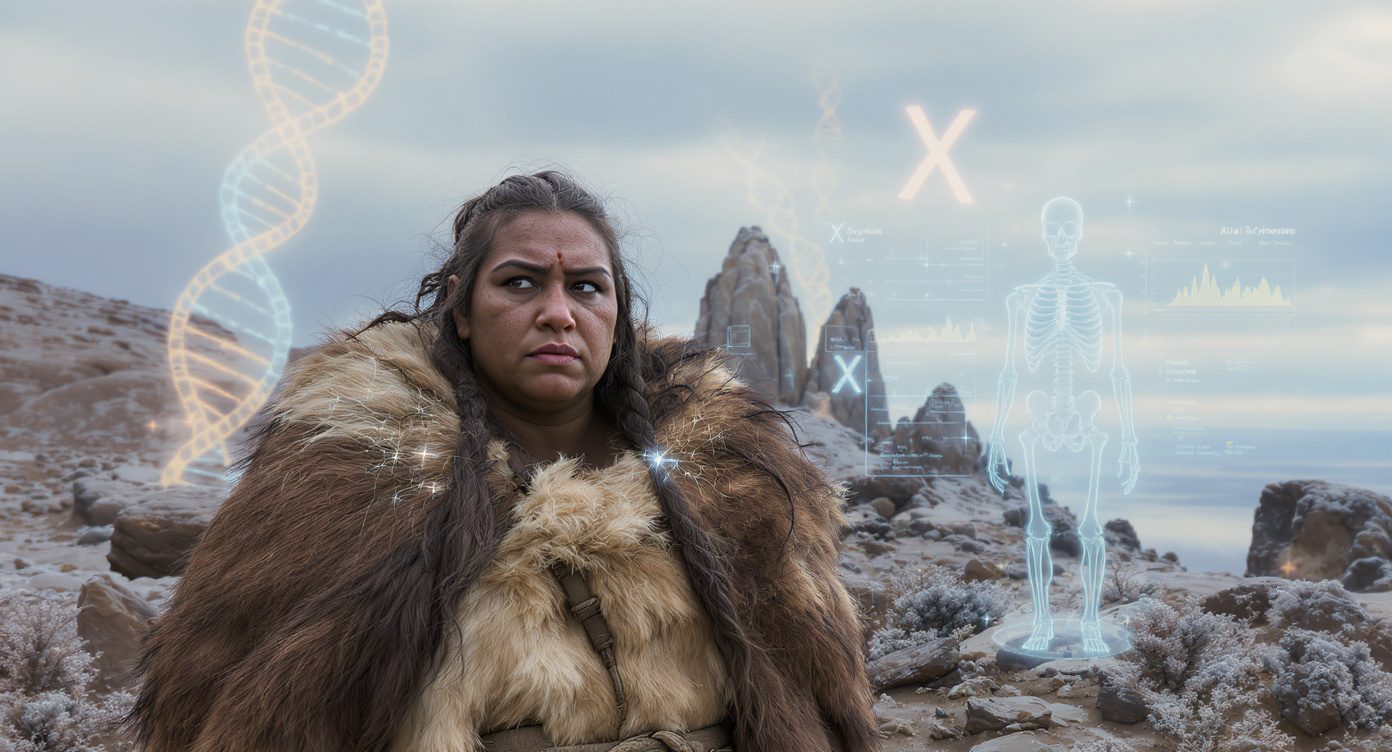
American geneticists have uncovered the reasons behind the emergence of so-called "Neanderthal deserts"—regions of the X chromosome in the human genome where there are no traces of interbreeding with Neanderthals. Research on ancient DNA has shown that this phenomenon is not due to natural selection or biological incompatibility between species, but rather to a pronounced bias in mate selection. Over many generations, Neanderthal men more often formed unions with Homo sapiens women, while hybrid men rarely left descendants.
Distribution Patterns of Neanderthal DNA
All modern humans of non-African descent carry traces of Neanderthal DNA in their genomes, distributed across the autosomes. However, Neanderthal genes are almost never found on the X chromosome. There are several possible explanations for this: perhaps evolution eliminated mixed X chromosomes due to harmful mutations, or hybrid offspring were infertile.
Analysis of Ancient DNA
As part of the study, researchers examined the genome of a Neanderthal woman from the Altai region who lived about 122,000 years ago. It is known that her ancestors interbred with early Homo sapiens, acquiring some of their genes. Scientists hypothesized that if selection always removes foreign DNA from the X chromosome, then the Neanderthal genome should also lack traces of sapiens genes on this chromosome.
By comparing the Neanderthal woman's genome with samples from 73 modern African women from isolated tribes whose ancestors never interacted with Neanderthals, the researchers determined the proportion of human DNA on the autosomes and X chromosomes of the ancient woman. They then ran computer simulations to explore which migration and interbreeding scenarios could have led to the observed results.
Modeling Results
The Neanderthal woman's X chromosome contained 1.62 times more sapiens DNA than her autosomes. Natural selection did not eliminate these sequences, allowing them to accumulate. Moreover, the Homo sapiens DNA segments were mainly located outside functional regions, ruling out their preservation due to evolutionary advantage.
Modeling showed that ordinary demographic processes could not create such a bias. Women pass on two X chromosomes to their children, while men pass on one. If only sapiens women had migrated to Neanderthals, the proportion of foreign DNA on the X chromosome could have increased, but the mathematical limit of this growth would be a ratio of 1.33 (or 4:3).
To explain the actual ratio of 1.62, the model introduced a strict social filter. It is suggested that men with predominantly Neanderthal features consistently chose pure or hybrid sapiens women as partners, while unions involving hybrid men were much less common. As a result, their reproductive success declined, and sapiens autosomes passed on by sons gradually disappeared from the gene pool, while sapiens X chromosomes became fixed in the Neanderthal population through the female line.
Conclusions
The researchers concluded that such a behavioral model explains the appearance of "Neanderthal deserts" in the genomes of modern humans. Since in later periods unions were also typically formed between Neanderthal men and sapiens women, Neanderthal X chromosomes always entered the modern human gene pool in smaller numbers. The reasons for these shifts remain unknown.
This work demonstrates that the composition of the human genome was shaped not only by biological laws but also by the complex social behaviors of ancient people, whose marriage traditions and preferences persisted for tens of thousands of years.