

Deep-sea fish have discovered a new way to develop vision
The study revealed that deep-sea fish larvae use unique hybrid cells for vision, combining the properties of both daytime and nighttime receptors. This discovery highlights the remarkable flexibility of evolution in adapting to life in darkness.
Cursus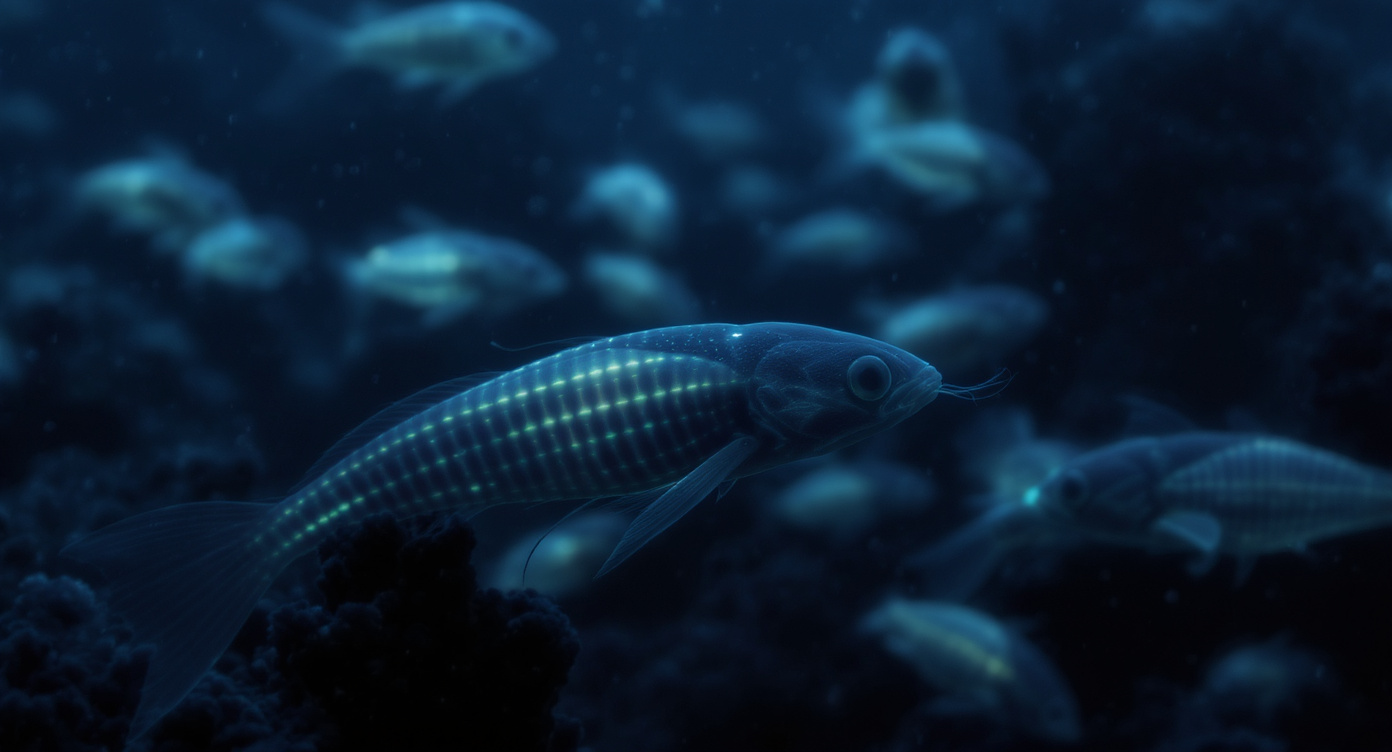
An international team of biologists has discovered that deep-sea fish defy the usual rules of vision development in vertebrates. Instead of waiting for fully formed “night” receptors to develop, their larvae use special hybrid cells: outwardly, these cells resemble rods, but structurally they are closer to cones.
How vision typically develops in vertebrates
It was previously believed that all vertebrates follow the same scenario in eye development: first, cones form, which are responsible for daytime and color vision, and then rods appear, which are necessary for black-and-white vision in low light. This order makes sense for land animals and fish living in shallow waters, where juveniles begin life in sunlight.
The challenge for deep-sea fish
For deep-sea fish, this scenario presents a paradox. Their larvae emerge in the mesopelagic zone—the twilight region of the ocean—where daytime cones are useless due to the lack of light, and rods have not yet developed. This raises the question: how do the young survive in darkness without suitable visual cells?
Studying hybrid photoreceptors
Scientists studied the development of three species of deep-sea fish: lightfish (Vinciguerria), pearlsides (Maurolicus), and lantern anchovies (Benthosema). Using electron microscopy, they examined the structure of retinal photoreceptors and applied transcriptomics to analyze the active genes and opsin proteins in these cells.
The analysis revealed a previously unknown cell type—“transmuted” photoreceptors. These biological chimeras combine features of both types of visual cells. In shape, they resemble rods, with a long cylindrical outer segment that increases the area for capturing light and allows them to detect rare photons in the dark. However, inside, they operate with genes and biochemical processes typical of daytime vision, notably synthesizing Rh2 opsin proteins, which are not found in ordinary rods.
The advantages of hybrid cells
This combination gives the larvae an advantage: they possess the high light sensitivity of rods and the ability to quickly recover after flashes of light, like cones.
Differences between species
The fate of these hybrid cells varies among species. In lightfish and anchovies, as they mature and descend to greater depths, the hybrid cells are replaced by true rods. In pearlsides (Maurolicus), however, these “fake rods” persist for life: their retina is made up of 99% cells that outwardly look like rods but are genetically cones.
The significance of the discovery
This discovery demonstrates the remarkable plasticity of evolutionary mechanisms. To adapt to the perpetual twilight of the ocean, nature did not have to reinvent the eye—instead, it made daytime receptors take on the form of night ones, ensuring the survival of larvae in near-total darkness.