

Ancient cave paintings are reshaping the history of human migration.
The oldest known cave paintings in the world, estimated to be around 68,000 years old, have been discovered on Muna Island. This finding changes our understanding of ancient human migration and capabilities in Southeast Asia.
Cursus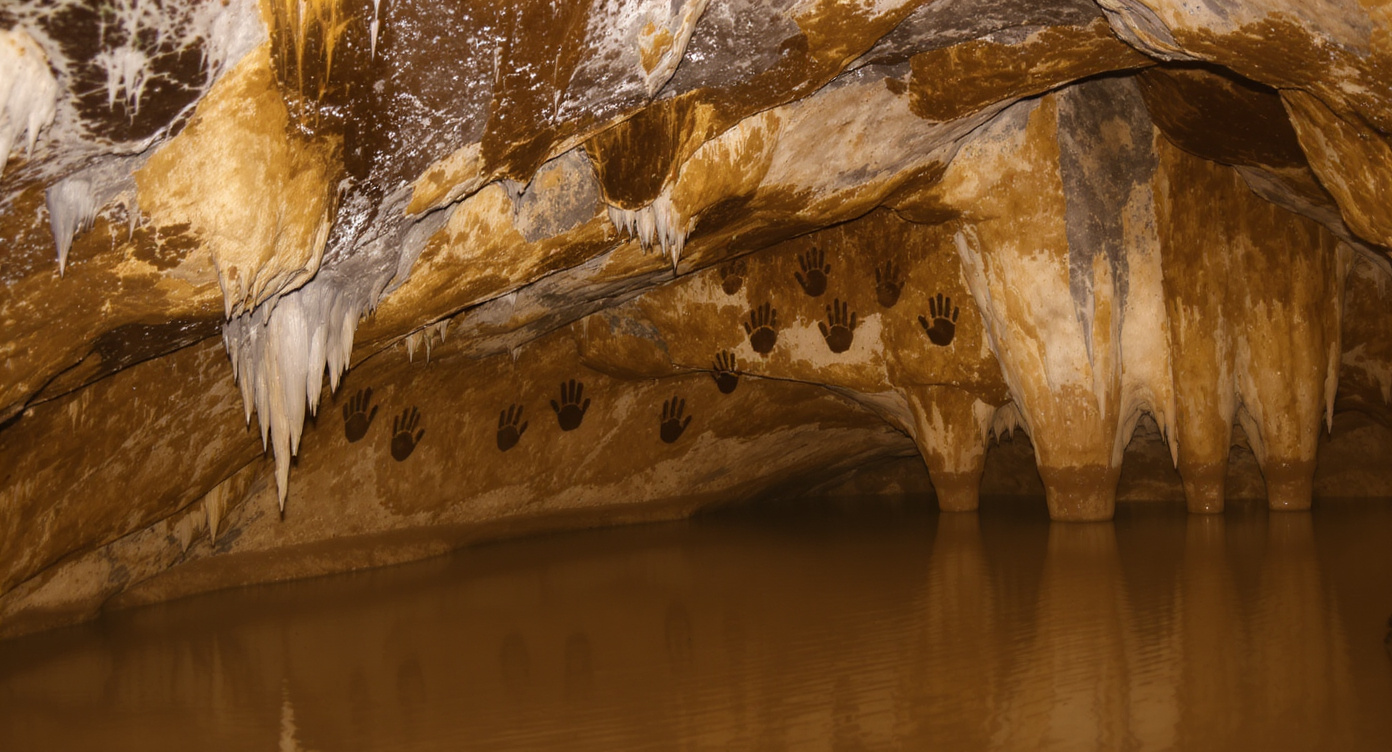
On an island near Sulawesi, traces of the first successful migrants who left Africa have been discovered. Several thousand years after this migration, these people were already creating cave paintings in locations that could only be reached by crossing open sea. These new findings are prompting anthropologists to reconsider what ancient humans were capable of.
Discovery of the Oldest Examples of Cave Art
An international team of researchers studied 44 caves in the southern part of Indonesia’s Sulawesi province, 14 of which had not previously been documented by science. In one of these caves, they found traces of paint applied around human hands. Despite the simplicity of these stencil images, they turned out to be the oldest known examples of cave art. The results of the study were published in the journal Nature.
Precise Dating and Its Significance
To determine the age of the images, scientists used highly accurate uranium-thorium dating methods on a layer of calcite carbonate that covered the paintings in the Liang Metanduno area on Muna Island (southeast of Sulawesi). The age of this layer was found to be 71,600 ± 3,800 years, which allows researchers to establish a minimum age for the paintings themselves—67,800 ± 3,800 years.
This date is 16,600 years older than the earliest previously known cave paintings in the region. Even the oldest European images are 1,100 years younger. Notably, the authorship of the European drawings is attributed to Neanderthals, although dating in archaeology often sparks debate.
Who Created the Ancient Paintings?
The researchers concluded that they had discovered the oldest known example of cave art. However, it is impossible to determine exactly which human species created these images. It is known that early human species inhabited the territory of modern Indonesia as far back as a million years ago. Nevertheless, the authorship of the paintings most likely belongs to members of our own species, as more archaic humans are considered incapable of creating such images—though similar doubts were once expressed about Neanderthals as well.
New Insights into Ancient Human Migrations
This discovery both clarifies and complicates our understanding of humanity’s past. Previously, anthropologists believed that after leaving Africa around 70,000 years ago, modern humans quickly reached Australia (about 65,000 ± 3,700 years ago). However, the exact route of their sea crossing remained unclear, as no traces of humans had been found between the continent and Australia with New Guinea (then part of the Sahul continent).
There were two main hypotheses: a southern route across the sea to Timor and then to Sahul, and a northern route through the Sulawesi region and nearby islands. Until now, there was no archaeological evidence supporting the northern route of colonization around 70,000 years ago. These new images are the first such evidence.
Flexibility and Capabilities of Ancient Humans
At the same time, this new finding complicates the picture: it cannot be ruled out that migrations occurred along both routes simultaneously. Our modern understanding of the flexibility and abilities of Paleolithic humans has changed significantly in recent years. It is known that people brought wild pigs to the Sunda Islands tens of thousands of years ago—long before the advent of agriculture—simply to have animals to hunt. Those who colonized Australia even exported wild kangaroos from there to islands hundreds of kilometers from the continent, likely for the same purpose of breeding them for hunting. People capable of transporting large mammals across open sea could certainly have crossed it by various routes.