

AI patch for controlling robots in any environment
Researchers have developed a portable controller powered by artificial intelligence that allows users to operate robots and devices using gestures, even in environments with vibrations and interference. This technology can be applied in industry, healthcare, and everyday life, providing precise remote control without the need for manual input.
Ingenium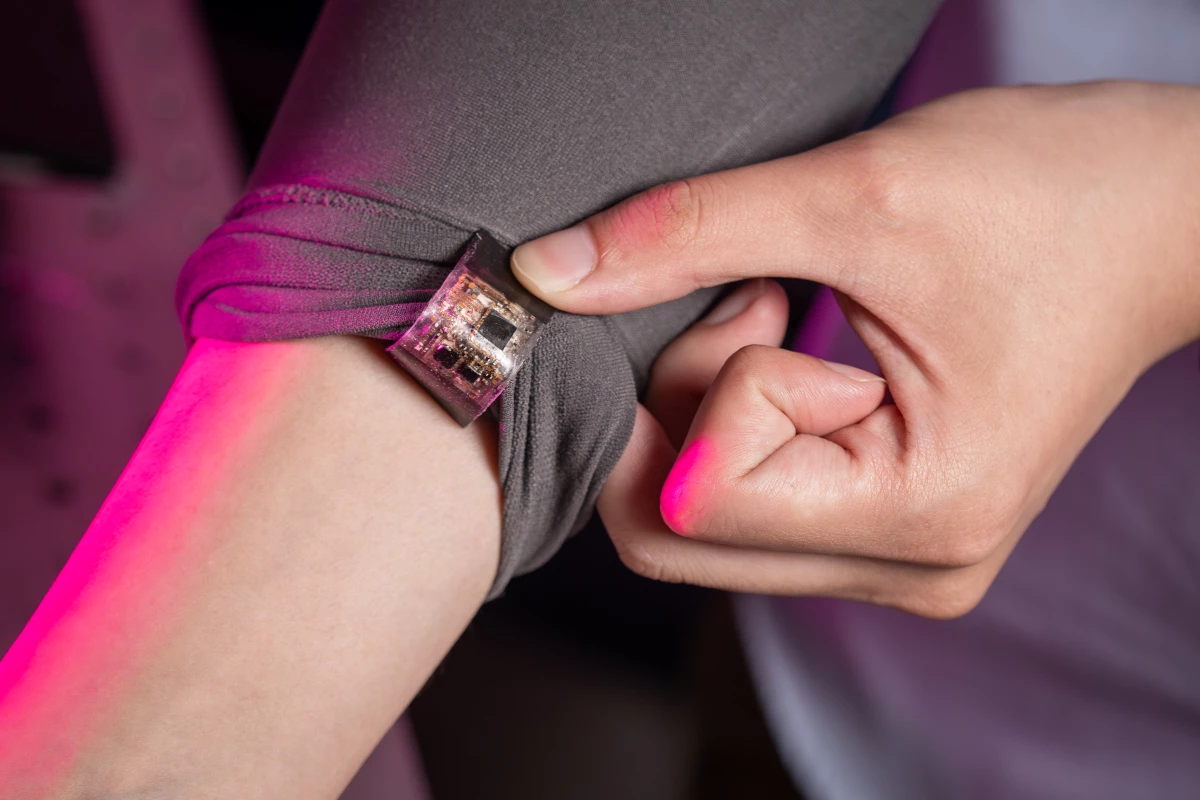
Imagine you're piloting a high-tech exoskeleton, like Tony Stark, using eye-tracking sensors in your helmet to control the suit. Suddenly, you're hit by an energy beam, and a powerful blow knocks you off course. In that moment, as your eyes spin like unbalanced gyroscopes, can you keep flying or will you lose control?
Researchers from the University of California, San Diego—Xianzhun Chen, Jiyuan Lou, Xiaoxian Gao, and Lu Yin—weren't aiming for such a sci-fi scenario when they worked on their article in Nature Sensors, "A Noise-Resistant Human–Machine Interface Based on Wearable Sensors with Deep Learning Support." Their goal was to create a reliable gesture-based remote control system that could function even amid the inevitable bumps, vibrations, and motor disruptions of real life.
Artificial Intelligence for Noise Filtering
Using artificial intelligence for "data cleaning," Chen, a research scientist at the Department of Chemical and Nanoengineering at the Jacobs School of Engineering, focused on removing noisy sensor data in real time. This allowed his team's device to reliably recognize common gestures and control machines even in highly dynamic environments.
From Military Applications to Wearable Tech
Initially, with support from the labs of Professors Sheng Xu and Joseph Wang, as well as the U.S. Defense Advanced Research Projects Agency (DARPA), Chen's team aimed to improve the control of underwater robots for military divers. However, over time, it became clear that robust control was also needed on land, especially for the rapidly growing field of wearable technology, where systems resistant to vibration were still lacking.
Next-Generation Technology
"This work introduces a new way to ensure noise resistance in wearable sensors," notes Chen. "It paves the way for next-generation wearable systems that are not only flexible and wireless, but also capable of learning in complex environments and adapting to individual users."
The electronic patch, which can be attached to a bandage or bracelet, combines motion and muscle activity sensors, a Bluetooth transmitter, and a stretchable battery. Artificial intelligence filters out noise caused by jolts and shaking, so even in turbulent conditions, control remains precise.
Testing in Real-World Conditions
Using a database of gestures collected in dynamic conditions on land and at sea, the device analyzes hand signals with its own deep learning platform. This helps eliminate false triggers and ensures instant control of mechanisms, including robotic arms. Test subjects operated the device while running, experiencing shaking, bumps, and high-frequency vibrations. Marine conditions were simulated using the Scripps Ocean-Atmosphere Research Simulator. In all cases, the system demonstrated high accuracy and low latency.
Application Prospects
If Chen and his colleagues' findings are confirmed, their device will become the first wearable gesture-based controller that effectively solves the problem of noise caused by turbulence. This makes such systems suitable not only for perfectly stable laboratory settings, but also for the real world, where people can't always—or don't want to—remain still.
In the future, the technology developed at the University of California, San Diego could help factory workers and emergency responders remotely control robots, vehicles, and tools hands-free—even at high speeds or in hazardous environments.
Beyond Emergency Situations
The device's applications go far beyond action movie scenarios and emergency situations. For example, patients undergoing rehabilitation or people with movement disorders could train the device's model using their natural gestures, even without fully restored fine motor control.
"This progress," says Chen, "brings us closer to intuitive and reliable human–machine interfaces that can be used in everyday life."