

Beavers and People: An Alliance to Save Ecosystems
Beavers play a crucial role in restoring ecosystems by helping to conserve water, lower temperatures, and prevent wildfires. Their engineering solutions inspire people to create similar structures that support biodiversity.
Natura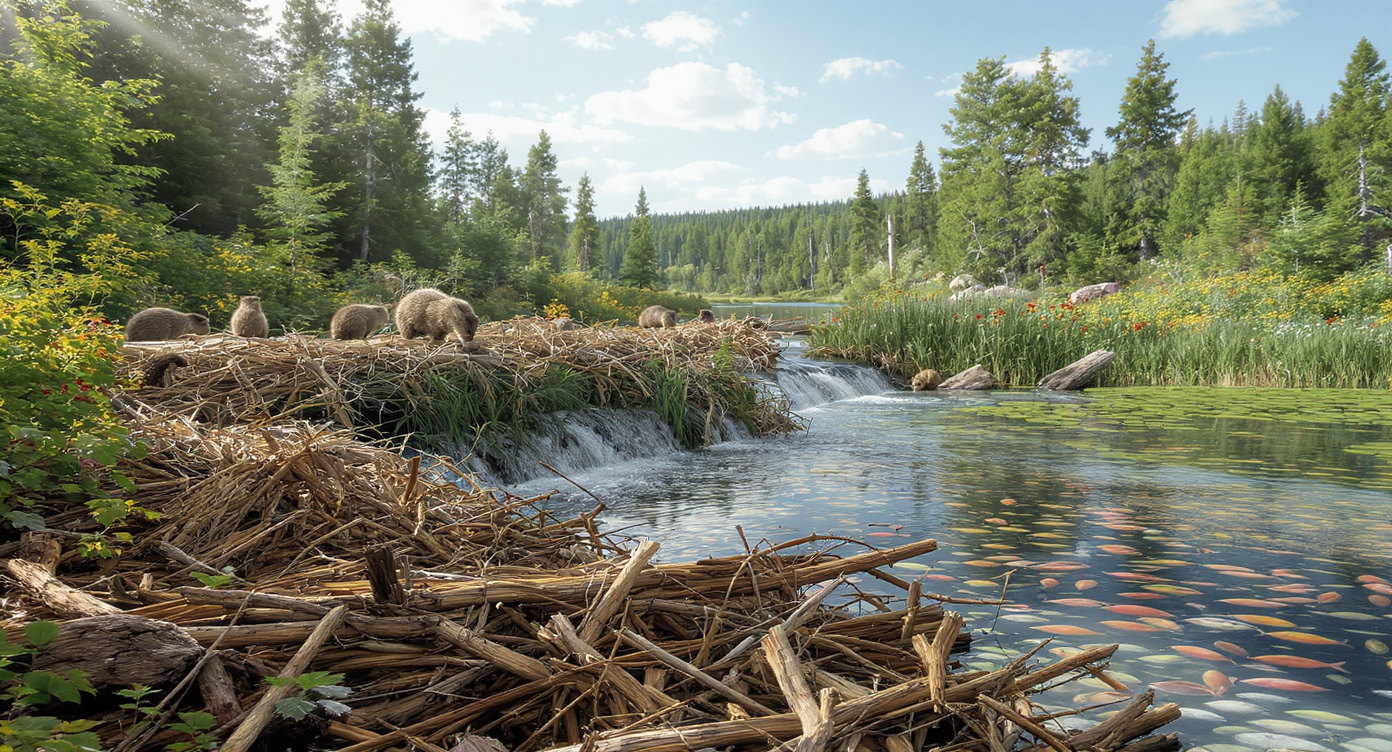
Descendants of giants, comparable in size to black bears and capable of carrying massive stones in their mouths, modern beavers (Castor canadensis) once numbered up to 400 million individuals in North America. Thanks to their strong, iron-rich orange incisors, which are nearly impervious to damage, beavers felled mighty trees and built semi-submerged eco-homes, the architectural blueprints for which are encoded in their DNA. However, due to extensive hunting for their fur, their population has declined by 97.5%.
For a long time, beavers were considered pests, but today they are increasingly seen as independent managers of the biosphere, capable of playing an irreplaceable role in combating the effects of climate change. Nevertheless, with a current population of about 10 million, beavers cannot build dams quickly enough to save the environment threatened by industrial activity. Perhaps humans should adopt some of the architectural solutions created by beavers?
Beaver Architecture: More Than Just Dams
A study published in the field of restoration ecology focused on the impact of beavers on the resilience of freshwater ecosystems to climate change in western North America. Lead author Jesse A.S. Burger and his colleagues from Washington State University analyzed 161 scientific papers on the potential restoration effects associated with beavers. They concluded that beaver dams not only store water in deep ponds but also perform much more important ecological functions.
Beaver structures help water bodies recover after climate shocks, lower water temperatures during hot months, improve connectivity between river floodplains, and help prevent the spread of wildfires. All of this contributes to increased biodiversity and brings significant benefits to the environment.
Human Analogs of Beaver Dams
Senior study author, Associate Professor at the School of Biological Sciences at Washington State University in Vancouver, John Piovia-Scott, notes that efforts are now underway to create beaver dam analogs (BDAs)—structures made from willow and other plants. This practice is becoming increasingly common in the Pacific Northwest of the United States. Thanks to the installation of numerous BDAs along Bridge Creek, a tributary of the John Day River in Oregon, ecologists have managed to increase the populations of various fish species, including the endangered steelhead trout.
Piovia-Scott emphasizes that the scale of this practice is outpacing scientific research on the topic. Scientists still need to bridge the gap between potential benefits and real-world results, as well as determine whether local successes can be replicated in other ecosystems. He notes, “It’s not at all clear whether these advantages will manifest in other systems.”
Partnership with Local Communities
One of Piovia-Scott’s goals is to build partnerships with Indigenous peoples and nonprofit organizations seeking to restore beaver populations, especially if they lack the resources to conduct their own scientific research. He shares this mission with co-author Burger, who also leads a wildlife program for the Cowlitz Indian Tribe.
Working with many people involved in restoring beaver populations and habitats, Piovia-Scott observes, “They often have much more practical knowledge on many issues than I do as a researcher.” However, he acknowledges that despite their high level of expertise, such organizations rarely have the funding for large-scale scientific projects. As a result, there is a vast amount of knowledge about restoration practices that can be gained through these partnerships.