

Ancient plants attracted insects with warm signals.
Long before the appearance of bright colors and fragrances, plants attracted insects using heat signals. A new study has shown that ancient cycads used infrared radiation to communicate with their pollinators.
Cursus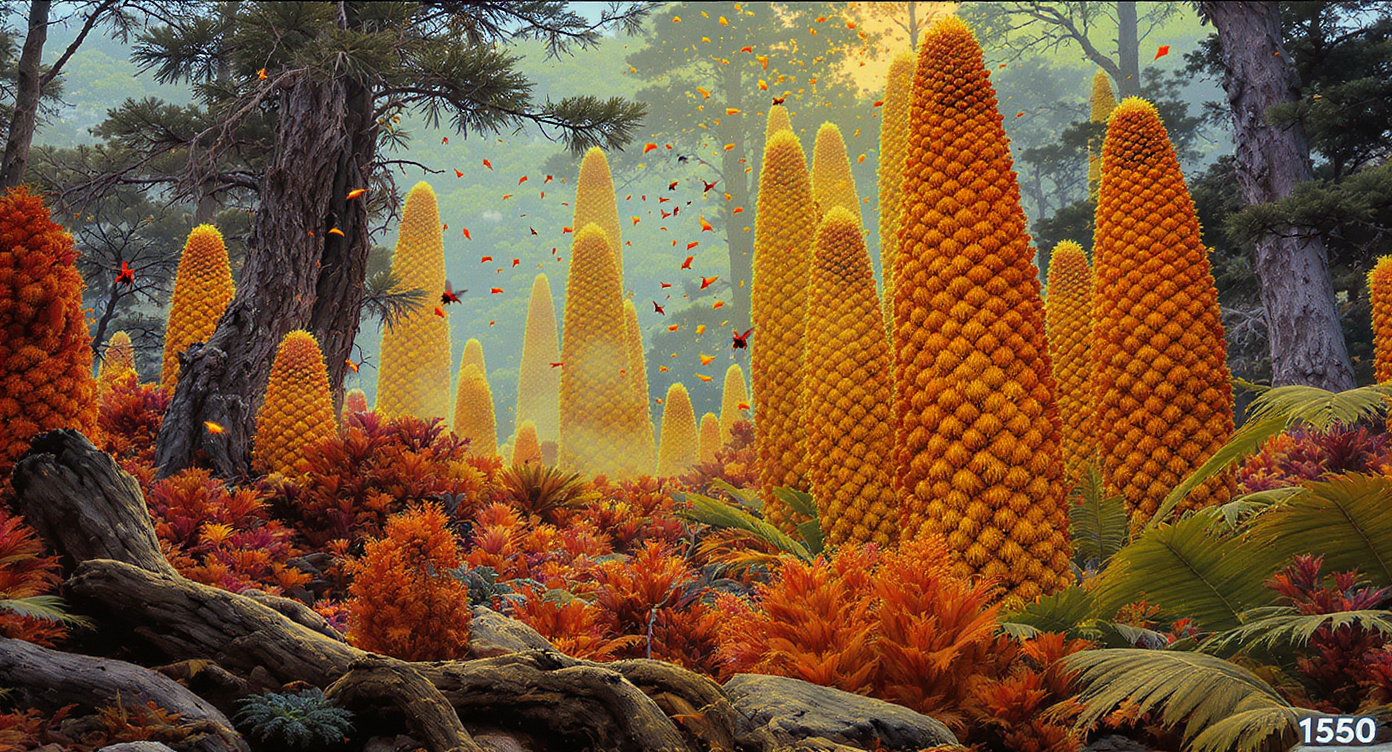
An international team of biologists has discovered that long before plants began attracting pollinators with bright colors and fragrances, they used “invisible light”—thermal radiation. The study of ancient cycads and beetles has provided evidence for the existence of a communication channel based on infrared signals, which dominated during the Mesozoic era.
Ancient Cycads and Their Pollinators
Cycads (Cycadales) are among the oldest groups of seed plants, and have been pollinated by beetles for about 200 million years, dating back to the time of the dinosaurs. It is known that their reproductive organs (cones) are capable of heating up. Previously, it was believed that this heating was necessary to evaporate scents that attract pollinators or to protect against cold. However, the authors of a new study published in the journal Science have suggested that the heat itself acts as a kind of navigational beacon for insects.
Experiments with Thermal Signals
Scientists conducted a series of experiments with Zamia cycads and their pollinators—Rhopalotria furfuracea weevils. Thermal imaging revealed that the cones heat up according to a strict circadian rhythm: during the day, the temperature rises in male plants, and towards evening—in female plants. The plants function like biological furnaces, burning starch in their mitochondria to raise their temperature by more than 10 °C above the surrounding environment.
To prove that the beetles are attracted specifically to heat, the researchers created 3D models of the cones. In experiments that excluded the influence of scent and tactile sensations, the insects consistently chose the heated models, ignoring the cold ones. Moreover, the beetles moved from cooling “male” models to warming “female” ones, which in nature ensures the transfer of pollen.
Molecular Mechanisms of Heat Perception
An anatomical analysis of the insects revealed specialized sensors in their antennae. Molecular biologists found that the beetles possess the TRPA1 gene, which encodes a thermoreceptor protein. Interestingly, a similar mechanism is used by mosquitoes and pit vipers to locate warm-blooded prey. Blocking this receptor rendered the beetles “blind” to the thermal signals from the plants.
The Evolution of Communication Methods
Researchers believe that during the age of dinosaurs, infrared communication was the primary means of interaction between plants and insects. However, about 50–100 million years ago, a global shift in strategies occurred. In the Cretaceous period, flowering plants and their pollinators (bees, butterflies) emerged and evolved, possessing excellent color vision. Producing colorful pigments turned out to be more energy-efficient than constant heating, so “thermal beacons” gave way to the vibrant diversity of flowers we see today.