

How light nuclei survive during particle collisions
Physicists have discovered that light atomic nuclei are formed not at the center of particle collisions, but in a cooler region, which allows them to survive under extreme temperatures. This finding helps to better understand processes in space and the development of theoretical models.
Cursus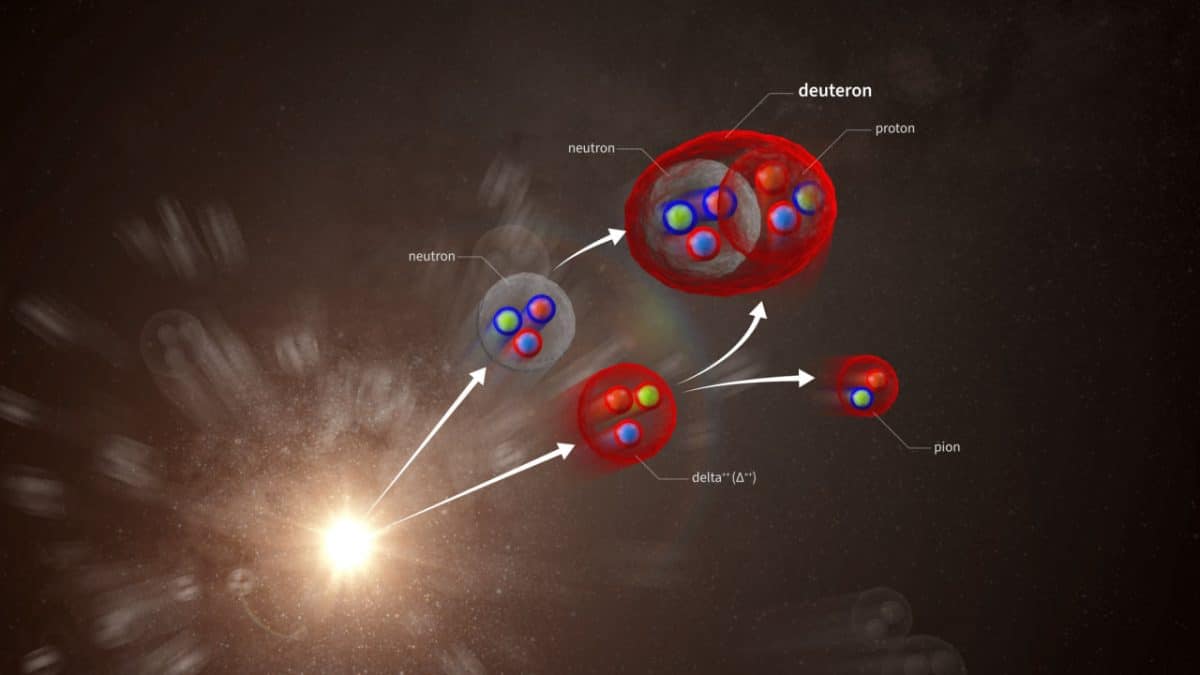
For a long time, physicists could not understand why light atomic nuclei do not break apart under the extreme temperatures generated during particle collisions. Recent research has revealed that these nuclei are not formed at the very center of the collision, but rather in a cooler region, which allows them to survive.
Extreme Conditions at the Large Hadron Collider
During experiments at the Large Hadron Collider (LHC), temperatures are reached that are a hundred thousand times higher than those at the core of the Sun. One would expect such conditions to destroy the bonds within atomic nuclei. However, light nuclei and their antimatter counterparts emerge from the collision zone intact, a phenomenon that puzzled scientists for years.
Discovery of the Mechanism Behind Light Nuclei Formation
The ALICE collaboration conducted a detailed study of the processes involving light nuclei using experimental data. The results were published in the journal Nature.
Researchers examined deuterons (nuclei made of a proton and a neutron) and antideuterons (composed of an antiproton and an antineutron), which are produced in high-energy proton collisions at the LHC. Analysis showed that nearly 90% of deuterons and antideuterons are not formed directly at the moment of collision, but rather as a result of subsequent nuclear synthesis from particles created during the collision. One of the particles involved in deuteron formation arises from the decay of a short-lived particle.
The Role of Short-Lived Particles
The scientists measured the momenta of deuterons and pions—particles consisting of a quark-antiquark pair. They discovered a correlation between the momenta of these particles, indicating a common origin in the decay of a short-lived particle known as the delta resonance (Δ-resonance). This particle decays within a trillionth of a trillionth of a second into a pion and a nucleon (proton or neutron). The nucleon can then combine with other nucleons to form light nuclei such as deuterons.
Formation of Nuclei in a Cooler Environment
Nuclear synthesis occurs a short distance from the collision point, in a cooler environment. This significantly increases the chances of survival for the newly formed nuclei. This mechanism is observed for both particles and antiparticles. Physicists concluded that the same process governs the formation of both deuterons and antideuterons.
Scientific Significance of the Discovery
According to ALICE experiment representative Marco van Leeuwen, these results mark an important milestone in the field. They fill a gap in our understanding of how nuclei form from quarks and gluons, and provide valuable material for the development of new theoretical models in physics.
Impact on Astrophysics and Cosmology
This discovery could have major implications for astrophysics and cosmology. Light nuclei and antinuclei are produced when cosmic rays interact with the interstellar medium, and may also arise in processes related to dark matter. The new experimental data from ALICE provide a solid foundation for modeling the formation of light nuclei in space. This will help scientists interpret cosmic radiation data more accurately and search for traces of dark matter.