

Oxygen played a key role in the evolution of life.
A new study of ancient rocks in Northern Australia has revealed that even the earliest eukaryotes depended on oxygen. This evidence confirms the crucial role of oxygen in the evolution of complex life on Earth.
Cursus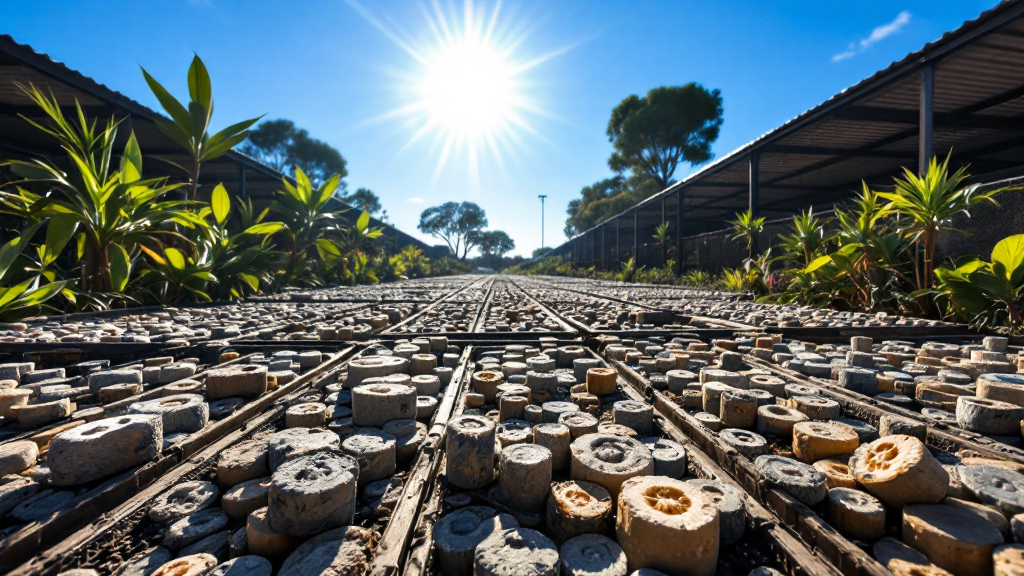
In an open storage facility under the sky in Darwin, Australia, dozens of trays hold cylindrical rock cores. These samples were extracted from boreholes drilled by mining companies hundreds of meters deep many years ago.
Some of these cores, now held by the Northern Territory Geological Survey, are argillites—a type of sedimentary rock formed from hardened marine mud. The companies that drilled these cores were mostly unaware that within these argillites lay fossils of microscopic organisms, buried on the seafloor of an ancient inland sea that covered much of northern Australia over 1.5 billion years ago. A recent study published in Nature revealed that these fossils are crucial for understanding a major evolutionary leap: the emergence of complex life on Earth—the rise of eukaryotes.
Two Types of Life on Earth
All life on our planet falls into two main types, distinguished at the cellular level. Prokaryotes (bacteria and archaea) have a simple cell structure and are mostly single-celled. Eukaryotes, which include animals, plants, algae, and fungi, have a more complex cellular organization, featuring a nucleus and specialized organelles.
The appearance of eukaryotic organisms marked a pivotal moment in Earth’s history, leading to the evolution of animals and, ultimately, humans. Genomic analysis of modern organisms has shown that the last common ancestor of all living eukaryotes arose from a symbiotic union of at least two prokaryotic microbes: an archaeon and a bacterium.
The Oldest Eukaryote Fossils
The earliest evidence of eukaryotic life comes from fossils of single-celled organisms with a level of cellular complexity characteristic of eukaryotes. Such fossils have been found in rocks at least 1.5 billion years old across the globe. Samples from Australia’s Northern Territory, dated to 1.75 billion years ago, are currently considered the oldest known eukaryote fossils.
However, the ancient world in which early eukaryotes evolved remains poorly understood, and many fundamental aspects of their nature are still unknown.
The Role of Oxygen in Eukaryote Evolution
Many types of bacteria can survive without oxygen, but nearly all modern eukaryotes rely on oxygen for life. Aerobic respiration provides the energy needed for complex life. In recent years, evidence has emerged challenging the assumption that oxygen was always essential for all eukaryotes. This is due to the discovery of eukaryotes capable of living in oxygen-free environments, as well as geological data indicating low oxygen levels in ancient seas during the emergence of eukaryotes.
These findings raise questions about whether eukaryotes were truly dependent on oxygen from the very beginning.
Studying Ancient Argillites
In a recent study, researchers crushed and dissolved argillite core samples from Darwin. After processing, more than 12,000 fossils were identified under the microscope. The argillites themselves were also analyzed to determine the environmental conditions in which the rocks formed. Chemical analysis helped establish whether oxygen was present in the ancient seawater.
The results showed that eukaryote fossils are found only in samples formed under oxygen-rich conditions, while only simple prokaryotic forms were discovered in oxygen-poor environments. This indicates that even the oldest known eukaryotes, which lived 1.7–1.4 billion years ago, depended on oxygen. These findings support the hypothesis that oxygen played a key role in the evolution of early eukaryotes.
Significance for Science
Understanding the factors and conditions that led to the emergence of early eukaryotes remains one of the main unsolved challenges in biological sciences. Further research into ancient microscopic fossils may provide new insights into the origins of complex life on Earth.