

A female humpback whale showed care for her dead calf.
Australian biologists have, for the first time, closely documented a female humpback whale staying near her stillborn calf, repeatedly returning to it. This is the first recorded case of post-mortem attention in humpback whales.
Cursus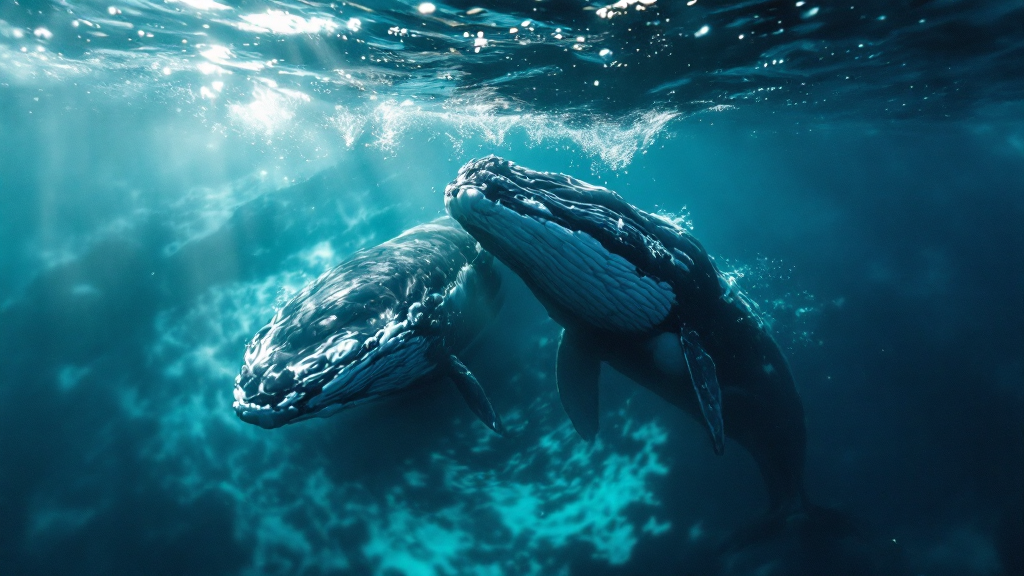
Marine biologists have, for the first time, thoroughly documented the behavior of a female humpback whale that stayed near her stillborn calf, repeatedly touching it and returning to the spot where its body lay. This observation is considered the first recorded case of post-mortem attention in humpback whales.
Reactions of Cetaceans to the Death of Their Kin
The reactions of cetaceans to the loss of group members have long attracted scientific interest. Such behavior is especially well-documented among toothed whales, like dolphins and orcas. These animals may remain near deceased companions for extended periods, touch them, nudge them, keep the body afloat, or even move it over some distance. This behavior is known as post-mortem attention—a form of social interaction in which an animal continues to engage with a deceased individual. It is believed this may be linked to strong social or maternal bonds, though current observations make it difficult to determine whether it is associated with the experience of grief.
Behavioral Features of Baleen Whales
Most documented cases of such behavior involve toothed whales. Among baleen whales, which include humpbacks, similar reactions are observed much less frequently. This may be due to differences in behavior or because the bodies of deceased newborn baleen whale calves quickly sink, making it harder to observe the mother's response.
Description of the Observation
Australian marine biologists have described the first case of post-mortem attention in humpback whales (Megaptera novaeangliae). They observed a female remaining near her stillborn calf for some time, repeatedly touching it. The behavior was compared to how other mammals react to the loss of offspring.
In 2025, about a kilometer off the coast of Gold Coast in Queensland, two adult humpback whales were seen swimming together and diving periodically. After 30 minutes, traces of amniotic membrane appeared on the water’s surface, indicating a recent birth. Using an underwater camera, researchers discovered the body of a calf less than four meters long lying lifeless on the sandy seabed. The female approached it several times, touching it with her head and pectoral fin, then surfaced before returning to the bottom.
What made this case unique was that the female did not attempt to bring the calf to the surface, although humpback mothers typically support their newborns at the surface to help them take their first breaths. Researchers suggested that the mother may have recognized the absence of response from the calf, but this remains a hypothesis.
The Role of the Accompanying Whale
Alongside the female was a second adult humpback whale, which did not interact with the calf but stayed nearby, slowly circling the site of the calf’s death with the mother. During migration and birthing periods, another adult whale is sometimes seen near a female humpback, possibly providing social support or protection, but the exact role of this animal in the described case remains unclear.
Additional Observations
During the observation, whale vocalizations were recorded, but it was not possible to determine whether the sounds came from the female, the accompanying whale, or both.
Over the next two days, the two adult humpbacks were seen again in the same area, where they remained for several hours. Researchers believe these may have been the same individuals, suggesting a continued attachment to the site after the calf’s death. However, individual identification was not possible, so this cannot be confirmed with certainty.
Scientific Assessment
Researchers note that human concepts of emotion and grief cannot be directly applied to animals without additional evidence. Biologists can only describe the female’s actions: she did not leave the birthing site, repeatedly returned to the dead calf, and made physical contact with it. However, it is impossible to determine the animal’s internal state based on these behaviors alone.
The scientific article describing this observation was published in the journal Discover Animals.