

Possible traces of dark matter particles detected
A new study has detected gamma radiation from the center of the Galaxy, which may be linked to the decay of dark matter particles. If this discovery is confirmed, it could transform our understanding of the Universe.
Cursus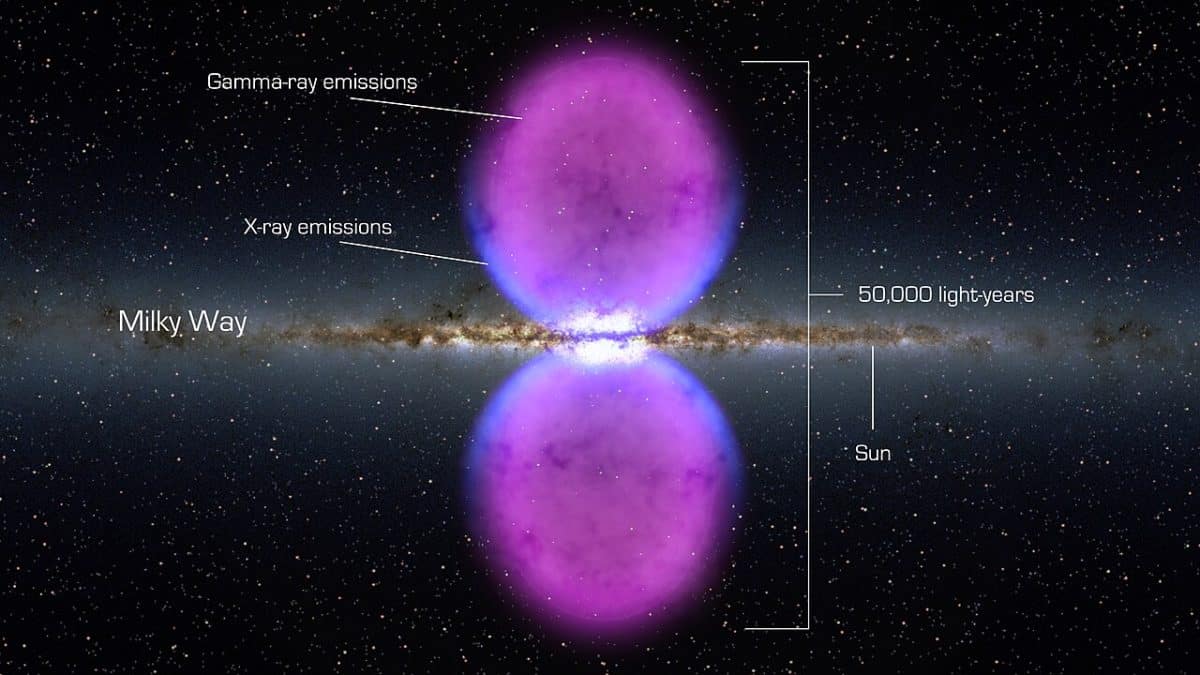
The gamma radiation detected by the Fermi gamma telescope, according to the researcher, can only be explained by the decay of WIMPs—particles of dark matter whose very existence has already been questioned by many physicists. If independent verifications confirm this discovery, it could fundamentally change our understanding of the Universe.
The WIMP Theory Crisis
Until the 2020s, the most widely accepted hypothesis explaining the observed structure of the Universe was the existence of weakly interacting massive particles—WIMPs—as dark matter. Proponents of this theory believed that such particles interact with ordinary matter only through gravity and do not participate in other interactions. However, by the late 2010s, this concept began to face increasing skepticism.
Billions have been spent searching for traces of WIMPs using various detectors, but these efforts have yielded no results. Observations of galactic cluster collisions have also failed to reveal any influence of these particles on the velocities of galaxies. Even if WIMPs do not interact with ordinary matter, they should still collide with each other, yet no such traces have been found, casting doubt on the very existence of WIMPs.
New Study: Possible Detection of Dark Matter Traces
Tomonori Totani from the University of Tokyo published a paper in the Journal of Cosmology and Astroparticle Physics, claiming to have found evidence of WIMP decay. According to him, this could be the first "direct" proof of dark matter's existence.
According to prevailing views in the 2010s, WIMPs and dark matter in general should be concentrated in the centers of galaxies. When such particles annihilate, gamma photons should be produced. Totani analyzed gamma radiation data from the central region of our Galaxy and discovered a statistically significant peak around 20 gigaelectronvolts.
The radiation corresponds to a spherically symmetric halo around the center of the Galaxy. The researcher accounted for possible systematic uncertainties, but even with these considered, the peak near 20 GeV remains.
Signal Characteristics and Possible Explanations
The energies of the gamma photons correspond to the annihilation of particles with a mass approximately 500–800 times greater than that of a proton, and the product of the WIMP annihilation cross-section and the process rate is estimated at 5–8×10⁻²⁵ cm³/s. Totani notes that this value is higher than previous limits set by other groups, but considers such a result plausible given the uncertainties in the initial data.
"If all this is correct, then, as far as I know, this is the first time humanity has 'seen' dark matter. And it would mean that it consists of new particles not included in the standard model of particle physics, which would be a significant breakthrough for both astronomy and physics," the astronomer believes.
The main argument of the researcher is that other known astrophysical sources of gamma radiation should not produce a peak at 20 gigaelectronvolts. However, high-energy radiation sources in galaxies are still not well understood, and new discoveries in this area could challenge his conclusions. Moreover, WIMPs with a mass of 500–800 protons have not yet been detected in terrestrial accelerators, despite significant investments in their search.
Alternative Hypotheses and Scientific Skepticism
In recent years, more and more astrophysicists and cosmologists have begun to doubt not only the existence of WIMPs, but also whether dark matter consists of particles at all. An alternative hypothesis—that dark matter is made up of compact spherical clusters of black holes—has been gaining popularity in the 2020s.
Image: Map of gamma radiation intensity toward the center of the Galaxy, excluding everything except the presumed dark matter halo (in particular, the gray band where the galactic disk plane is located). © Tomonori Totani, University of Tokyo