

Magnetic fields have unveiled the mystery behind the birth of black holes
A new study has shown that magnetic fields play a crucial role in the formation of black holes with unusual masses and spin rates, helping to explain the mysterious observations made in 2023. This mechanism opens up new possibilities for studying extreme objects in the Universe.
Cursus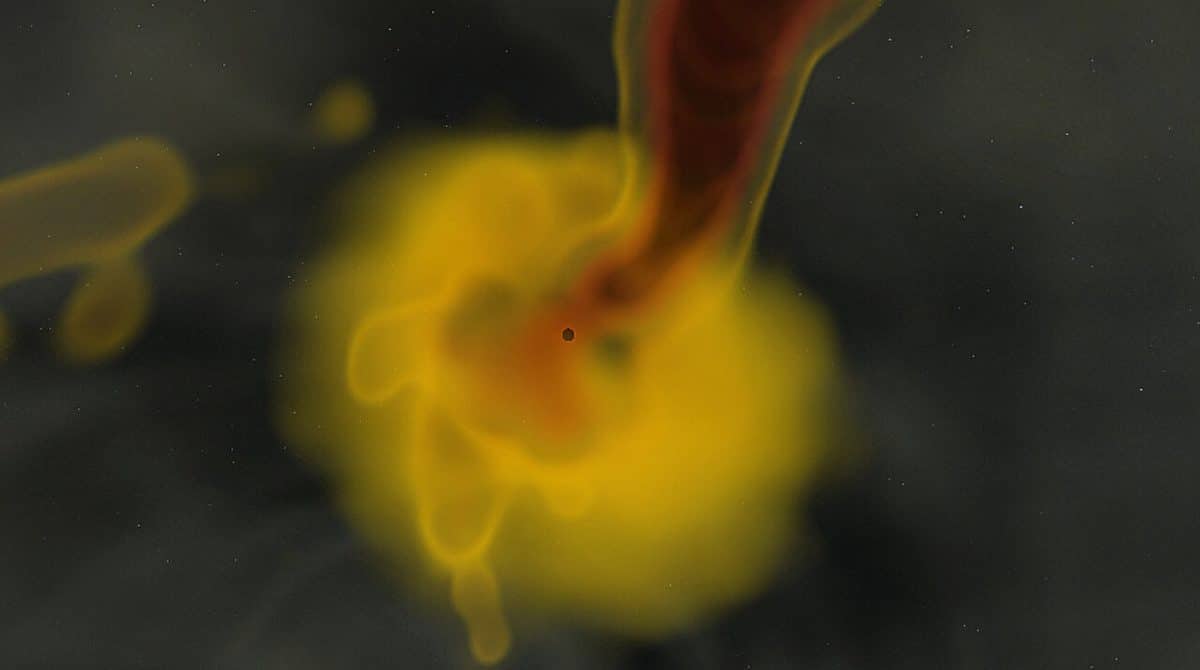
Astrophysicists have uncovered the mystery behind the origin of black holes whose collision was recorded in 2023. A new study has shown that their formation is linked to the influence of magnetic fields—a factor previously overlooked in similar models.
An Unusual Collision and the Mass Gap Mystery
In 2023, the LIGO-Virgo-KAGRA gravitational wave observatories detected the merger of two black holes about seven billion light-years from Earth. This event, designated GW231123, puzzled scientists: the mass and spin of the resulting objects did not fit existing theories. According to previous understanding, black holes with such characteristics should not exist.
The issue lay in the so-called "mass gap." Calculations suggest that stars within a certain mass range end their lives as a special type of supernova—pair-instability supernovae. Such explosions completely destroy the star, leaving behind no black hole. Therefore, astronomers did not expect to find black holes with masses between roughly 70 and 140 solar masses. However, the objects from GW231123 fell precisely within this range.
The Role of Magnetic Fields in Black Hole Formation
Theoretically, a black hole can fall into the "mass gap" if it forms from the merger of two less massive objects. However, such events usually disrupt the spin of the resulting black hole. In the case of GW231123, the black holes were spinning at nearly the maximum possible speed, indicating a missing factor in standard models.
Astrophysicists proposed that the key lies in the influence of magnetic fields during the collapse of massive stars. The results of their research were published in The Astrophysical Journal Letters.
Computer Modeling: Two Stages
To test their hypothesis, the research team conducted a complex computer simulation in two stages. First, they traced the life cycle of a giant star with an initial mass of 250 solar masses. By the time of collapse, the star had lost some material, leaving it with a mass of about 150 solar masses—just above the upper limit of the "mass gap," allowing a black hole to remain after the explosion.
In the second stage, the researchers created a more detailed simulation of the collapse itself, adding the star’s rotation and magnetic fields to the model. Previously, it was believed that after a black hole forms, all remaining stellar material falls into it. The new simulation revealed a different picture: if the star was spinning rapidly, the surrounding cloud of material formed a rotating disk.
How Magnetic Fields Affect Mass and Spin
Magnetic fields in this disk generated pressure that ejected some of the material outward as powerful jets moving at nearly the speed of light. These outflows reduced the amount of material available for the black hole to absorb. The strength of this effect depended on the intensity of the magnetic field: the stronger the field, the more material was expelled.
The modeling showed that with strong magnetic fields, up to half of the star’s original mass could be thrown into space. As a result, the final mass of the newborn black hole became significantly smaller, placing it within the "mass gap."
The study also found a link between the black hole’s mass and its spin. Strong magnetic fields not only reduced the mass but also slowed the rotation, leading to the formation of lighter and more slowly spinning black holes. Weaker fields, on the other hand, allowed the object to gain more mass and spin up to high speeds. This scenario explained the properties of the objects in the GW231123 system.
New Perspectives for Observations
The proposed mechanism also predicts that the birth of rapidly spinning massive black holes should be accompanied by bursts of gamma radiation. Future observations will help test this theory and deepen our understanding of the physics of the most extreme objects in the Universe.