

Slow growth of black holes has proven to be more effective than rapid growth.
New cosmological simulations have shown that supermassive black holes in the early Universe grew gradually, rather than through rapid consumption of matter. Slow but steady growth proved to be more effective than a fast start.
Cursus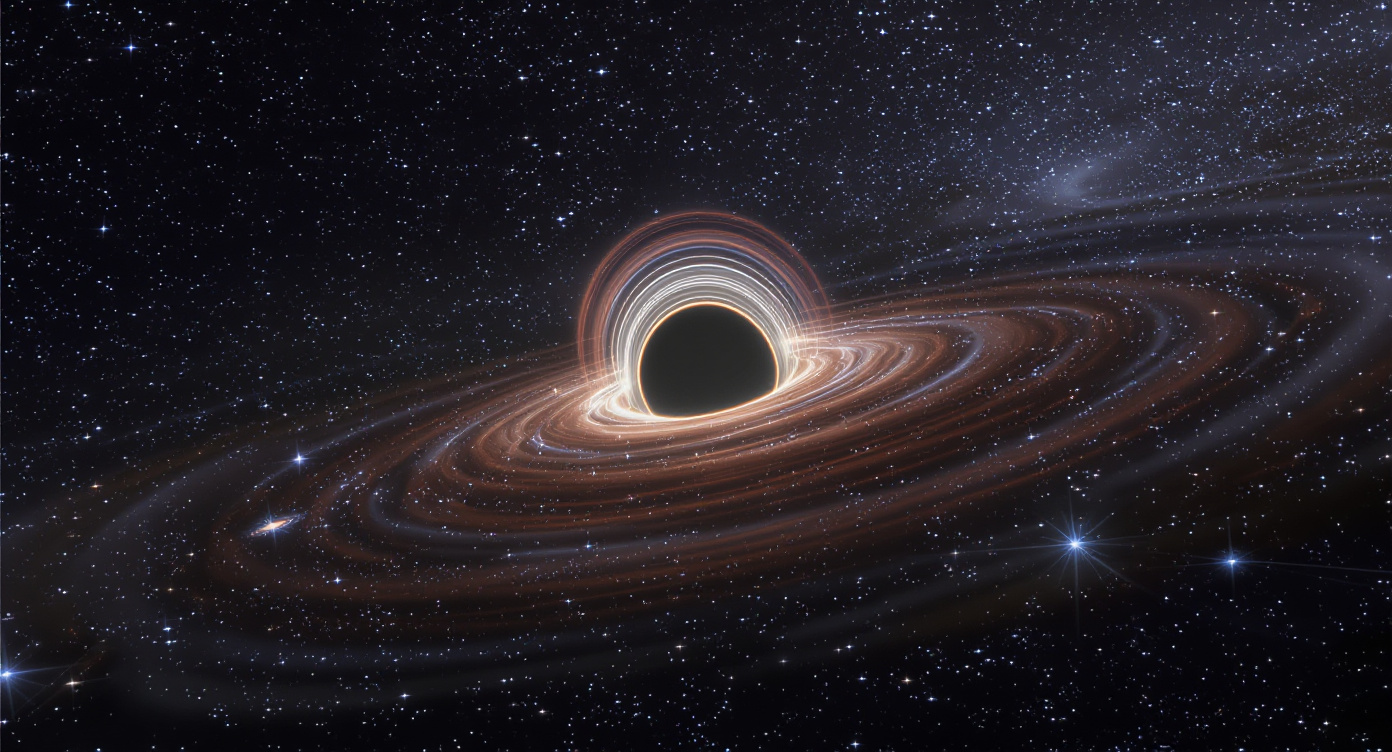
Until recently, it was believed that supermassive black holes in the early Universe grew solely by endlessly absorbing surrounding matter. However, new cosmological simulations that recreate the conditions shortly after the Big Bang have enabled astrophysicists to discover that this process actually occurred in two distinct stages.
Formation of the First Black Holes
The first stars and galaxies appeared about 400–800 million years after the Universe began. During this period, known as the epoch of reionization, supermassive black holes (SMBHs) began to form, with masses reaching millions or even billions of times that of our Sun. Despite this, the exact reasons for such rapid growth of these objects remained unclear.
New Insights into Black Hole Growth
An international team of researchers led by Ziyuan Wu from Zhejiang University (China), using cosmological simulations, traced the formation of supermassive black holes in the early Universe. Their findings, published on the Cornell University preprint server, showed that black holes increased their mass gradually, rather than through rapid, uncontrolled absorption of matter as previous models had suggested.
The Two Stages of Evolution
When a black hole’s mass reached about a thousand solar masses, a brief but extremely intense period of accretion began—matter was absorbed at a rate roughly three times higher than the Eddington limit (the maximum stable “feeding” rate for a black hole). Over several tens of millions of years, the black hole’s mass could grow to 10⁴–10⁵ solar masses, regardless of the intensity of supernova explosions or other feedback mechanisms.
However, powerful radiation and energy outbursts heated the surrounding gas, pushing it out from the center of the galaxy. By the time the black hole’s mass reached around 100,000 solar masses, the inflow of matter slowed, and growth nearly stopped. Nevertheless, after several hundred million years, such black holes caught up with and even surpassed those that initially grew through super-Eddington accretion. Thus, slow but steady growth proved more effective than a rapid “start.”
A New Understanding of Supermassive Black Hole Origins
These results could change our understanding of black hole formation during the epoch of reionization. The new model shows that rapid early growth does not determine their final size. Supermassive black holes observed with the James Webb Space Telescope may have formed thanks to stable Eddington-rate “feeding” that continued for hundreds of millions of years.