

China is speeding up production, but robots are still lagging behind
China is actively investing in the development of humanoid robots, but their current technology is not yet advanced enough to replace humans in most jobs. Despite impressive demonstrations, these robots still lag behind industrial counterparts in terms of speed and versatility. Achieving a real breakthrough will require further advancements in artificial intelligence.
Ingenium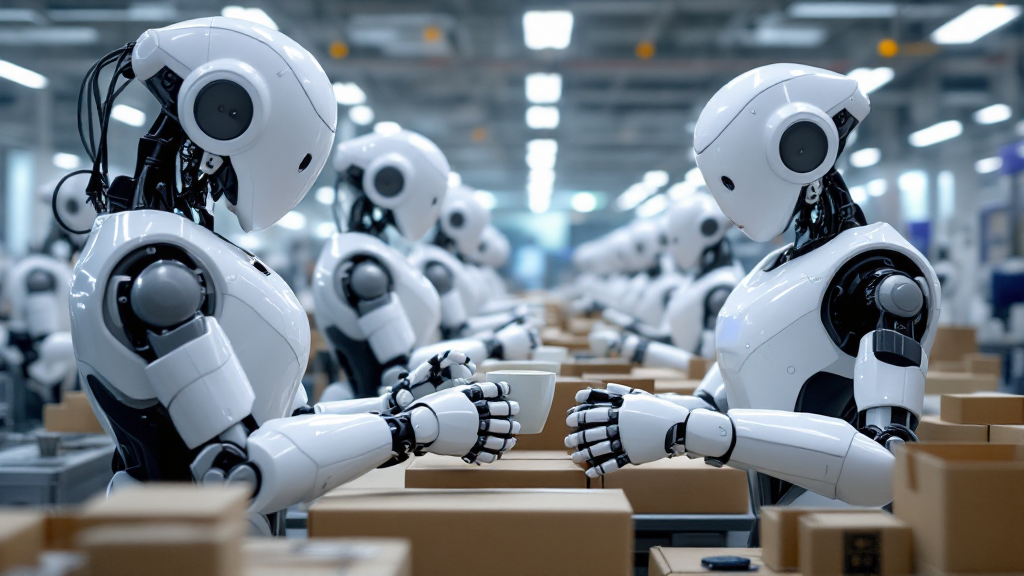
China is rapidly expanding its production of humanoid robots, with more than 150 companies currently engaged in their development. Despite significant government investment and large-scale demonstrations, the current level of technology is not yet sufficient to replace humans in most jobs.
Current State of Development
At a robotics training center in southern China, over 100 humanoid robots are being taught to perform simple tasks such as sorting boxes, packing goods, and making coffee. However, these machines operate slowly and inconsistently: a beginner trainer needs about 300 attempts to master a single movement, while an experienced one requires around 50. Some robots can only complete tasks at 20% of the speed or productivity of a human.
Humanoid robots struggle to adapt to changing conditions, for example, if objects are placed at different angles or the lighting changes. Traditional industrial robots are often faster, cheaper, and more reliable for factory work.
Artificial Intelligence Limitations
The main obstacle to the advancement of humanoid robots is not just hardware, but also artificial intelligence. Models that integrate vision, speech, and actions are much harder to train than language models used for chatbots. Effective training requires vast amounts of real-world data: currently, about 500,000 hours have been accumulated, whereas a fully developed physical intelligence would require around 100 million hours.
Investment and Production
In the first half of 2026, Chinese government agencies invested at least $230 million in the development of humanoid robots and related equipment, a significant increase from $62 million the previous year. Chinese manufacturers supplied about 95% of the roughly 20,000 humanoid robots delivered worldwide last year.
Strategy and Prospects
China is applying a strategy similar to its approach in electric vehicles and solar panels: ramping up production capacity in advance, subsidizing the industry, and using intense competition to drive down costs. However, humanoid robot technology is still less mature, and the sector may face consolidation as subsidies decrease.
Applications and Challenges
Some promising applications are already being implemented. For example, Galbot is deploying humanoid robots in pharmacies, where they retrieve items from shelves with a reported success rate above 95%. However, general-purpose factory work remains a much more complex challenge.
Currently, Chinese humanoid robots can impress audiences at public demonstrations, such as with dancing or kung fu displays, but performing real-world work will require further technological advances.