

Computer Vision: The Key to Smart Automation
The article explores the key aspects of implementing computer vision in industrial automation, including the integration of 2D and 3D data, calibration, error handling, and adaptation to the physical properties of objects to ensure reliable operation in manufacturing environments.
Opus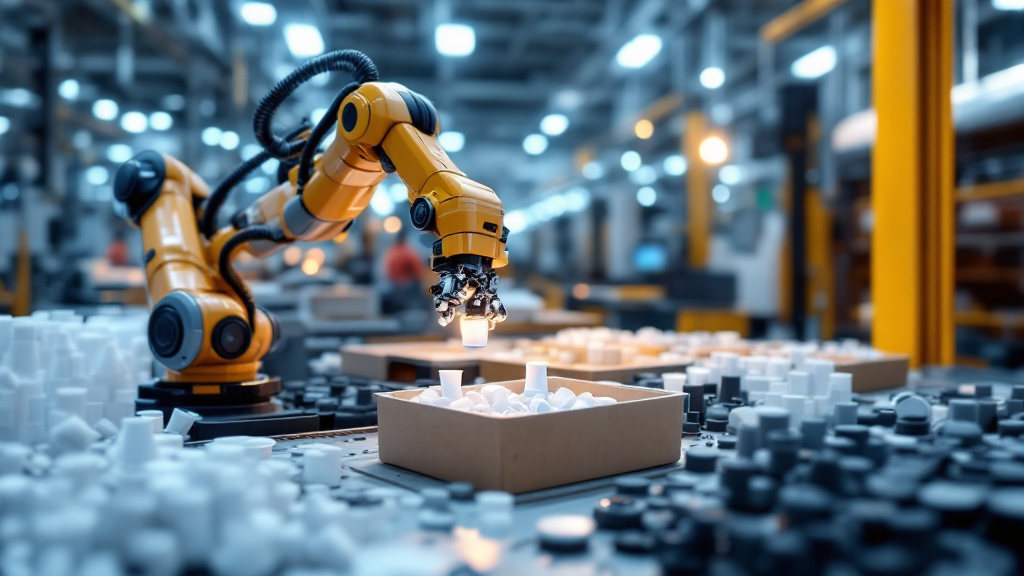
Integration of 3D Sensors and Calibration
Modern automated systems that utilize computer vision combine 3D depth sensors, calibration procedures, strict confidence rules, and adaptive mechanisms to ensure stable operation in manufacturing environments. Object detection is only the first step; transforming visual data into physical actions requires precise spatial calibration and multi-level processing. To maintain accuracy in dynamic production settings, continuous automated calibration procedures are necessary, taking into account possible physical shifts in equipment.
Combining 2D and 3D Data
Integrating 2D images with 3D depth sensors enables precise determination of the position, orientation, and surface topology of objects—crucial for complex tasks such as picking parts from a container. The confidence assessment of vision models is governed by strict rules: if confidence is insufficient, the system initiates corrective procedures or halts operation to prevent errors. Adaptive processing that considers material properties ensures the protection of fragile items and proper handling of rigid objects.
Translating Data into Actions
In industrial environments, converting raw camera data into robotic physical actions involves four stages: object classification, determining its position in the image, evaluating its spatial position and orientation, and generating execution commands. Here, 2D coordinates are mathematically projected into 3D space, and the system calculates the exact position and orientation of the component relative to a defined coordinate system across six degrees of freedom (6DoF).
Production Environment Dynamics and Calibration
Industrial setups shift over time, so calibration is viewed as an integrated, active subsystem rather than a one-time procedure. This is achieved through automated Tool Centre Point (TCP) evaluation procedures, which periodically correct physical displacements, ensuring long-term reliability and accuracy in translating vision data into movement.
Example: Bin Picking
In tasks where multiple parts are randomly placed in a deep bin, 2D vision systems cannot determine which part is on top or hidden. Solving such challenges requires combining 2D analysis with 3D depth data, using individual deep learning models and advanced 3D sensors. This hybrid approach allows the system to identify objects, analyze their spatial positions, and select optimal grasp points, avoiding collisions with neighboring parts or the container walls.
Confidence Assessment and Error Handling
Vision models operate with probabilities rather than absolute certainty. The acceptable confidence level is determined by the specifics of the process, the type of component, and the potential consequences of failures. When confidence is low, the system initiates rescanning or a controlled station stop, preventing errors from propagating along the production line.
Adaptive Mechanics and Physical Context
The gripping profile must adapt to the material properties of the object. For example, a fragile plastic cup requires gentle force and smooth trajectories to prevent breakage, while a sturdy cardboard box allows for more aggressive handling. The vision system must accurately identify flat surfaces for reliable gripping.
Diagnostics and Data Analysis
The computer vision system generates a stream of spatial, geometric, and quality data that can be used to detect inefficiencies, unstable stations, and recurring defects in production. This approach transforms the camera from a local sensor into a powerful diagnostic tool for the entire enterprise.
Requirements for an Industrial Vision System
For industrial use, the system must provide:
Calibrated perception
Consideration of physical context
Clear confidence rules
Controlled machine behavior
Integrating spatial calibration, physical depth, strict error handling, and adaptive mechanics enables the creation of systems that meet the predictability, repeatability, and safety requirements of modern production lines.
Conclusion
Implementing computer vision in real-world manufacturing requires a comprehensive engineering approach. A high-precision deep learning model is only one part of a larger physical system. To achieve reliability and industrial suitability, the system must be designed with the full operational lifecycle in mind, integrating all key components and requirements.