

A unified mechanism for the winds of gas giant planets has been discovered
A new study has shown that the atmospheric currents on Jupiter, Saturn, Uranus, and Neptune can be explained by a single physical mechanism—deep convection—rather than differences in their internal structures. This universal approach will help scientists study similar processes on other planets and stars.
Cursus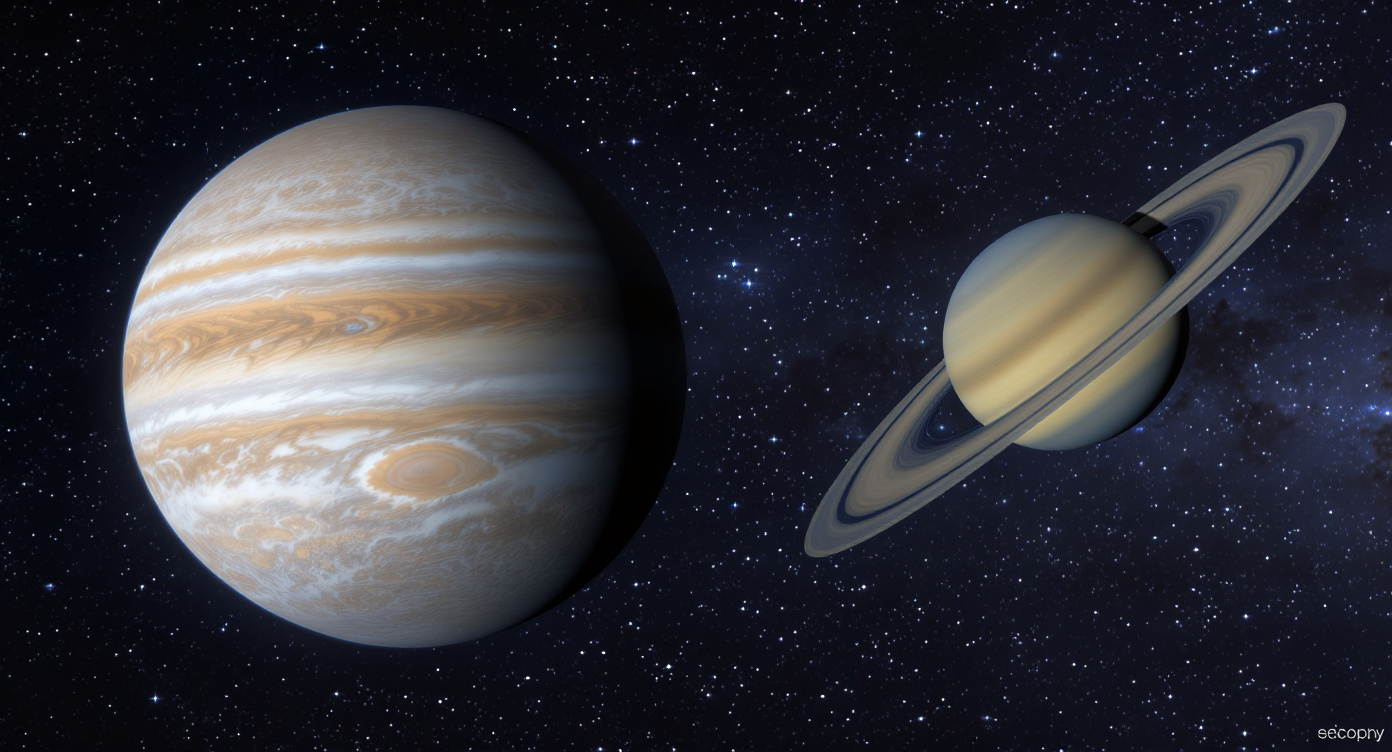
On Jupiter and Saturn, equatorial winds blow eastward, matching the direction of the planets’ rotation, while on Neptune and Uranus, these winds move westward. Until recently, this difference was attributed to the unique internal structures of these planets. However, new research has revealed that a single physical mechanism is responsible for this phenomenon.
Structure and Atmosphere of the Giants
The gas giants of the Solar System—Jupiter and Saturn—are composed mainly of hydrogen and helium. Deep within these planets, high pressure causes the gases to gradually transition into a liquid state, and powerful internal heat sources make their atmospheres literally “boil” from within. In contrast, the ice giants Uranus and Neptune contain less hydrogen and helium but more water, methane, and ammonia. Their interiors are denser and colder, and their own thermal radiation is much weaker, especially in the case of Uranus.
Causes of Atmospheric Circulation
Previously, stable atmospheric circulation on gas giants was linked to internal heat flows, while on Uranus and Neptune it was thought to be influenced by solar radiation. For reference: winds on giant planets can reach speeds of about 300 meters per second on Saturn and 400 meters per second on Neptune.
A New Perspective on Atmospheric Currents
Recent scientific work published in Science Advances has shown that both types of atmospheric flows may be manifestations of the same mechanism—deep convection. This process involves the mixing of heat in an atmosphere or liquid through circulation. Planetary scientists reached this conclusion by developing a universal model that demonstrated how convective flows (“columns”) forming in the planet’s interior under the influence of rotation can tilt in different directions, determining the direction of equatorial winds.
An international research team led by Keren Duer-Milner from the Weizmann Institute (Israel) used a three-dimensional numerical model to simulate atmospheric currents driven by the upward movement of hot material from the interiors of giant planets.
The Universality of the Mechanism
Since, apart from the tilt of the convective “columns,” all other physical parameters remained unchanged, scientists were able to demonstrate for the first time that even under identical physical conditions, a planet’s atmosphere can stabilize in one of two states—with either eastward or westward equatorial winds.
The transition between these states depends on the depth of the convective layer: deeper shells are typical for Jupiter and Saturn, while shallower ones are found on Uranus and Neptune. In the intermediate range, both outcomes are possible, and the result is determined by random fluctuations in initial turbulence. The modeling also revealed the presence of equatorial waves moving in opposite directions depending on the type of rotation, which, according to planetary scientists, points to a universal mechanism behind these processes.
The Significance of the Research
Thus, the authors of the new study have unified the atmospheric dynamics of the four giant planets and provided essential tools for studying similar processes in the interiors of distant worlds and stars.