

GD 362 System: How Planets Die After Their Star
Astronomers are observing the GD 362 system, where, after the death of a star, a disk of debris from destroyed planets has formed around a white dwarf. This is a vivid example of what could one day happen to our own Solar System.
Cursus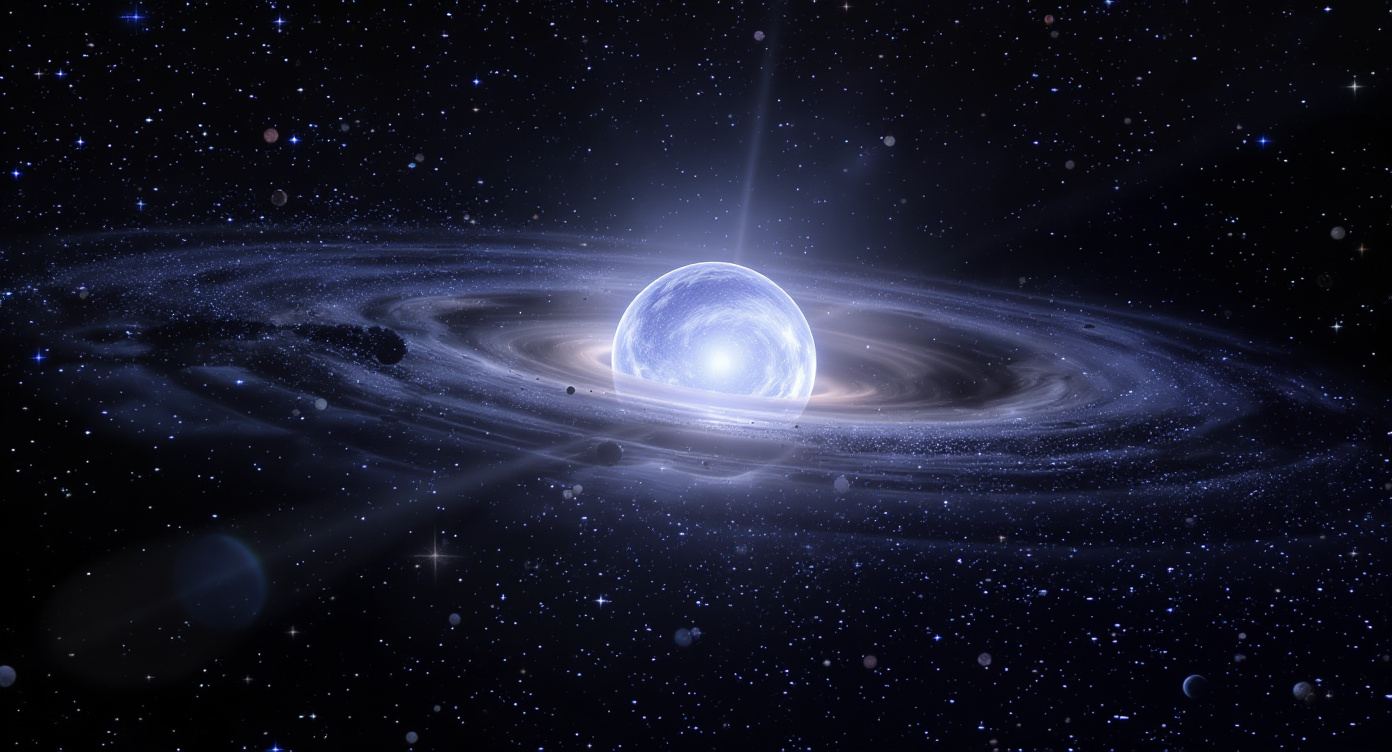
At a distance of 183 light-years from Earth, astronomers are observing the final stage in the evolution of a planetary system reminiscent of our own Solar System. Around a white dwarf star, a disk has formed from the debris of planets that managed to avoid being engulfed by their dying sun, only to be destroyed later by its influence.
The Future of the Sun: Red Giant and White Dwarf
According to scientists, in about five billion years, the Sun will exhaust its nuclear fuel. Once this happens, nothing will be able to counteract gravity, and the core will begin to contract and heat up, while the outer layers of the star will expand due to overheating. The Sun will enter the red giant phase, swelling to about 200 times its current size. Its outer envelope will likely reach the orbit of Venus, and may even engulf Earth and possibly Mars.
At the end of its evolution, the Sun’s outer layers, along with the material from any planets it has consumed, will be ejected into space, creating a short-lived, bright planetary nebula. After several tens of thousands of years, this nebula will dissipate, leaving behind only the Sun’s core—now a white dwarf, compressed to the size of a planet—surrounded by gas giants and any other surviving bodies.
GD 362: A System After the Death of Its Star
Astronomers have observed various scenarios like this in systems with white dwarfs. Recently, American astrophysicists described an intriguing example: the GD 362 system, located 183 light-years away in the constellation Hercules. At its center is a white dwarf with a mass about 0.6 times that of the Sun, which is believed to be the remnant core of a star slightly more massive than our own. Spectral analysis shows that this white dwarf has existed in its current state for 680 million years.
No planets have yet been detected around GD 362, but this may be due to the limitations of current instruments, which cannot detect objects smaller than 25 Jupiter masses at such distances.
Debris Disk: Traces of Destroyed Worlds
Instead of planets, astronomers have found a disk of fine particles around GD 362, stretching from 4.5 to 12 million kilometers from the white dwarf (for comparison, Mercury’s average distance from the Sun is 58 million kilometers). The disk is about 42,000 kilometers thick, more than twice the diameter of the white dwarf itself.
The disk emits intense infrared radiation, typical of dust and solid particle accumulations. Astronomers believe these are fragments of rocky bodies—former planets and asteroids. The total mass of material in the disk is comparable to that of the dwarf planet Ceres in our Solar System. There may be larger fragments that have not yet been detected, and some of the material has already been absorbed by the white dwarf.
How Planets Die Around White Dwarfs
The unique aspect of the GD 362 system is that the debris could not have come from planets consumed by the star during its red giant phase—otherwise, no trace of them would remain. Researchers suggest these worlds were destroyed after the star became a white dwarf.
It is believed that chaos arose in the outer regions of the system: the gravity of a hypothetical gas giant or several large planets could have sent smaller bodies onto orbits bringing them close to the star. Once too near the white dwarf, these objects cross the so-called Roche limit—the boundary where tidal forces begin to tear them apart. The fragments of these destroyed bodies then form the observed disk.
Thus, the GD 362 system vividly demonstrates what the fate of planetary systems like ours might be, billions of years after the death of their stars.