

How to Find Traces of Alien Technologies Near Stars
Astrophysicists have proposed searching for signs of extraterrestrial civilizations by looking for gigantic protective screens that could shield planets from overheating. Such artificial structures might be detectable by future space telescopes.
Cursus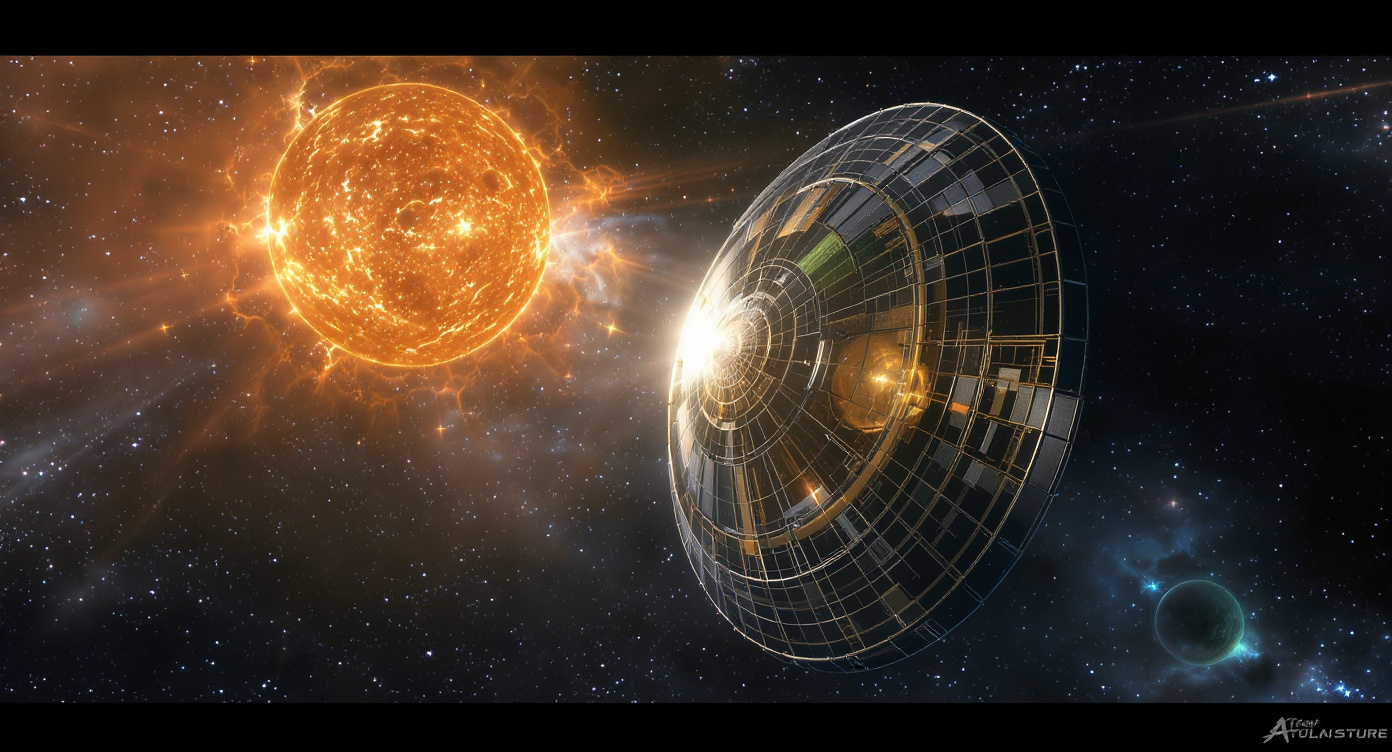
If we assume that an extraterrestrial civilization exists near an old and therefore very hot star, it might be able to protect its planet from overheating using a special astroengineering structure. Astrophysicists have explained how such a construction could be detected with the help of future space observatories.
Why Planets Overheat
According to forecasts, the Sun will continue to shine for about five billion more years, but life on Earth will disappear much sooner. Over time, the star becomes hotter, disrupting the planet’s climate balance: in about a billion years, there will be no carbon dioxide left in the atmosphere for photosynthesis, and the oceans will begin to evaporate rapidly, triggering a powerful greenhouse effect. As a result, almost all life will perish.
Astrophysicists from Sweden believe that a similar fate awaits any habitable exoplanets, including those inhabited by intelligent beings. Even our relatively young human civilization already has ideas about how to extend Earth’s habitability, so it’s quite possible that hypothetical aliens might have come up with similar concepts.
How a Planet Could Be Saved
In a recent scientific article, researchers suggested that an extraterrestrial civilization could protect its planet from overheating by creating a giant protective screen for partial shading. Such a screen would be placed at one of the Lagrange points between the planet and its star, where gravity is balanced and an object can remain stable for a very long time.
If such a structure exists, it would noticeably affect the way the planet reflects light during observations: depending on the screen’s position relative to the observer, the light would be reflected differently, and periodically the screen would create sharp “flashes” of light.
How to Distinguish an Artificial Object
Astrophysicists took into account that a planet may have natural rings, moons, or clouds of gas and dust, but they are confident that an artificial structure can be distinguished from natural objects by its unique features.
Searching with New Telescopes
Calculations show that such a “screen” could be detected with the future Habitable Worlds Observatory, which is planned for launch in the 2040s. The main goal of this telescope is to search for “Earth twins” within a radius of about 81 light-years.
Scientists have already compiled a list of about 120 suitable old stars with masses close to that of the Sun. Among them, for example, is the orange dwarf HIP 73184, located 19 light-years away and over seven billion years old, as well as the even older star HIP 57443 at a distance of 30 light-years.