

Ancient people deliberately hunted mammoths.
A new DNA study of mammoth remains has revealed that ancient humans primarily hunted females rather than males. This selective hunting may have affected the population size of the species and accelerated their extinction.
Cursus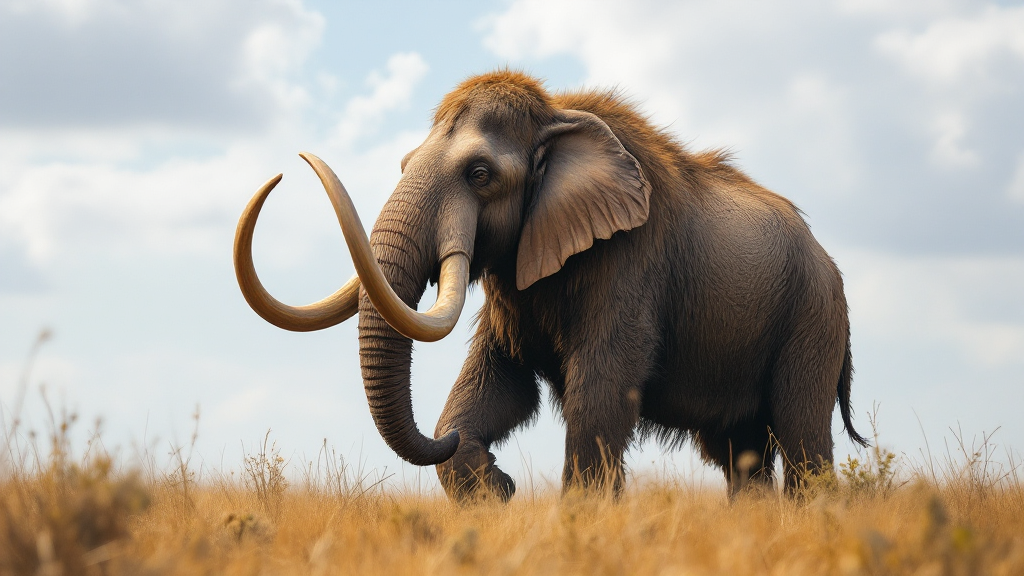
For over a century, archaeologists have debated the origins of large accumulations of woolly mammoth (Mammuthus primigenius) bones found at Paleolithic sites across Eurasia and North America. There are two main hypotheses to explain these discoveries. The first suggests that ancient humans hunted mammoths, as evidenced by the presence of hearths, stone tools, and bones bearing cut marks, impact traces, and embedded spear points found alongside the remains. The second theory posits that people simply collected the carcasses of animals that had died naturally, using their meat, tusks, and other materials without engaging in dangerous confrontations with live mammoths.
An international team of paleogeneticists and evolutionary geneticists conducted a study to determine how these bone accumulations formed. Using modern ancient DNA analysis techniques, they examined the remains of 521 mammoths. Of these, 100 samples came from 11 archaeological sites associated with human activity (dating back 20,000–30,000 years), while 421 samples were from locations where the animals likely died of natural causes.
The analysis revealed that among mammoths that died without human involvement, 66.5% were males. This is explained by the fact that, like modern elephants, adult male mammoths tended to lead more solitary lives, often leaving the herd and facing greater risks, which increased their chances of dying in natural traps. Similar patterns are observed in other animals, such as bison and brown bears.
At ancient human sites, however, the picture was different: of the 100 animals studied, 70 were females. This ratio was consistent across nearly all sites in different regions of the world, making it unlikely to be a coincidence. If the bone accumulations had formed naturally, one would expect roughly equal numbers of males and females, or even a predominance of males, as seen at natural death sites. However, the data showed the opposite.
The researchers proposed two possible explanations for the hunters’ selection. First, female mammoths were smaller and therefore lighter, and if a calf was present, the herd’s speed decreased, and the need to care for offspring made the animals less mobile and more vulnerable. Such prey required less effort and posed less danger. Second, as with modern elephants, females with calves followed the same seasonal migration routes year after year, while males moved less predictably. If ancient people were familiar with herd migration paths, they could set up camps in places where encounters with mammoths were more likely.
This strategy suggests that humans possessed knowledge of mammoth behavior and used these insights to hunt more effectively. Ancient hunters observed the animals, understood their routes, and planned their hunts accordingly.
The findings offer a new perspective on the relationship between Ice Age humans and mammoths, as well as the role these animals played in human life and the final stages of mammoth existence. If humans predominantly hunted females over a long period, this could have gradually reduced the population’s ability to recover, since the loss of adult females has a greater impact on species numbers than the death of an equivalent number of males.
The study’s conclusions were published in the journal Current Biology.