

How many "Earth twins" are hidden in the Galaxy?
Scientists have estimated how many planets in our galaxy could potentially support intelligent life, and found that the nearest possible civilization might be located tens of thousands of light-years away from us. The key conditions for the emergence of intelligence are considered to be an atmosphere rich in nitrogen and oxygen, as well as geological activity.
Cursus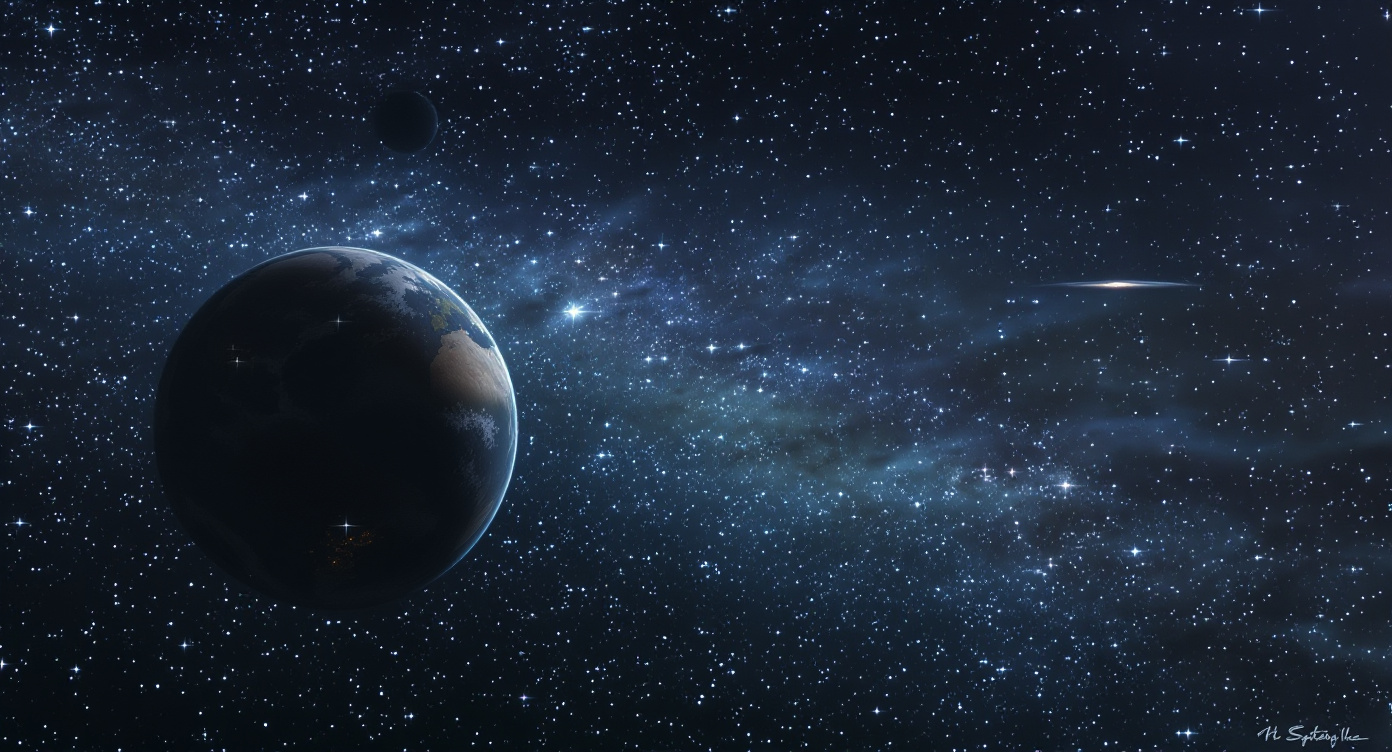
Scientists have attempted to determine how common planets capable of supporting intelligent life over long periods are in the Universe. Their calculations suggest that if there is another civilization developing simultaneously with ours in the Milky Way, it could be located on the opposite side of the Galaxy.
The History of the Search for Extraterrestrial Civilizations
After Yuri Gagarin's spaceflight, American radio astronomer Frank Drake proposed his famous equation in 1961, which allows scientists to estimate the number of intelligent civilizations in our Galaxy. His goal was to move the discussion of this topic from the realm of science fiction into the sphere of serious scientific research.
The Drake Equation takes into account parameters such as the rate of star formation in the Galaxy, the fraction of stars with planets, the number of planets in the habitable zone, the probability of life and intelligence arising, the presence of communication technologies, and the average lifespan of a civilization. As a result, the equation is meant to provide an estimate of the number of intelligent societies with which contact might be possible.
However, due to the large number of unknown variables, the equation can lead to conclusions ranging from a multitude of inhabited worlds to the possibility that we are completely alone in the Universe.
A New Approach to the Search for a “Second Earth”
Recently, researchers from the Institute for Space Research of the Austrian Academy of Sciences proposed a different method: they focused on estimating the number of planets where intelligent life could, in principle, arise. The scientists presented their findings at a joint conference of the European Planetary Science Congress and the Division for Planetary Sciences of the American Astronomical Society.
According to their view, the emergence of a civilization requires a planet as similar to Earth as possible. It is important not only for the planet to be in the “habitable” zone around a Sun-like star and to have an atmosphere, but also for that atmosphere to have a specific composition.
The Role of Atmosphere and Geological Processes
Scientists believe it is unlikely for a habitable planet to exist without an atmosphere rich in nitrogen. On Earth, nitrogen makes up 78% of the air, providing the necessary atmospheric pressure for liquid water to exist on the surface. In addition, nitrogen suppresses combustion, making it possible to control fire, and is a component of DNA, RNA, proteins, and enzymes—without it, life as we know it cannot exist in any cell.
Oxygen is also essential for technological development: without it, the use of fire would be difficult, and metabolic processes involving oxygen provide organisms with much more energy than anaerobic processes. Therefore, complex anaerobic life forms are considered unlikely.
Oxygen can be produced abiotically, but only in very small amounts. Its accumulation requires photosynthesis, which in turn needs carbon dioxide supplied to the atmosphere by volcanoes. Volcanism, in its turn, depends on the movement of tectonic plates. If a planet lacks tectonic activity, it is unlikely to become a cradle for intelligent life.
How Many “Earth Twins” Are There in the Galaxy?
By analyzing data on known exoplanets, scientists tried to estimate the possible number of “Earth copies” in the Milky Way. They consider such planets the most likely places for other civilizations to exist. Their calculations showed that the nearest extraterrestrial civilization could be no closer than 33,000 light-years away. For comparison, the Solar System is located 26,000 light-years from the center of the Galaxy, meaning that potential aliens could be somewhere on the other side of the galactic disk.
The Time Factor and Synchronous Development
The researchers also took into account that life and intelligence do not arise and develop on different planets at the same time. Some civilizations may have already disappeared, while others have yet to emerge. According to their estimates, there may be only one civilization in the Milky Way developing simultaneously with us, and it would have to be significantly more advanced, having evolved for at least 280,000 years.