

Chimpanzees receive a daily dose of alcohol from fruit.
A new study has shown that chimpanzees consume a significant amount of alcohol each day by eating overripe fruit. This discovery sheds light on the ancient evolutionary roots of humans' attraction to alcohol.
Cursus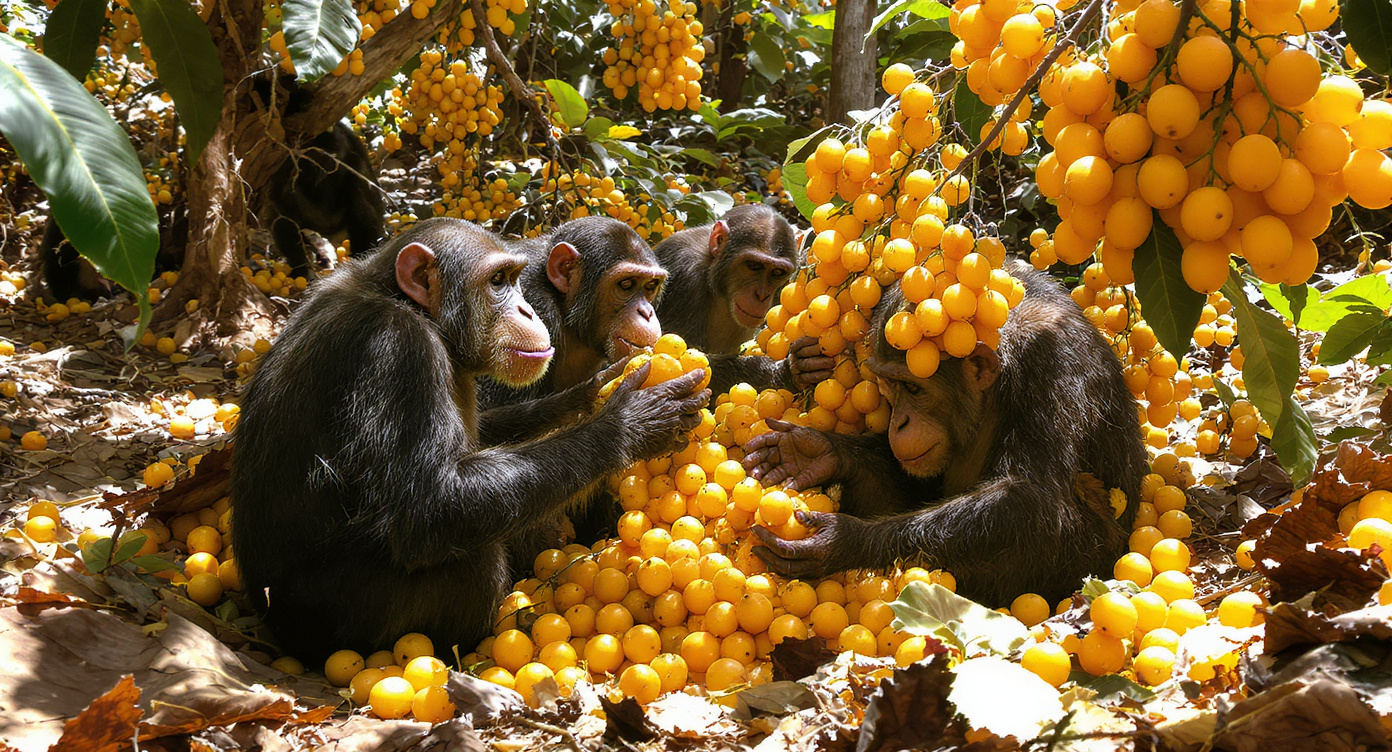
The closest relatives of humans—chimpanzees—regularly consume alcohol along with their food. Researchers have determined how much ethanol these primates ingest daily by eating overripe fruit. This discovery offers a new perspective on the origins of human attraction to alcohol and suggests that the connection between Homo sapiens and ethanol is much older and deeper than previously thought.
Evolutionary Roots of Alcohol Preference
The idea that the human inclination toward alcohol has deep evolutionary roots has been discussed in the scientific community for over 20 years. Observations of primates in captivity and in the wild have shown that apes sometimes eat fermented fruit and display signs of mild intoxication. These findings formed the basis of the so-called "drunken monkey hypothesis."
In the early 2000s, American biologist Robert Dudley proposed a hypothesis that primates’ attraction to the smell and taste of ethanol helps them find the ripest, most calorie-rich, and tastiest fruits. Yeasts and other microorganisms live on the surface and inside the pulp of fruits, and when the fruit is damaged or overripe, they break down sugars to produce ethanol. According to Dudley, the ability to detect the smell and taste of alcohol could have been an evolutionary advantage.
However, the hypothesis lacked precise quantitative data: scientists did not know how much alcohol is present in the natural diet of wild primates. Without this information, the idea remained an interesting assumption, and critics argued that apes eat fermented fruit rarely and by chance. Verifying this in the wild was extremely difficult—until recently.
New Study: How Much Alcohol Do Chimpanzees Consume?
An international team of biologists and primatologists led by Alexey Maro from the University of California set out to investigate this question. The researchers visited two groups of chimpanzees living in Kibale National Park (Uganda) and Taï National Park (Côte d’Ivoire).
First, using camera traps, the scientists identified which fruits the apes in each population preferred to eat. Then, they collected samples of the same fruits that the chimpanzees had consumed during the day. For fruits growing high in the trees, they only took those that had recently fallen to the ground and were easily recognizable by their appearance.
Analysis of the diet revealed interesting differences: chimpanzees in Uganda preferred ripe fruits of the fig tree Ficus mucuso, while their relatives in Côte d’Ivoire favored plum-like fruits of the evergreen tree Parinari excelsa, which are also loved by elephants known for seeking out and eating fermented fruit.
How Much Ethanol Is in Their Diet?
Laboratory analysis of the collected samples showed that all these fruits contained ethanol at concentrations ranging from 0.3 to 0.4 percent. Despite the relatively low alcohol content, chimpanzees consume enough fruit pulp in a day—about 10% of their body weight—that even small percentages of alcohol in each fruit add up to a significant dose.
Calculations indicated that, on average, each chimpanzee consumes about 14 grams of pure ethanol per day. For comparison, a standard glass of wine (125 ml at 12.5% strength) contains almost 12 grams of alcohol. Given the average chimpanzee weight of 40 kg (compared to about 70 kg for humans), this is equivalent to two glasses of wine per day, adjusted for body mass.
The Significance of This Discovery for Understanding Humans
This discovery is directly relevant to humans. The evolutionary lines of humans and chimpanzees diverged millions of years ago, but our ancestors lived in similar environments and ate comparable foods. The study’s results suggest that ancient hominids also regularly consumed significant amounts of naturally occurring alcohol.
The "drunken monkey hypothesis" has now been confirmed: constant exposure to alcohol through fruit could have created a deep neurobiological connection in our ancestors. The brain began to associate the taste and smell of alcohol with rewards—finding valuable sugars and calories. This ancient program, inherited by humans, may explain why people are drawn to alcoholic beverages despite all their negative consequences.
Key Differences Between Humans and Chimpanzees
Nevertheless, scientists emphasize an important distinction: chimpanzees only consume alcohol together with food, do not seek it out specifically, and do not produce alcoholic drinks. Humans, on the other hand, deliberately create and consume alcohol at concentrations not found in nature. For chimpanzees, alcohol is an incidental part of their diet; for humans, it is a conscious choice. This is precisely why humans developed the problem of alcoholism, which does not exist among apes.
Prospects for Further Research
To better understand how alcohol is metabolized by chimpanzees and whether they prefer more fermented fruit, Alexey Maro conducted an unusual experiment: he collected urine samples from the apes directly under the trees, shielding himself from splashes with an umbrella. Analysis of these samples is ongoing and may provide an even clearer picture.
Many experts have praised Maro’s team’s work, noting that this is the world’s first study to provide quantitative estimates of daily alcohol consumption by wild primates.
The study’s results have been published in the journal Science Advances.