

The disappearance of dinosaurs transformed rivers and landscapes
A new study reveals that the disappearance of large herbivorous dinosaurs after the Cretaceous period was one of the key factors behind the dramatic changes in Earth's landscapes and hydrological systems.
Natura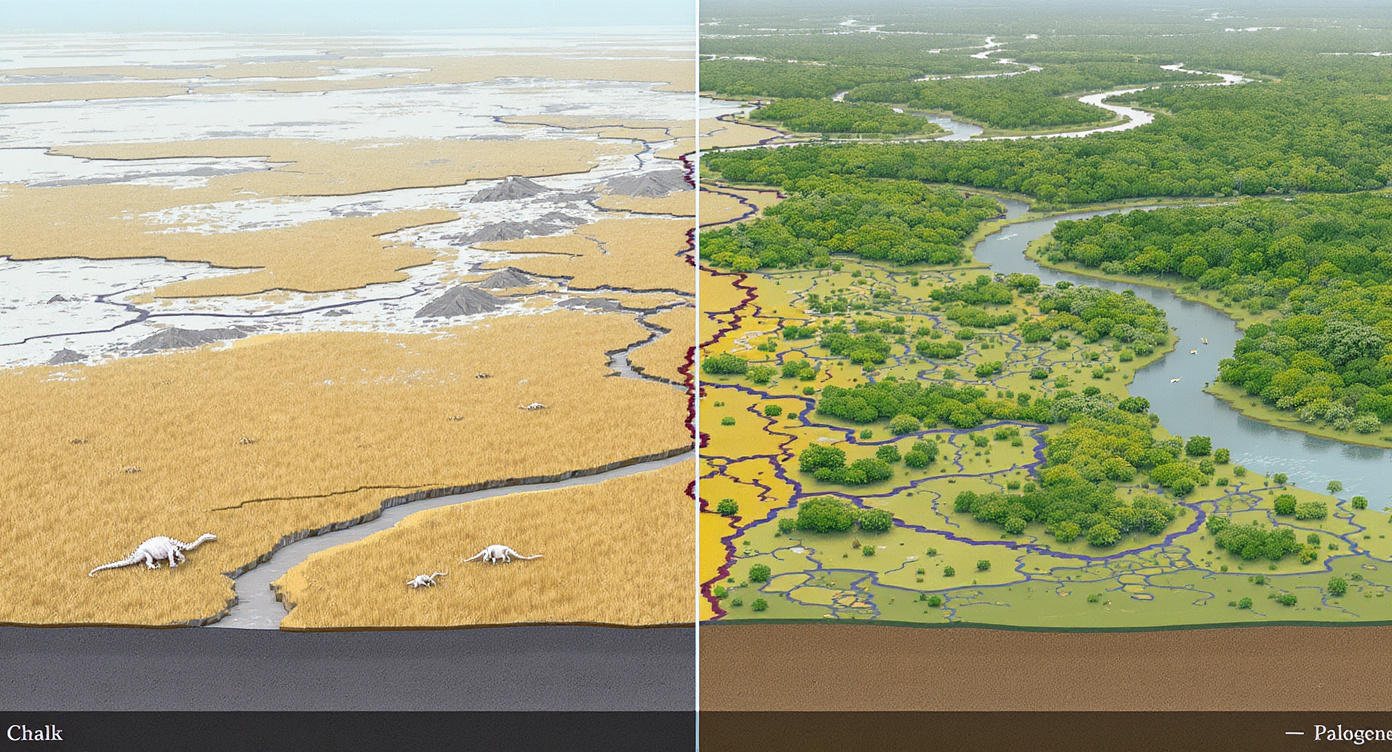
The boundary between the Cretaceous and Paleogene periods in the geological record is marked not only by elevated levels of iridium compared to surrounding layers. The rocks found above this boundary differ significantly from those below: they contain more organic material, and the structure of the layers points to a completely different hydrological regime. Such changes are usually linked to global climate shifts that occurred after the Chicxulub meteorite impact. However, a recent study by American geologists and paleontologists has highlighted another important factor that was previously rarely considered—the disappearance of large herbivorous animals.
The Role of "Ecosystem Engineers"
When discussing "ecosystem engineers," beavers are often cited as an example, since their dam-building activities dramatically reshape landscapes over vast areas. Yet, from a scientific perspective, any organism can be an ecosystem engineer—from algae and grasses to worms and large mammals—if their life activities have a major impact on the ecosystem.
The authors of an article published in Communications Earth & Environment suggest that the massive herbivorous dinosaurs of the late Cretaceous played a similar role to that of modern elephants. Herds of these animals traveled great distances daily, consuming enormous amounts of vegetation and trampling vast expanses of land.
The Consequences of Large Herbivore Extinction
After the catastrophe that triggered the mass extinction at the Cretaceous-Paleogene boundary, the hydrological regime and the nature of sedimentary rocks changed within just a few hundred thousand years. This transformation was driven not only by global climate changes and the direct aftermath of the disaster, but also because there were no longer giant herbivorous dinosaurs on land, and mammals had not yet filled their ecological niches.
In regions once inhabited by these animals, dense forests and thickets could not form—vegetation remained sparse, and root systems were less effective at binding the soil. As a result, less organic matter accumulated in the soil, and what did was easily washed away by rain. Such soils prevented rivers from developing well-defined channels, causing them to flood more often and dry up more quickly.
Changes in Ecosystems After the Extinction
With the disappearance of large herbivores from ecosystems, radical changes took place. Following the K–Pg event (the Cretaceous-Paleogene extinction), all animals heavier than 10–25 kilograms vanished from land. Their ecological niches were later occupied by birds, mammals, and other quadrupeds, but this did not happen immediately. At first, plants took over the "emptied" Earth.
The flourishing of vegetation in previously unoccupied regions led to the formation of meandering rivers with well-defined channels and a completely different hydrological regime, even if overall precipitation and climate remained unchanged. These changes can be traced not just in one locality, but across the entire territory of what is now the United States.
Geological Evidence
Geologists compared cross-sections from ten different locations. Everywhere above the K–Pg boundary, they found rocks characteristic of meandering, permanent rivers, sometimes with swamps along the banks. Below this boundary were layers of sedimentary rocks formed under the influence of regularly flooding and drying rivers. The Cretaceous layers consist of clastic rocks, poor in organic matter and with traces of stagnant water. In contrast, the Paleogene layers are rich in organic substances and the products of their interaction with water.
Thus, the extinction of large herbivorous dinosaurs became one of the key factors driving the dramatic changes in landscapes and the hydrological regime of the Earth after the Cretaceous period.