

Jupiter turned out to be smaller and more flattened.
New measurements from a NASA probe have revealed that Jupiter is slightly smaller and more flattened than previously believed. This data will help scientists study the planet's atmosphere and internal structure with greater accuracy.
Cursus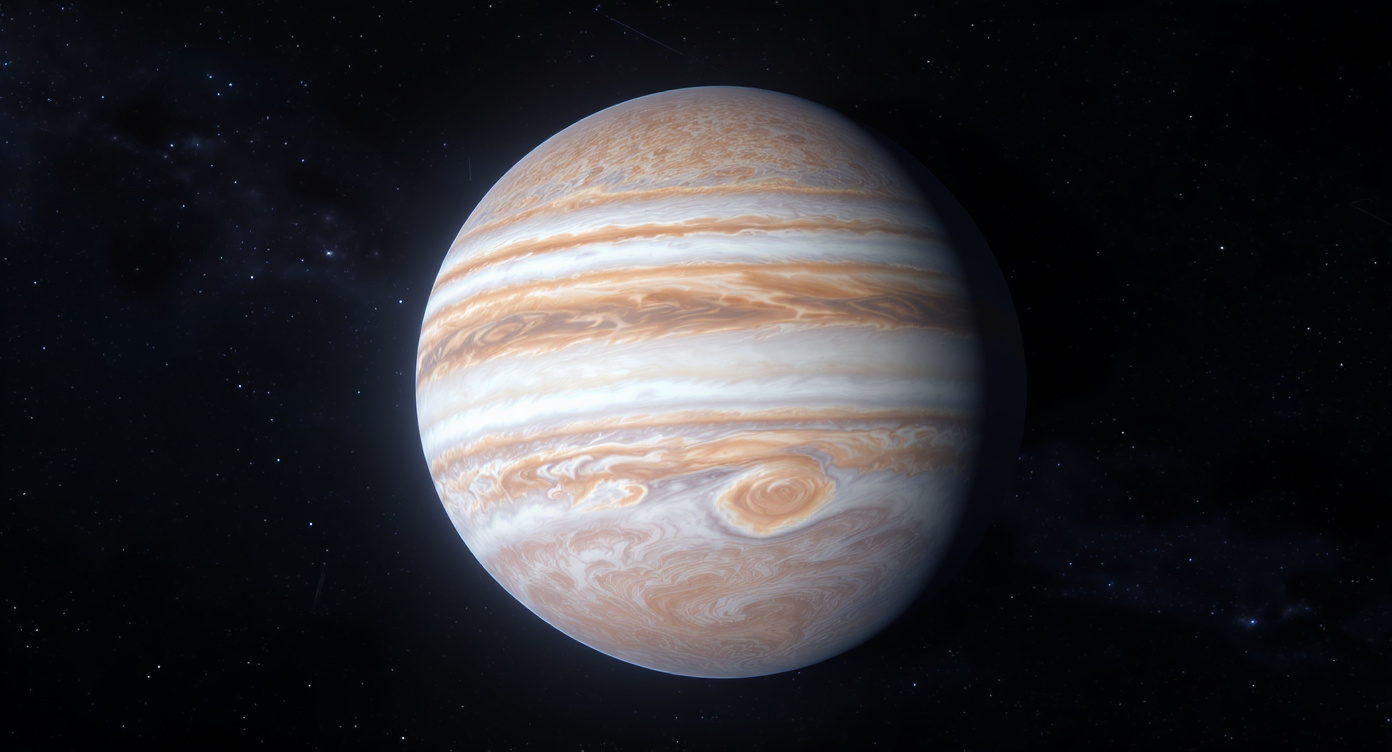
The largest planet in the Solar System, long admired for its immense size, has turned out to be not quite as big and round as astronomers believed for the past 40 years. New, highly accurate measurements taken by a NASA orbital probe have revealed that Jupiter is slightly smaller and even more flattened than previously thought.
Jupiter’s Rapid Rotation and Shape
Jupiter is not only the biggest planet in our system, but also the fastest-spinning: at the equator, a day lasts just 9 hours and 50 minutes, while at mid-latitudes it’s 9 hours and 55 minutes. This rapid rotation causes Jupiter’s equatorial radius to be noticeably larger than its polar radius, giving the planet the shape of an oblate spheroid—flattened at the poles and bulging at the equator.
Earlier instruments were not precise enough to accurately measure the shape of this gas giant, so scientists only had rough estimates of its dimensions.
Challenges in Measuring Jupiter’s Size
The main difficulty in determining Jupiter’s size is the absence of a solid surface. The planet is mostly made of gases, so astronomers agreed to define its boundaries by a specific gas pressure level. The standard reference point is the radius at a pressure of one bar—where the atmospheric pressure matches that of Earth’s atmosphere at sea level.
Previous Studies and Their Limitations
Until recently, the most accurate data on Jupiter’s shape came from NASA’s Voyager and Pioneer missions. These probes conducted six radio occultations, sending radio signals through the planet’s atmosphere back to Earth. By analyzing how the waves changed after passing through the gas layers, scientists calculated the pressure at various altitudes. However, the margin of error for these measurements was up to four kilometers, and the effects of powerful winds at different latitudes were not taken into account.
New Data from the Juno Mission
In 2016, NASA’s Juno spacecraft entered Jupiter’s orbit, equipped with much more sensitive instruments. An international team of astronomers led by Eli Galanti from the Weizmann Institute (Israel) conducted 13 radio occultation sessions and compared the new measurements with known wind speeds on the planet. This allowed them to obtain the most precise dimensions of the gas giant to date.
As a result, Jupiter’s average diameter was found to be about eight kilometers smaller than previously thought. The polar regions shrank the most, while the equatorial radius decreased by only four kilometers, making the planet even more flattened. For the first time, data on zonal wind speeds were included in the calculations, improving the accuracy of the planet’s shape determination.
Jupiter’s Current Dimensions
According to the new data, at the one-bar pressure level, Jupiter’s equatorial diameter is about 142,984 kilometers, while the polar diameter is around 133,708 kilometers. The difference of 9,276 kilometers (almost 7%) clearly demonstrates the degree of flattening: rapid rotation “pushes” material toward the equator, and the lack of a solid surface leads to greater deformation of the outer layers compared to terrestrial planets.
Scientific Significance of the New Measurements
The data obtained are key to unlocking the mysteries hidden deep within Jupiter. They confirm an important hypothesis: the directions and characteristics of the winds observed in the upper atmosphere remain almost unchanged with depth—at least down to the levels that radio waves can penetrate.
Now that scientists know Jupiter’s exact diameter, it’s easier to match atmospheric observations with specific pressure levels. This will help create a more accurate “map” of pressure distribution in the atmosphere and better understand the movement of clouds and winds on the planet.
Additionally, the new data on Jupiter’s shape confirm that its atmosphere contains more heavy elements than previously thought, and that the atmosphere itself is colder than expected. This discovery may help explain discrepancies between theoretical temperature models and the results obtained by the Voyager probes.
Presentation of the Results
The research findings were presented at the Europlanet Science Congress, held in Helsinki from September 7 to 12, 2025.