

Scientists have discovered the deepest ecosystem on Earth
An international team of biologists has discovered a unique ecosystem at the bottom of the Kuril-Kamchatka Trench, thriving at depths of over 9,500 meters thanks to chemosynthesis. This is the deepest community of its kind ever found, challenging previous ideas about life and methane reserves in the ocean.
Cursus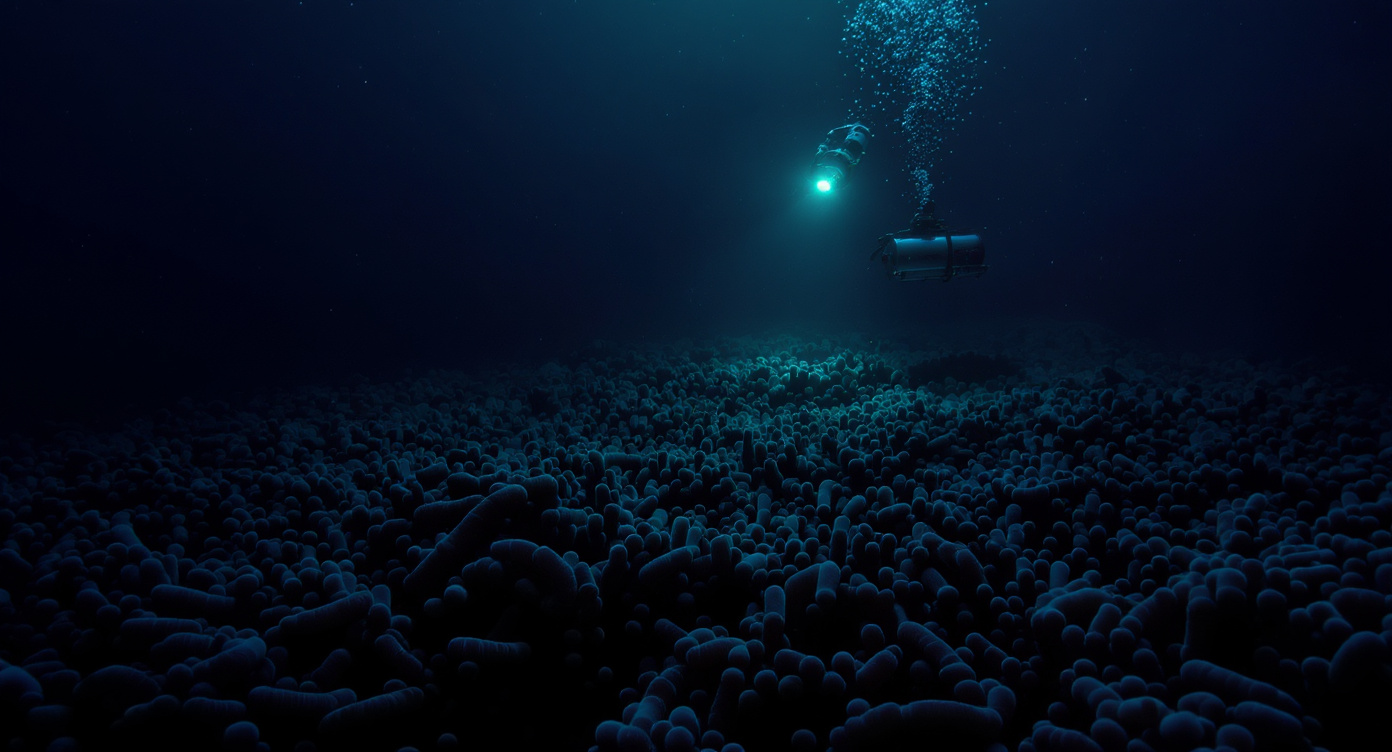
The depths of the ocean often seem to us, land dwellers, like an entirely alien and mysterious world. Recently, a team of marine biologists descended to the bottom of the Kuril-Kamchatka Trench, the fifth deepest trench in the world, reaching a depth of 9,500 meters. There, the scientists discovered astonishingly rich communities of organisms that survive thanks to chemosynthesis. Thousands of kilometers of the seafloor are covered with invertebrates that feed on the byproducts of bacteria that oxidize methane.
Life at the Limit
Surviving at such depths is challenging not only because of the immense pressure, which some organisms have learned to adapt to. The main problem is the lack of food: only a small amount of organic matter reaches the bottom, mostly the remains of fish and whales living above. The deeper you go, the fewer chances there are to find anything edible.
This pattern is typical for the usual, or background, life—heterotrophic organisms that feed on organic matter of photosynthetic origin. However, at depths of nearly 10 kilometers, where sunlight cannot penetrate, there are organisms that obtain energy in an alternative way—using organic substances produced through chemosynthesis. Some bacteria and archaea can independently synthesize such compounds, using the energy of chemical reactions without sunlight.
Methane Sources and Unique Ecosystems
Methane is one of the key energy sources for deep-sea ecosystems. Until recently, the maximum depth at which methane seeps were found on the seafloor was 7,400 meters (in the Japan Trench). Now, methane seeps have also been discovered at the bottom of the Kuril-Kamchatka and Aleutian Trenches. The Kuril-Kamchatka Trench, reaching a depth of 9,717 meters, is among the five deepest in the world. It was here that an international team of marine biologists traveled in the summer of 2024.
During the expedition, using the Chinese manned deep-sea submersible "Fendouzhe," researchers made 31 dives at various points in the trench. At a depth of 9,533 meters, specialists discovered an extensive field of tube worms, resembling a shaggy carpet, inhabited by polychaetes, mollusks, and amphipods. It turned out that this ecosystem exists thanks to chemosynthesis and is the deepest of its kind in the world. The discovery was described in the journal Nature.
Research and Discoveries
The biologists recorded their observations on video and collected samples of sediment, water, and living organisms. Previously, such materials could only be obtained blindly using trawls, but now scientists were able to observe everything firsthand. These communities usually form clusters tens or even hundreds of meters in diameter.
"After this discovery, we knew where to look for methane seep communities, and during each subsequent dive, we assessed their presence and extent. Once, the submersible traveled two kilometers along the bottom, and the benthic communities still continued. The scale of these fields in such conditions is colossal. Then we compiled a map of all the expedition's dives, and from south to north, the area with methane seeps stretched for 2,500 kilometers. This is a major discovery that significantly changes our understanding of methane reserves on the ocean floor," said Dr. Andrey Gebruk, head of the Laboratory of Deep-Sea Fauna at the P.P. Shirshov Institute of Oceanology, Russian Academy of Sciences, and co-author of the study.
How Life Works in the Depths
Paradoxically, the invertebrates found do not feed on methane itself, but on hydrogen sulfide produced by symbiotic bacteria living in the tissues of pogonophoran tube worms. These bacteria oxidize methane, which seeps to the seafloor, in oxygen-free conditions—this is how chemosynthesis occurs. Methane seeps can only be detected by the clusters of tube worms.
Methane at such depths forms as a result of organic matter being buried over millions of years. The remains of animals, organic particles, and detritus settle on the trench floor, covered by new layers over time. Bacteria decompose the accumulated sediment and produce methane, which, under high pressure, exists as crystals—gas hydrates. Since trenches are often subduction zones, the descending tectonic plate carries crystalline methane into the Earth's interior, where, under compression, gas hydrates break down and the gas seeps back to the surface.
"This fauna is remarkable because so few organisms can survive at such depths. And if some species have adapted to these conditions, it is likely they can also be found at similar depths in other oceanic trenches," noted Andrey Gebruk.